Bulletin for the Study of Religion: Placing Neoliberal Jesuses: Doing Public Geography with the Historical Jesus

I’m happy to announce that the Bulletin for the Study of Religion has published a piece that I recently wrote in a review forum on New Testament scholar James Crossley’s Jesus in an Age of Neoliberalism.

While most of the commentators were biblical scholars, I was asked by the Bulletin‘s editor Phil Tite to comment as a human geographer on Crossley’s book. As it happens, there has indeed been some cross-polllination between biblical studies and human geography, and I knew about this because many of my biblical studies colleagues have expressed to me that their discipline is more like a secular social science than it is theology and that the field comprises people from a variety of theological orientations. In fact, in stark contrast to the high-profile biblical studies firings that we have witnessed in the evangelical world, the mainstream of biblical scholarship would maintain that Crossley’s own theological convictions are completely moot; certainly, they influence his scholarship as any positionality would, but that’s why all scholarship circulates in discplinary conversations. For the conversation between biblical studies and human geography, there has been a five-volume series titled Constructions of Space that has attempted to use the work of human geographers like Henri Lefebvre, Lily Kong, and (honorary geographer) Kim Knott to examine how biblical authors conceptualize and make places.

Crossley’s book is different. His idea of New Testament studies is not simply the study of the New Testament as a text, but also the study of the study of the New Testament. In other words, Jesus in an Age of Neoliberalism doesn’t look at Jesus in the New Testament text. It examines how contemporary New Testament scholars have interpreted Jesus, and it critiques them for making Jesus a proponent of the political economic ideology that has arguably taken over the world in the last forty years, neoliberalism, i.e. the ideology that the free market must be allowed to run unhindered by government intervention and that it must be protected from violent threats, which has often led to the framing of the MIddle East as an ‘oriental’ geopolitical threat.

As a geographer, I found that Crossley and I seemed to speak the same language. The geographers (and honorary geographers) he cites are similar to the ones on my reading list — Edward Said, David Harvey, Derek Gregory, for example.

As a result, I used my essay to push Crossley to come into his own right as an honorary geographer. Crossley locates New Testament scholars as diverse as John Dominic Crossan, Bruce Malina, N.T. Wright, and even the Pope Emeritus as unintentionally tied up with neoliberal ways of thinking. However, to locate someone in a train of thought is just the beginning of a geographical study, not the end. I wanted to push Crossley to show how New Testament scholars are actually creating and contesting neoliberal political regimes and everyday practices. I don’t just want to read that the historical Jesus is a neoliberal fiction; I want to see how the historical Jesus gets put to work in constructing neoliberalism, as well as challenging it from the inside-out. Indeed, Crossley has a chapter on how one pseudonymous biblio-blogger, N.T. Wrong, consistently challenges his/her/xyr colleagues on their neoliberal assumptions, and I wanted to see how these contestations actually work them out in the production of space.

The example that I gave that illustrates this dynamic is the democracy movement in Hong Kong, Occupy Central with Love and Peace (OCLP). Because Crossley protests against the ‘orientalizing’ practices of neoliberalism, the work of the historical Jesus in this ex-British colony and current site of a ‘one country, two systems’ experiment would be fascinating to investigate. I gave the example of the exchange between megachurch pastor Rev. Daniel Ng Chung-man and the OCLP leader Rev. Chu Yiuming as a case where the historical Jesus became a subject of intense public political debate. I also give a shoutout to my colleagues at Hong Kong Baptist Theological Seminary, such as Sam Tsang, Freeman Huen, Nathan Ng, Vincent Lau, and Andres Tang, who have been doing excellent work in public theology in Hong Kong.

This article should be of interest to all who want to understand the contemporary significance of biblical studies in the public sphere. What remains fascinating to me is how much geography is done by biblical scholars, and I am encouraged by what seems to be an exciting trend in exploring how the work of those who study the biblical text (regardless of their theological orientation) has contributed to the making of the world today. I’d like to thank the Bulletin‘s editors Phil Tite and Arlene MacDonald for this exciting opportunity to engage, as this encounter has also shaped my scholarship insofar as I am coming to understand how important it is for me as a social scientist to keep up with my social science colleagues who work in biblical studies.

South China Morning Post: Chinese parents clash with striking Canadian teachers as school year fails to start

Photo: CBC

Yesterday in The South China Morning Post, Ian Young did another spectacular job trying to suss out some of the intricacies of the trans-Pacific social field that we find in Vancouver. In this most recent article, he wrote on how some Chinese parents associated with the British Columbia Parents’ Federation (BCPF) protested the teacher’s union, the British Columbia Teachers’ Federation (BCTF), for the strike that is finally starting to come to an end. Young reached out to me for a comment, and this is what I noted about the BCPF:

Dr Justin Tse, an academic who has studied activism within the British Columbia Chinese community, said that although the BCPF’s desire to get children back in class was shared with other opponents of the strike, there was also a strong undercurrent of anti-unionism in general that ran through the protests.

“My sense is that there is a view that unions disrupt business, and most Chinese migrants have this view that unions get in the way of the free market,” said Tse, a post-doctoral fellow at the University of Washington. “For them, it’s not really just the educational stuff – it’s the union stuff.”

The BCPF has garnered supporters via Chinese-language social media, and the couple of dozen members at Sunday’s protests all appeared ethnically Chinese. The federation has attempted to widen its outreach to non-Chinese parents, but these efforts appear to have been aborted, for now. A Facebook page and an English-language website seeking new BCPF members were visible on Sunday, but were taken offline that night.

“A lot [of Chinese immigrants] are kind of scared of public protest,” said Tse. “They want the media to capture their numbers at a protest, but they don’t want to be singled out as individuals, so you get the face mask thing. You can’t really have it both ways, but that is the sentiment.”

Tse said conservative Chinese political activism in BC was informed by “a specific vision of democracy” that focused on majority rule alone, without emphasising some of its other aspects, such as deliberation, consensus and accountability.

“There is this sense that democracy means you get to say your private views in public, no matter how outrageous, because that’s free speech, and that it is all about getting numbers,” said Tse. “This view is that democracy just means majority wins, majority rules.”

My comments here need to be read in conversation with a piece that I wrote on my blog, Religion Ethnicity Wired, arguing that the constitutional issues swirling around the BCTF strike provide a remarkable mirror to the democratic movement in Hong Kong, Occupy Central with Love and Peace. This is because what I said there qualifies what Ian Young and I talked about in relation to Chinese immigrants.

The impression that I do not want the public to get is that there is something about this nebulous term Chinese culture that is against labour unions, public protest, and deliberative democracy. Such a statement would not only be irresponsible — it would be empirically unsubstantiated. After all, if that were the argument, then movements such as the May Fourth Movement, the Beijing Spring of 1989 in Tiananmen Square, and the recent democratic movements in Taiwan and Hong Kong would have to be marked as un-Chinese. As Craig Calhoun insists in Neither Gods Nor Emperors, it would be more accurate to say that these democratic movements constitute a strand of Chinese tradition. So too, Asian American author Frank Chin observes in his novel Donald Duk that even Confucian concepts like ‘the Mandate of Heaven’ are a de facto form of democratic consciousness because it is a term that can be deployed by the people to criticize unjust power.

However, it is true that many of those associated with the BCPF were ethnic Chinese — its spokespeople seem to be Putonghua-speaking, and as their name suggests, they represent parents. Here, I also rejected the discourse of the ‘tiger parent’: Amy Chua’s essentialist caricature of Asian American (and Asian Canadian) parenting has simply reinforced notions of the ‘model minority’ that should have been put to bed in the late 1960s right where it started. This is not to deny that Asian Americans and Asian Canadians themselves take on the discourse of the ‘model minority’ as an identity statement — indeed, my work explores that at an ethnographic level — but using the ‘model minority’ as an essentialist explanation for Chinese parental behaviour stops the conversation at several points. First, it conveniently isolates Chinese parents from the general population, blinding us to how Chinese parents are saying some of the similar things as even Anglo-Canadians. The second is that it doesn’t get at the specific undercurrents that make up the discourse of the ‘model minority.’

What I’ve done here is to try to listen to what these parents are actually saying. They agree with the general population that the BCTF strike has crippled education in BC. However, while public opinion has been turning against the BC Liberal Government for its flouting of the Canadian constitution and the bargaining rights of the teachers, these parents are placing the blame squarely on the teachers for striking and thus using collective bargaining as a bullying tactic that has put their kids out of school. This sounded a lot like my dissertation research, in which conversations about the BCTF in 2011 (well before this set of strikes) quickly led into discussions of how a variety of labour unions tended to obstruct the free market.

Moreover, it sounded a lot like how many of my interview subjects and focus group participants wanted to participate in public protests, but were shy about having their pictures taken or being interviewed by the press. When members of the public engaged them in debate, they tended to see this as an attack on their freedom of speech instead of an opportunity for public deliberation. Their goal, as they told me, was to build an awareness that the majority in fact supported their positions because that was the point of democracy.

While this could be called ‘Chinese’ in some senses of the word, I prefer to think of it as part of a debate about the relationship between Chineseness and democracy. After all, while such majoritarian and non-deliberative arguments about the nature of democracy certainly comprise one faction in Greater Chinese and trans-Pacific contentions about democracy, there are movements as old as the 1970s — and dare I say, even the May Fourth Movement in 1919 — that advocated for a more deliberative form of democracy that also pays attention to minority rights. In other words, there is a political spectrum among ethnic Chinese views on democracy, and the BCPF represents one strand in a larger conversation. I was asked about the BCPF, so I answered along the lines of what the BCPF represented. But you have to read my blog post on Religion Ethnicity Wired to get the catch on what I said.

In short, I am very happy that Ian Young got me on record about the BCPF. As always, I enjoy my collegial relationship with journalists like Ian who are at the top of their craft. This incident certainly was of public interest in Vancouver, as well as in the trans-Pacific social field, and I look forward to this conversation piece doing what it’s intended to do — engender more conversation!

Christ and Cascadia, Seattle, WA, September 26-27, 2014

I am delighted to announce that I will be presenting in two sessions at an exciting new conference in Seattle. Organized by Fuller Seminary Northwest, the conference, Christ and Cascadia, aims to start a conversation about how Christianity is practiced in the Pacific Northwest. It’s a conference aimed at both practitioners and academics. The venue is First Church at 180 Denny Way, and the dates are September 26-27, 2014.

christ_cascadia
Registration details can be found here. The schedule can be found here.

I will be speaking at two sessions, both on September 26. The first session, Solidarity and Empowerment, is from 11 AM – 12 PM in Room 3. The organizers tell me that I have 20 minutes to deliver a talk entitled ‘Faith Communities Committed to Solidarity with the Poor: Religious Freedom, Interfaith Initiative, and Poverty Ministry at Tenth Avenue Alliance Church in Vancouver.‘ Here’s the abstract:

This paper explores how repositioning religious freedom arguments in a Cascadian context may rearticulate their political emphases. From 2007 to 2008, an interfaith coalition of religious congregations and organizations formed Faith Communities Committed to Solidarity with the Poor (FCCSP). Its objective was to lobby the City of Vancouver for Tenth Avenue Alliance Church’s religious freedom to run a homeless food and shelter program without a social services permit. Arguing that a new mandate to obtain a permit dictated to the church what religious practice was and was not, the campaign successfully deployed a religious freedom argument to contend that faith communities of a variety of religious traditions should be able to serve the poor as a core part of their theological practice. Although more conventional religious liberty cases around socially conservative issues have been filed in Cascadia on both the Canadian and American sides, I argue that religious freedom has been rearticulated by FCCSP as a progressive cause that gained wide social acclaim in a liberal Cascadian political climate. This argument is based on key informant interviews with core participants in this activism. This paper thus advances conversations in Christ and Cascadian culture by demonstrating that the oft-celebrated politically progressive politics of the region offers opportunities for faith communities to reframe their public engagements away from a set of narrow ideological issues in order to display the complex totality of their theological commitments.

The second session is on the same day from 4:15 – 5:30 called Mega Churches and Gender: What’s Sex Got to Do With it? in Room 3. Organized by my colleague Elizabeth Chapin, the panel will address gender at a prominent megachurch in Seattle. Because this is a panel session that is meant to be more conversational, I am compiling my thoughts into a paper for publication right now, but tentatively, my talk will focus on Mars Hill Church in Seattle and private property ownership.

If you are interested in Christianity in the Pacific Northwest, we really hope to see you there!

Vancouver Sun: Douglas Todd, ‘We Must Stand On Guard for Canada’

In the Vancouver Sun, Douglas Todd has given the Canadian public a fascinating discussion piece on the limits of liberal multicultural democracy. I’m quoted in the piece, so I thought I might offer a few critical reflections in light of what Todd says.

Todd’s piece takes its departure from what he describes as the rise of ‘religious extremists’ and what Immigration Minister Jason Kenney calls ‘homegrown religious radicals’ due to contemporary Canadian migration policy. Interviewing Liberal politician Ujjal Dosanjh and the Laurier Institute’s Farid Rohani, Todd finds these liberals of colour are themselves concerned that new migration trends to Canada are bringing more forms of abusive patriarchy within families, opposition to interracial and interreligious marriage, refusal to fit into the unspoken secular sartorial code in Canadian workplaces, and homophobic discrimination. On that last point, Todd reaches out in collegial fashion and quotes me: ‘Both Rohani and Dosanjh are aware of widespread anti-homosexual beliefs among many religious immigrants, which can lead to actual discrimination. And University of B.C.-trained scholar Justin Tse has cited the strong degree to which many Chinese Christian immigrants find Canada’s human rights laws regarding homosexuality “ridiculous.”’ The main point of the article, in turn, is that Canadian liberal democratic values are under strain from these new migrations and thus needed to be guarded more carefully. What’s smart about the article is that Todd seldom quotes from white Canadian public figures; all of the quotes are from people of colour, including me.

In many ways, Todd represents me fairly well. The attitude that Canadian human rights legislation is ‘ridiculous’ is a direct reference to my dissertation, which was cited in the South China Morning Post saying the same thing – that many of conservative Cantonese evangelicals with whom I spoke in Vancouver felt that Canadian human rights legislation was ‘ridiculous.’ That this is what my dissertation actually finds among conservative Cantonese evangelicals in Vancouver means that I feel very well-quoted and thankful that Todd has reached out yet again in a such a fine showing of collegiality.

But because this is a discussion piece, I also feel that I’m allowed to register a bit of collegial dissent from Todd’s conclusions. This is because I think Todd and I, while recognizing each other as colleagues in the public forum, are working on two fundamentally different social projects.

Gérard Bouchard (left) and Charles Taylor (right) listen intently.

While Todd makes the case that Canada has to guard its liberal multicultural democratic values, my project is to interrogate why it is that some migrants — in my case, some (but not all) Cantonese-speaking Protestants — were opposing the very liberal things that Todd wants to guard. I don’t pass judgment; I ask why. This is because the social (and arguably, political) thrust of my academic project is in many ways informed by Canadian philosopher Charles Taylor and his call for mutlicultural societies to practice the ‘politics of recognition.’ What this means is that various communities in the modern world have taken on certain identities that they don’t want to be unrecognized or misrecognized; misrecognition, in fact, can be viewed as an insult. What we have to do, Taylor proposes, is to recognize the other — to get past simple disagreements to understand precisely how the other’s identity is formed and how that othered identity is in fact part of the ‘we’ in this society. Taylor himself has put that into political practice: at a time when controversy erupted in the mid-2000s over head-coverings in Quebec (as Todd notes about Quebec’s proposed Charter of Values, it’s still under contestation), Taylor teamed up with Gérard Bouchard to form a commission to get every voice possible on the record about the practice of multiculturalism/interculturalism in Quebec, including all the nasty stuff people wanted to say about the hijab, niqab, and sundry. The result was a report titled Building the Future: A Time for Reconciliation, in which Taylor and Bouchard painstakingly detail the problems with interculturalism in Quebec, report on every possible voice that they heard during their time on the commission, and propose that what’s needed is an open secularism, a sort of society where religion is not excluded but in fact included in everyday public deliberations.

In many ways, that’s what that section in my dissertation on Cantonese evangelicals in Vancouver calling Canadian human rights legislation ‘ridiculous’ is trying to do. To stop at that assertion of ‘ridiculousness’ is to cut the project short right at the beginning. If you read the dissertation (yes, it is publicly accessible), you’ll find that my question then goes to why these Cantonese evangelicals thought that Canadian human rights legislation tended to be ‘ridiculous.’ As the South China Morning Post succinctly quoted me in May, it’s because the sort of rights-based legislation around sexuality (hate crime bills, same-sex marriage, transgender rights, etc.) went against a certain vision of a ‘rational, orderly society.’ As I discovered, this wasn’t so much a ‘culture’ thing — ‘Chineseness’ was frequently invoked and qualified by my interviewees — but a performative agenda that understood best practices in civil society to be the creation of private, family-based economic units in which the second generation could be trained to become productive, private citizens in Canada. This means that sexuality is only the tip of the iceberg; other issues that contributed to what they might call the ‘irrationalization’ of society included the legalization of marijuana (medical or otherwise), harm-reduction drug treatment (some spoke of methadone; a few contested halfway houses in their neighbourhoods; most spoke of Vancouver’s inSite safe-injection program), the Anglican Church of Canada’s embrace of religious and sexual pluralism, and the building and expansion of casinos. The Cantonese evangelical public activism that propels this vision is certainly not un-Canadian; it is Chinese Christians wading into the fray of the partisan debates around what it means to be Canadian. That is, the fact that it is a socially conservative, privatized understanding of Canadianness does not make it un-Canadian; it makes it part of the debate around how Canada should be constituted as a nation.

My dissent, then, from Todd’s otherwise excellent, provocative discussion piece is that Todd seems to be portraying new immigrants, including the Chinese Christians that I studied, as bringing their religiously-based homeland politics to contest our hard-won liberal, multicultural, democratic Canadian values. But as my dissertation clearly states, the reasons that some Cantonese evangelicals thought that their rational, orderly vision of society was under assault tended to be modern and secular. It wasn’t a sort of backward homeland politics being imposed onto Canadian values. After all, this sort of politics of privatization comes from the need not to protect ‘culture,’ but as a business strategy in a globalizing world. This sort of rationality may be ideologically ‘conservative,’ but it is rooted in a very modern version of how society should operate. It may be theologically informed (as I argue elsewhere, what isn’t?!), but the reasons given for this rational, orderly society sound rather more to do with the very secular goal of maximizing private participation in the market economy. One may not agree with this sort of vision for a ‘rational, orderly society,’ especially one so rooted in the politics of privatization. But one cannot disagree that it is a vision.

In other words, I’m collegially dissenting from Todd’s piece because I don’t think that Canadians need to stand on guard for liberal, democratic, multicultural values. Instead, what’s more needed is a recognition that the ‘other’ is one of us, locked into the deliberations of democracy of which we are all a part. Contrary to Todd’s interview with Tung Chan in which Chan says that we need to ‘educate’ people and then let them go their merry way, this public deliberation is itself educative. It’s because it’s in deliberation — public, honest, open, and even heated deliberation (like the Bouchard-Taylor Report) — that we realize that the solution is never ideological entrenchment, but openness to the other as fellow citizens, persons even. Talking softens us. What perhaps needs emphasis is not so much the part of the national anthem to ‘stand on guard’ for Canada. It’s rather that if this is indeed ‘our home and native land,’ well, then, it is ours together. We need to keep talking.

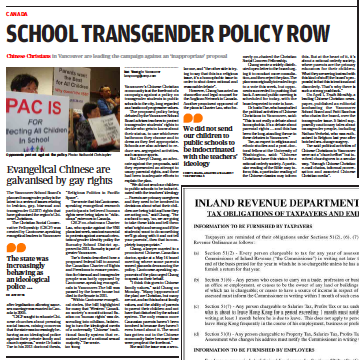
South China Morning Post: School Transgender Policy Row

I have received quite a warm welcome back to Vancouver for my doctoral graduation today. Ian Young has done a masterful job of quoting me in today’s edition of the South China Morning Post.

scmp_ianyoung

The article is about how Chinese Christians — in particular, Cantonese-speaking evangelicals — in Vancouver are contesting the Vancouver School Board’s proposed policy for transgender faculty, students, and staff. There is both a main article and a side column based mostly on a reading of chapter 5 of my dissertation.

The controversy centers on those who have opposed the policy because they feel that their ‘parental rights’ to educate their children primarily in the private sphere have been violated. As I explained to Young:

This is not really a debate about homophobia. It’s a debate about parental rights … and this has been the long-standing theme in these debates in Vancouver…Chinese Christians have this vision for a rational orderly society. A particular reading of the Bible may inform this, a particular reading of the Chinese classics may inform this. But at the heart of it, it’s about a rational orderly society, where parents are the primary educators for their children. What they are seeing instead with this kind of stuff [the board’s proposals] is that this is irrational and disorderly. That’s why there is such a strong pushback.

In addition, I emphasized that these political activities ‘were not a “church effort” but involved churchgoers in a secular way, “through Chinese Christian e-mail chains, informal conversation and assorted Chinese Christian media”.’

I am very thankful to Ian Young for our collegial relationship. He first contacted me last year about an article on youth transitioning to adulthood between Hong Kong and Vancouver, a topic that Jo Waters and I had written on in Global Networks. I found Young’s questions very perceptive and incisive, always pushing me to draw out my points, to illustrate with examples, and to pose counter-illustrations. I suppose I should expect no less from the former International Editor of the SCMP, but I must say that it is always a pleasure to work with someone at the height of his craft.

I also appreciate how Young engages multiple sources in his account in order to draw out the multi-sided complexity of this debate. His interview with Cheryl Chang is revelatory both because of how Chang insists on her secularity as a concerned parent activist and because she was the legal advisor for the Anglican Network in Canada, a realignment group that sued the diocese for their property because they insisted that it was they who were holding to historic Anglican orthodoxy on theological doctrine and sexual praxis. He not only quotes me about the non-church-based Chinese Christian networks, but goes right to the source, Truth Monthly, one of the two premier Chinese Christian newspapers in Vancouver (the other is Herald Monthly). He has done his research on Charter Lau, mostly through my dissertation, but instead of just quoting the thesis, he has used it to trace the precedents for this poobah in both Burnaby’s Policy 5.45 controversy in 2011 and the ongoing debate about Bill C-279 to amend the Canadian Human Rights Act and the Criminal Code (my dissertation fieldwork took place during the C-389 controversy).
[UPDATE: May 23, 2014: These items have been corrected in the online edition.]

As this information develops, however, I do want to make two very minor clarifications to the record, none of which affect Young’s larger point. The ‘CSCF’ that Young mentions is the ‘Christian Social Concern Fellowship,’ not the ‘Christian Social Conservative Fellowship.’ While many of its members are politically conservative and some are card-carrying members of the federal Conservative Party of Canada, ‘social concern’ is a term derived from mainline Protestantism in Hong Kong to talk about the church getting involved in social action. The second is that the Truth Monthly post date is from the January 2014 issue. That this post predates the debate by four months instead of several weeks in fact strengthens Young’s point about this transgender issue being widely discussed in Chinese Christian media.

Again, many thanks to Ian Young for a very thorough article and sidebar for SCMP. I look forward to further collaboration in the future.

SSHRC Postdoc Fieldwork, Summer 2014

I’ve got some fun news. I’m back in the field!

I’ve really missed this. Much of my PhD was consumed with doing ethnographic fieldwork, key informant interviews, and focus groups, both for my actual doctoral project (see my work in San Francisco [x2], Vancouver, and Hong Kong) as well as for the collaborative project on the Highway to Heaven in Richmond, BC. After finishing all of that, I did a ton of writing, which has resulted in a dissertation and will result in a series of publications that you can expect to roll out over the next few years.

But as the summer is starting up, teaching is done, and frameworks are being solidified, it’s time to do some new fieldwork for the Social Sciences and Humanities Research Council of Canada Postdoctoral Fellowship. That’s the whole reason I’m here in Seattle in the first place.

I need your help. I need to talk to people.

Here’s what the project is about.
I am interested in publics. Asian American and Asian Canadian Christian publics, to be specific. And to be really precise, in Seattle and Vancouver, for now. And to be super-precise, publics produced by the younger generation.

What are publics?
That’s actually what I want to find out. There’s a huge academic literature on publics, as well as a lot of popular reflection. In general, a public is just whenever someone puts something into circulation and creates an audience. This is usually contrasted with the private, which means stuff that’s not supposed to be circulated outside of a self-governed institution, like a family, a church, or a corporation. But do younger-generation Asian American and Asian Canadian Christians think of their work as public or private? That’s the golden question.

So what are you really interested in?
I’m interested in how younger-generation Asian American and Asian Canadian Christians understand their participation in making publics. This can be really broad. It can include stuff like electoral politics, grassroots activism on a variety of issues, social media participation, artistic/musical production, social services, and a lot more stuff. Like my PhD on Cantonese-speaking Protestants and how they engaged the civil societies of Vancouver, San Francisco, and Hong Kong, I let the data drive the issues that I explored.

So what’s the key research question? (Because I’m a social scientist and I know what I’m talking about.)
The key research question is: how do younger-generation Asian American and Asian Canadian Christians in Seattle and Vancouver engage and create publics?

How will you find out about this?
By talking to people. My research is usually driven by key informants. These are usually named individuals (although I always give the option for anonymity) who are positioned well to provide information about a phenomenon. My research is qualitative, so unlike a statistics-based project, I’m not aiming for representativeness. I’m trying to get stories, opinions, perceptions, and insider explanations on the record. To make sense of this data, I usually overlay it with focus groups of lay people and extensive methods where I consult quantitative data that’s already out there. I also use the key informant research to point me to documents that I need to put in my archives.

Who do you need to talk to?
I need to talk to key informants who can talk intelligently about how younger-generation Asian American and Asian Canadian Christians make publics. This means that they are usually a) talking about their own work as an individual or part of an institution or b) talking about people that they work very closely with.

What do you mean by Christian?
I mean people who self-identify as Christian. Evangelicals, liberal Protestants, Catholics, Orthodox, hard to categorize, etc. If you’re from another religious tradition or not part of a religious tradition and still want to talk to me, let’s also talk…about Christians.

By Christian, do you mean that you want to talk to Asian American and Asian Canadians who are doing Christian stuff in the public sphere?
NO. I’m also interested in people who are working in the secular public sphere but personally identify as Christians. If the public stuff doesn’t have much to do with personal identification as Christian, that’s interesting too!

What do you mean by younger-generation?
I mean ‘second-generation’ (i.e. born in North America) + people who came here when they were young. This way, I don’t exclude people I should be talking to arbitrarily based on birth. It also means that I’m interested in talking to people who do work in Asian languages, not just English-speaking.

But ‘Asian’ is so diverse!
I know! The thing is, there’s this theory that I’m trying to suss out called pan-ethnicity. People who work on second-generation stuff (especially my colleague Russell Jeung in his book Faithful Generations) have noted how Asian Americans — and to some degree, Asian Canadians — cooperate across ethnic lines (i.e. Chinese, Korean, Filipina/o, Japanese, Indian, Vietnamese, Cambodian, Indonesian, Malay, etc.) and talk about themselves as ‘Asian.’ I want to see if that works when Asian Americans and Asian Canadians do stuff in the public sphere.

But I don’t live in Seattle or Vancouver.
That’s OK. For one thing, I need your information to contextualize what I’m finding here in the Pacific Northwest. For another, the data here might lead to sites outside of the Pacific Northwest because this public work might not be regionally bound.

Do you have ethics clearance for this research?
Yes. The University of Washington’s Human Subjects Division in fact determined that my research was exempt from review under Category 2 of their Exempt Determination. This means that — given adherence to common-sense ethical research procedures — my work has been approved by the university.

I’ll be working on the initial phase of collecting data for this project in Seattle and Vancouver throughout Summer 2014. This initial phase means that I am very interested in talking to key informants. This usually means setting up an interview that is usually audio-recorded, lasts for about one hour, and is transcribed for accuracy. I have a formal letter of invitation, consent form, and interview questionnaire available, if you want to see that before talking to me.

Contact me at jkhtse (at) uw (dot) edu, and let’s talk!

Association of American Geographers, Tampa, FL (8-12 April 2014)

I am writing from Tampa, Florida to talk about the national conference that I am attending. As usual, I am at the Annual Meeting of the Association of American Geographers. There’s a lot going on here in geographies of religion (check out our specialty group’s newsletter) – the field seems to be growing, though many of my colleagues couldn’t attend this year! – and I will also be checking out sessions on migration, Asian geographies, urban studies, and other things, in addition to meeting colleagues and catching up with old ones.

I am presenting in a session this afternoon (Tuesday, 8 April) on Critical Geographies of Religion. My paper is titled The Civil Human Rights Front: religion and radical democracy in post-handover Hong Kong and features a lot of the field work I did among progressive Christian groups in Hong Kong in 2012. Here’s the abstract:

After Hong Kong returned to Chinese sovereignty in 1997, the Special Administrative Region has seen the emergence of calls for universal suffrage, the preservation of civil liberties, and solidarity with the materially marginalized in Hong Kong’s civil society.  In one moment of collective solidarity, an umbrella group called the Civil Human Rights Front launched a protest against anti-sedition legislation based on Basic Law’s Article 23, a law whose alleged threats to free speech drove some 500,000 Hongkongers to the streets on 1 July 2003.  This paper analyzes the radical democrats who have been key to such political placemaking activities in Hong Kong, contesting the city’s policy landscape through physical demonstrations.  It argues that while a wide swath of Hong Kong’s Catholics and Protestants have historically been allied with the state establishment both under British and Chinese sovereignty, the emergence of radical democratic groups like the Civil Human Rights Front have been driven largely by Catholic and Protestant Christians who emphasize a separation of church governance from the state.  While the separation of church and state has often lent itself in other contexts to more conservative politics, this spatial schematic has led these radical democratic activists, their churches, and their solidarity groups to contest the modus operandi of Chinese sovereignty.  This is thus a contribution to critical geographies of religion, for it shows the potential power of religious movements to critique the practices of the state in order to imagine more socially just cities.

There are two parts to this session. I am the first paper on the first part, which promises to be an engaging discussion on religion, politics, and the public sphere. Find us in Room 17 on the First Floor of the Tampa Convention Center. The first session is from 2:40 PM – 4:20 PM. The second session runs from 4:40 PM – 6:20 PM.

Tomorrow (Wednesday, 9 April), political geographer John Agnew will be giving our Geography of Religions and Belief Systems (GORABS) Annual Lecture. His lecture is titled The Popes and the city of Rome during Fascism, 1922-1943. Here’s the abstract:

It has become popular in recent years to see the Fascist years in Italy as reflecting the relatively successful transformation of Italian society at the behest of its Fascist rulers. This reflects both the rehabilitation of Fascism in contemporary Italy and the “cultural turn” in Italian historiography that has tended to emphasize the “making” of Fascist selves and other markers, such as the makeover of many urban monumental spaces, as measures of the regime’s success. My purpose is to disrupt this emerging consensus, alongside other commentators I hasten to add, by pointing how much the Fascist regime had to collaborate with other powers, not least the Catholic Church, and was often outflanked by them in its designs, most notably in efforts at making over the city of Rome as its showcase capital.

We want as many people as we can to attend, and we hope to see many of your there! Find us in Room 23 of the First Floor of the Tampa Convention Center, Wednesday, 9 April, 10 AM – 11:40 AM.

Please also join us for our business meeting. That is scheduled for Thursday, 10 April, from 7:30 PM – 8:30 PM in Room 9, Tampa Convention Center, First Floor. I will be chairing, and if you want the meeting agenda, please email me.

I look forward to a lot of collegial interaction this week, and I am anticipating learning a lot! It’s great to be with people in my home discipline, and I hope I have more to bring this year from all of my interdisciplinary journeying.

Postdoctoral Update, March 2014

It has been two months since my SSHRC Postdoctoral Fellowship at the University of Washington has started, and I think now is a good time to publicly take stock of the work that I’ve done so far and then look ahead into the future.
jsis_c_254_tse

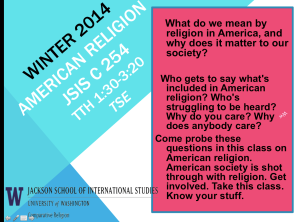
A major part of the first three months of this postdoctoral fellowship (January to March) has been, is, and will be devoted to teaching my course, JSIS C 254, on American religion. Depending on who is speaking, friends and colleagues with whom I have discussed this course tell me that I am perhaps the most fortunate and/or blessed of new teachers: the students participate without my prompting, seek me out during office hours, and genuinely care about the material. We have successfully journeyed through the development of an Anglo-Saxon Protestant consensus in early American religion and explored the rise of a liberal consensus in twentieth-century America. We have also just recently completed a unit on the politics of race in American religion and are now starting a final unit on American fundamentalism.

I will do a more comprehensive reflection on the course when it is completed in late March. What I want to do here is to sketch the ways that teaching this course has shaped my research. As I’ve stated in previous posts, the two objectives of my postdoctoral fellowship are 1) to develop my doctoral research into publications and 2) to embark on new postdoctoral research on younger generation Asian American and Asian Canadian Christians.

Much of what I’ve done over the last two months has helped me to clarify what exactly my research is about and what philosophical and theoretical trajectories I find myself engaging as I prepare for a round of empirical work for my postdoctoral project.

First, I am seeing much more clearly that my work on Asia-Pacific and Asian American Christians ties in intimately with what might be called the liberal tradition. As I’ve said before, liberalism is not the opposite of conservatism. It is instead a philosophical and theoretical tradition that emphasizes the formation of public overlapping consensuses while upholding both rational argument and self-interest. I developed an interest in how liberal ideologies become geographies during my doctoral research on Cantonese Protestants and my argument that they were upholding a theological form of secularity. I realize increasingly that the implication is that while conservative Cantonese Protestants decry the liberalism of mainline Protestants and secular civil society, they themselves have emphasized to me (rightly so!) that they themselves should be considered ‘liberal’ as well for their focus on rationality and self-interest.

In other words, I am clarifying the centrality of interrogating the liberal tradition in my ongoing research agenda. My teaching in American religion has clarified for me the trajectory of how an American consensus was formed and the contributions of Protestant theology to the formation of a liberal tradition in America, one that has come to tentatively also include Catholics and Jews, as Will Herberg would say. On the same token, my recent readings in Asian American studies have also emphasized the connections among religion, racial formations, and liberalism. In the forthcoming issue of Amerasia Journal (40, vol. 1), I reviewed Ellen Wu’s phenomenal history of Chinese and Japanese American collaborations in the making of the model minority stereotype, The Color of Success: Asian Americans and the Origins of the Model Minority Myth. (This review will get its own post when it is out.) The major theme that I picked up in Wu’s history emphasized how American liberal ideologies produced a politics of assimilation, repeatedly framing issues in Chinese and Japanese Americans around integration issues. While Wu doesn’t talk much about religion, her book, combined with my own teaching on liberalism in American religion, brought clarity as I authored the encyclopedia entry on ‘Christianity’ for the SAGE/AAAS Asian American Society Encyclopedia, which I am pleased to announce has been accepted by the editors. My entry focuses on how both Protestant and Catholic threads in Asian American Christianity revolved around the question of assimilation for Asian Americans and that this is why the place of Christianity in Asian American communities is often so contested. Finally, the work around the Asian American open letter to the evangelical church has helped me to see the centrality of liberal ideologies in Asian American evangelical communities and has made me wonder openly about how such liberalism has managed to produce a ‘private consensus’ in American religion.

To the end of exploring the connections between liberalism and Asian American religion more thoroughly, I have a set of publications on which I am actively working that will be sent out over the course of this year. These articles, as well as a possible book manuscript, will develop my doctoral work on Cantonese Protestants and my postdoctoral work on younger generation Asian North American Christians around these theoretical formulations. This is possible because as a geographer, I am no stranger to dealing with what might be called grounded liberalisms. Indeed, when David Harvey published Social Justice and the City in 1973, he meant it to be a philosophical intervention that revealed the grounding of moral philosophies in concrete urban spaces, and he spends much of the book dealing with the insufficiencies of Rawlsian liberalism in urban geography, so much that he has to propose a Marxist way forward. By the time that David Livingstone wrote The Geographical Tradition in 1993, the notion that philosophy and theory were integral to any geographical research project was already the common consensus in the discipline. I’ll be using the resources from my home discipline, then, to address these philosophical concerns in publications that I will submit this year.

Second, I am finally coming to admit that while I have billed my research as focusing on Protestants, the truth is that both my doctoral and post-doctoral research is as ecumenical as it is evangelical, for Roman Catholics are inextricable from the Protestant story. It is thus more fair to say that I research Asia-Pacific and Asian American Christians for the simple fact that I have always included both Protestants and Catholics in my story, just as I have always sought to integrate liberal, liberationist, and evangelical voices in both my research and in my networks. In my doctoral research, I found that Catholicism was more integral to my Protestant story than I had anticipated. My research in the San Francisco Bay Area suggested that the push by some mainline Cantonese Protestants to pursue social justice as an ecumenical effort in fact stemmed from the success of the very successful ministry of the Paulist Fathers at Old St. Mary’s Cathedral in San Francisco’s Chinatown. While Chinese American Catholics and Protestants went quite separate ways after the 1970s in North America, that was precisely the time that they were being drawn together in Hong Kong. Democracy movements as from the Golden Jubilee Incident in the 1970s, the Tiananmen Incident in 1989, and the post-1997 protests for universal suffrage, migrant and labour rights, and religious freedom were all ecumenical efforts. Such ecumenism is calling me to revisit my data for the presence of Catholics throughout my research in San Francisco, Vancouver, and Hong Kong. Indeed, I included research interviews with Catholics in San Francisco, Vancouver, and Hong Kong; at what was perhaps one of the highest points of my research, I was allowed to interview Joseph Cardinal Zen twice in Hong Kong! As it is, my research has never been exclusive to Protestants. Catholics show up in my dissertation. They need to be explicit in my research.

I see the theological interests that can be derived from this empirical research as closely connected with the philosophical concerns that come from my discussion of liberalism. As I showed in my grounded theologies piece in Progress in Human Geography, theological thinkers (both Protestant and Catholic, and beyond the purview of Christianity, by all means!) can be read as honorary geographers because they are primarily interested in how theologies can be grounded in space. My postdoctoral research is causing me to revisit a variety of Protestant and Catholic thinkers from across the theological and ideological spectra to erect a theoretical framework that is fair to the empirical findings.

What you can expect, then, is that there will be a series of publications around my more ecumenical findings from my doctoral project, as well as a commitment to discovering ecumenical collaborations and contestations in my postdoctoral work. I suspect that most of my readers think that I focus exclusively on Asian American conservatives. They would not be wrong to think that social conservatism and the grounded theologies of family values politics takes up a significant chunk of my research agenda, but I expect that they will be surprised as I start publishing on ecumenical partnerships and progressive democratic movements this year. In addition, my emphasis on my research focusing on both Catholics and Protestants will mean that there may be some Catholic publication surprises in the works as well, including some publications targeted for Catholic Studies audiences.

Third, I am discovering that I need to publicly acknowledge my debts to what Cornel West calls ‘the black prophetic tradition.’ By the black prophetic tradition, I refer to a tradition of liberation critique and performative praxis that African American communities have contributed to the public rethinking of racialization in the public sphere. In many ways, these are personal debts that I have discussed when I have written about my personal history, especially my family’s ties to the African American patriarch, the Rev. Dr. J. Alfred Smith, Sr. However, I have seldom discussed how much I have long been influenced by the work of James Baldwin (since high school!), so much to the point that I am in fact teaching Baldwin’s The Fire Next Time in American religion as a book that brings together the poles of Martin Luther King, Jr. and Malcolm X in the black prophetic tradition, much as the academic corpus of James Cone does. In addition, with the emergence of theologians of race like Brian Bantum, J. Kameron Carter, and Willie Jennings, it is much easier to theorize connections between secularization and the geographical politics of race in modernity.

My thinking on race and religion again ties back with my ecumenical interests and my concerns with liberalism. If grounded liberalisms and theologies contribute to placemaking, then in the same ways do racialization and the myriad struggles for racial justice also produce geographies. These spaces have been documented by geographers, and I plan to emphasize that more strongly in my work. Again, this realization about the centrality of race to my work will show up in publications, both in theoretical contributions in my reading of key texts on race in a geographical way as well as in empirical explorations of how my doctoral and postdoctoral projects highlight ongoing problems of orientalization, including self-orientalization.
jkhtse_salmonsliders

All this is to say that my plate is quite full, and I am quite happy about that. I will be presenting some of this emerging work at various conferences this year, and I will use this blog, as usual, to make announcements about those. Publications are also in the works, as well as teaching syllabi. I look forward to the work ahead of me during this postdoctoral fellowship, and I hope that my colleagues, my readers, and indeed the various publics to which my work may have relevance will find my scholarship helpful and constructive.

JSIS C254: American Religion

In less than two hours, I will give the introductory lecture in my first course ever. This is a course on American religion, and it is listed as Jackson School of International Studies (JSIS) C254 in the comparative religion unit.

jsis_c_254_tse

This course is about how religion in America may well constitute American civil society more than we might think.  The key course question that the students and I will explore together is: what is the role of American religion in the construction of American civil society? While there has been a lot of interesting work on lived religions in America and how Americans may have reshaped religion via the constructs of a voluntary society, this course will look at how religion in America affects American public life.

There are four main units in this course. In the first unit, we will explore the making of an Anglo-Saxon Protestant consensus in American religion, and we will do that by reading David Hackett Fischer’s massive tome, Albion’s Seed: Four British Folkways in America. We will then do a second unit in which we look at how this consensus may have broadened out to non-Protestant religions, developed liberal and neo-orthodox strands, and formed some form of American religious pluralism, and to do that, we will read Will Herberg’s class text, Protestant-Catholic-Jew. After that, we’ll problematize the Protestant consensus by looking at race and religion in America. Our key text in this third unit will be James Baldwin’s civil rights book, The Fire Next Time, and we will supplement this unit with articles in Asian American, Chicana/o, and indigenous religions authored by Jane Iwamura, Andrea Smith, Tom Tweed, and David Yoo. Finally, our fourth unit will be on American fundamentalism as we explore the reassertions of the Protestant consensus, and we will read George Marsden’s Fundamentalism and American Culture.

To teach a course on American religion is to initiate students into a widely debated field of research. I understand, for example, that the emphasis of my course seems to be on the Protestant consensus in America may lead some to dispute whether I am privileging certain geographies or religions in America, and I am fully cognizant of revisionist histories that provincialize New England (e.g. Jon Butler’s Awash in a Sea of Faith), that seek to frame American religion via the geography of the Americas (e.g. Manuel Vásquez), and that seek to unsettle settler colonialism by emphasizing indigenous religions and relations. My reply would be that to do revisionist history implies still that there is a historical narrative to be revised, and I would argue that my course seeks to do that by positioning the traditional narratives of American religion via the Protestant consensus alongside the revisionist work on race. Scholars of American religion will recognize, then, that the first two units on the broadening of the Protestant consensus can be traced to Sydney Ahlstrom’s seminal Religious History of the American People. However, with the material on race, this Protestant consensus is actively being challenged and revised by groups with different senses of American geography, whether through a trans-Pacific framing (Asian American religions) or an Americas framework (a Chicana/o and indigenous religions). The idea is to look at how the conventional narratives can be juxtaposed with the alternate geographies.

As such, this course is a course on how religion can be seen as grounded in American civil society. It is not a history course, and it is not a course where we will tick off each of the religions in America. Instead, it asks the broader question of how American civil society is shaped by American religion, and my hope is that students will emerge from the course with the ability to articulate their perspective on that question critically.

Society for the Scientific Study of Religion, Boston, 8-10 November 2013

I am here at the Westin Waterfront Hotel in Boston, MA, at the annual meeting of the Society for the Scientific Study of Religion (SSSR), which is being jointly held with the Religious Research Association (RRA), from 8-10 November 2013.

I organized a session for Saturday, 9 November.  It’s a paper session titled Faith, Class, and Space: Geographies of Religion, session G-10 on the SSSR program. It will be held from 2-3:30 PM in the Carlton Room, and it will feature geographers who work on religion, including Banu Gökariksel (Geography, University of North Carolina), Anna Secor (Geography, University of Kentucky), and Betsy Olson (Geography, University of North Carolina). Ann Taves (Religious Studies, UC Santa Barbara) is our discussant; this is more than appropriate because Taves was our Annual Lecturer for the Geography of Religions and Belief Systems Specialty Group (GORABS) at the Association of American Geographers’ (AAG) Annual Meeting earlier this April 2013. If you are here in Boston, you are warmly invited to attend.

The genesis of our paper session came from a conversation that I had with Lily Kong at the AAG earlier this year. Following Kong’s 2010 paper in Progress in Human Geography (which was incidentally her inaugural Annual Lecture for GORABS in 2010), we discussed the various conferences that geographers needed to attend and in which they needed to intervene in order to spread the word that geographers are interested in religion as an analytic. Having heard from Ann Taves and James Wellman (Religion, Jackson School of International Studies, University of Washington) that the SSSR was a conference that we must attend, I decided to organize a panel with some of the latest work in geographies of religion. Kong herself was unfortunately unable to attend. However, we really did get the cream of the crop in our discipline. Gökariksel and Secor have made fascinating interventions in the intersection of religion and consumption in their study of tesettür, Turkish veiling fashion that is seen as morally and aesthetically ambivalent and yet political in regard to secular states. Olson is presenting work that she conducted with a team of social geographers in the United Kingdom interested in the intersection of religion, childhood and youth studies, and postsecularism; her collaborators include Peter Hopkins (Geography, Newcastle University), Giselle Vincett (Geography, University of Edinburgh), and Rachel Pain (Geography, Durham University). Their collective project focuses on the young Christians in Scotland and factors in class to differentiate different kinds of youth in their sample. These two projects are some of the latest work being published in geographies of religion and represent an exciting turn in the discipline where religion is demonstrably a geographical analytic that, when it intersects with other social factors, presents a powerful entryway into theorizing how the contemporary world is constructed.

My paper is titled ‘We were very orderly and peaceful’: model minority evangelicals in public space. This paper is drawn from my PhD research, but because I want to focus on just one case study, it will explore how Cantonese evangelicals in the San Francisco Bay Area participated in activism around Proposition 8. At a theoretical level, this paper also seeks (like the other papers) to intervene in the social scientific study of religion by arguing that geographers become part of this conversation by focusing on how places are constituted, constructed, and contested. Here is the abstract:

Images of Chinese evangelical demonstrations against sexual liberalization in San Francisco, Vancouver, and Hong Kong have circulated throughout a global debate about sexual minorities and marriage equality.  While anti-marriage equality demonstrators have often been portrayed as motivated by private religious convictions and homophobic sentiments, little has been done to theorize their intersections of race, ethnicity, and class.  This paper focuses on one such group: Cantonese-speaking evangelicals in the Pacific Rim.  Based on ethnographic fieldwork conducted in 2011 and 2012 that involved 140 interviews and 13 focus groups, I argue that Cantonese evangelical protests against sexual liberalization often invoke a middle-class ‘model minority’ conception of participation in public space as an orderly activity over against lower-class forms of anarchy.  While notions of the ‘model minority’ have been anathema in Asian American studies, that Cantonese evangelicals actively invoke their peaceful, legal, non-violent, and non-anarchic approach to public space as a frame for their political activities suggests that fissures along class among migrant religious populations.  These analyses must in turn be grounded in space, demonstrating that class differences as to how public spaces are used are illustrative of larger conversations about religion, ethnicity, and class in the public sphere.

So far, it’s been a very good and interesting conference. There is a lot of interesting talk about the social sciences and interdisciplinarity. I also attended a very interesting ‘Author Meets the Critics’ session for Julie Park’s new book, When Diversity Drops: Race, Religion, and Affirmative Action in Higher EducationIn addition to our disciplinary intervention with human geography here at the SSSR, I am enjoying meeting and reconnecting with people who are also interested in the social scientific study of Asian American religions. All that is to say, I am very glad that I am here, and I look forward to continuing to be productive while I am here.