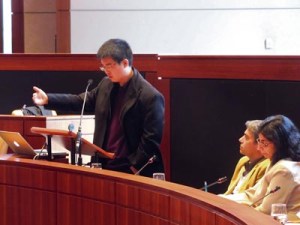
PhD Field Work: Metro Vancouver

Since mid-April, I have been conducting research on Cantonese evangelicals, their conceptions of civil society, and their social and political engagement in Metro Vancouver.  I hope to wrap up this first round of research by 2 June.  I plan to be flying to San Francisco on 3 June and returning mid-July.

A few things that are especially on my mind as I conduct this Vancouver field work over the next few weeks:

  • The upcoming Canadian federal election (2 May)
  • The recent Edgewater Casino hearings
  • Print and video media reports on Chinese Christians
  • Chinese Christian youth/young adult ministries and revival networks
  • Relationships between Christian parachurch organizations/networks and churches
  • Anything else about Cantonese evangelicals in Vancouver being socially and politically engaged (or not–and why not?)
As I’ve said previously, much of this project depends on semi-structured interviews, focus groups, ethnographic field work, and texutal/media analysis.  Feel free to contact me at jkhtse@interchange.ubc.ca for more information!

Human Ethics Clearance

GREAT NEWS: my application to UBC’s Office of Research Services ethics committee has been approved!

This is one of the interesting things about doing research in North America.  Because of a long history of research with questionable ethics (largely within psychology), many North American universities have decided to screen any research involving human subjects.  This ranges from anything including simple interviews and surveys to more complicated things like deception to get information (which I do NOT engage in).  There’s a science version too for lab subjects and animal safety (which I also don’t do).  All of this gets put under an umbrella at UBC called the Behavioural Research Ethics Board.  I applied for clearance in human subjects.

My application was actually very simple because there weren’t too many ethical risks in my project to begin with.  My project is very simply talking to people in interviews and focus groups, observing people at churches and organizations, and stuff like that.  The key thing about this kind of research is that everything has to be up front, i.e. I have to let people know when I’m taping what they’re saying, I have to let them know that I’m a PhD Candidate doing research, and all the rest of that.  As a very simple formality and also a common courtesy, people that I tape also have to sign consent forms that say that they give “free, informed, and voluntary consent” and that they know what the project is about.  For the record, I use a digital voice recorder that records in mp3s made in Korea that I got from this tech shop in Causeway Bay in Hong Kong that just plugs into the USB port with a wire on my laptop.  I use the recordings as another note-taking device so that I don’t have to scribble down verbatim what everybody says, and I transcribe the interviews and make sure nobody besides me and the person being interviewed hears the interviews or looks at the transcriptions (confidentiality MATTERS!).  I always leave the recorder on the table out in the open, and I never tape secretly.  It’s really just about being forthright that I am an academic researcher interested in Cantonese evangelicals.  That’s not very hard to do, especially because I like the project so much!

The whole process only took about two weeks.  I was put under the category of minimal risk and assigned for expedited review.  This means that really, the project doesn’t have too many ethical risks.  The key thing is just to be honest that I’m doing research.  I think that’s what any decent person would do.

But yes, this means I’m cleared by UBC to do research.  Vancouver, San Francisco, and Hong Kong, here we come!

Proposal Approval

On 31 March 2011, my PhD proposal was approved.

What does this mean?
It means that I’m finally approved to do research as a full PhD candidate.  The human subjects ethics forms are currently being approved, pending provisos for a few clarifications on my application (but nothing substantial), but I expect those to be taken care of in the next few days.

What’s the proposal about?
The proposal concerns my upcoming doctoral dissertation research, which is due to be completed in Summer 2013.  The working title is Religious Politics in Pacific Space: The Political Interventions of Cantonese Christians in Hong Kong, San Francisco, and Vancouver.  It’s basically about how Cantonese-speaking evangelicals see themselves as involved in society in these three metropolitan areas.  The basic methodology for this project is a global ethnography, a term coined by Berkeley sociology Michael Burawoy (2001) that refers to when social scientists contextualize their field work in larger global processes in time and space, and will mostly depend on semi-structured interviews with Cantonese Christian organization leaders and pastors as well as focus groups with Cantonese Christian lay persons.  These interviews and focus groups will be contextualized by basic field observation, quantitative data from organizations and the censuses, and textual and media analysis of both Chinese Christian media sources and secular news sources.  It’s going to take about a year, with at least three months in each site.

Can you help?
If you identify as a Cantonese Christian–or even just a Chinese Christian (even if you’re Mandarin-speaking, or if your parents are Cantonese-speaking)–or if you’ve done work with Cantonese Christians, I’d love to get in contact with you. In fact, even if you don’t identify as Cantonese Christian, period, but you wanted to get some of your friends involved in the project, please do contact me!

But I don’t like politics! It’s such a touchy topic!
THAT’S OK!!! I’m using “politics” in an fancy academic way–and I have to, because I’m an academic–to refer to when people get involved in their civil society.  In that sense, a lot of things count as “politics” for academics.  The way that I’m using “politics” is more in terms of social involvement; in other words, I’m interested in the constant conversation between Cantonese evangelicals and the societies they find themselves in.  Yes, it could refer to electoral politics when you try to vote someone into that society, but it may be as simple as feeling like you want your voice heard in the broader society, or joining in a march or a protest, or making your organization or church more engaged in social issues.  Or maybe you’re not interested in doing any of that–I’d really be interested in: why not?  Basically, although the title of my research concerns politics, I’m just interested in how Christians who speak Cantonese think about and get involved in society in Vancouver, San Francisco, and Hong Kong.

What will happen to information that is gathered?
I will use the data I gather to write my PhD doctoral dissertation.  These things are usually 300ish pages long.  I’ll turn that into an academic book that will be able to speak to scholars in human geography, religious studies, ethnic studies, migration studies, political studies, and urban studies.  I’ll also write some academic articles based on it.  While these things sound so academic, they also form the basis for community involvement as well, including using my studies to help Cantonese evangelicals reflect on issues of faith and society and providing a fair and balanced representation of Chinese Christian churches and organizations to the media.  I am very interested in contributing my academic skills in partnership with community leaders, organization heads, and pastors, and I hope that this project will be of use in both academic and non-academic settings.

If you want to get in touch with me because you’re interested, feel free to send me an email at jkhtse@interchange.ubc.ca or call me at +1-604-728-0024.  I’d be happy to hear from you!

APARRI 2011

The 2011 Annual Meeting of the Asian Pacific American Religions Research Initiative

APARRI
Call for Papers

Here and There: Race, Religion, Law and Immigration

Dates:  August 3–5, 2011
McCormick Theological Seminary
Chicago, IL

APARRI is a community advancing the interdisciplinary study of Asian Pacific Americans and their religions. Through conferences, mentoring, and collaboration, APARRI promotes the professional development of scholars and the emerging field of Asian Pacific American religious studies. The APARRI conference began in 2000 among a group of doctoral students and early-career scholars of religion and theology who sought to develop a community of mutual support for the development of interdisciplinary scholarship on Asian Pacific American religion.  The conference continues this cross-disciplinary work by organizing concurrent sessions. Presenters are encouraged to share their research and works-in-progress with other APARRI participants by organizing panels, presenting papers, and/or by structuring small group dialogue sessions on an important topic of inquiry in the study of Asian North American and Pacific Island religions. Selected papers/sessions will be scheduled during the concurrent panels.

Entitled “Here and There: Race, Religion, Law and Immigration” the 2011 conference will be held August 3–5 on the campus of McCormick Theological Seminary in Chicago, IL.  The conference will feature a plenary as well as concurrent sessions that showcase research-in-progress. Additionally sessions focusing on professionalization (“Research and Writing: Staying Productive and Sane” and “I got the Job: Now What?”) will be available for students and faculty.

Debates around immigration have become increasingly fraught in the U.S. and abroad.  The impact of these debates has affected the lives of Asian Americans in predictable and unexpected ways, especially when considerations about citizenship take into account religion, law, and race.  The 2011 Annual Meeting of the Asian Pacific American Religions Research Initiative (APARRI) will explore the nexus of race, religion, law, and immigration through papers, working groups, and experimental keywords sessions.  Among the questions the meeting will consider are: How have changes in legal, civic, and cultural understandings of religion and race affected the formation of immigration policies in the U.S. and in other nations? What role have Asian American religious communities and traditions played in the fight for the rights of immigrants? How have race relations among Asian Americans and other racial and ethnic groups affected attitudes about immigration policies and religious affiliations?  What discourses about social justice have Asian American religious communities developed?  We invite working papers that will address these and related questions.

Deadline for Submissions:  June 1, 2011.
Email submissions to:  We encourage work in multiple and diverse religious contexts. Proposals should be sent by e-mail to Joe Cheah at jpcheah@aol.com
Acceptances will be sent out by June 15, 2011.

Association of American Geographers 2011 (Seattle, WA)

A few updates on the sessions in this Association of American Geographers in Seattle’s Washington State Convention Center and the Sheraton.

Betsy Olson, Claire Dwyer, and I co-organized a session on Wednesday, 13 April 2011, at 10 AM entitled Religion and transnationalism/Traveling faith (#2244).  This paper featured paper presentations by Murat Es, Abby Day, Ben Kogaly, Sharon Suh, and Patricia Ehrkamp.  Claire Dwyer, David Ley, and I also gave our presentation on Richmond’s “Highway to Heaven”:

While geographers have written much about the varying dimensions of transnational urbanism (Ley 2004, MP Smith 2001, Mitchell 2004) religious transnationalism remains under explored despite the establishment of many new spectacular religious buildings in diaspora cities in the last decade and evidence of the continuing significance of religious practice for many migrants (Levitt 2007, Tweed 2002). In this paper we draw on recent empirical work in the multicultural suburb of Richmond, Vancouver to explore the complex geographies of a transnational suburban religious landscape. Along the Number 5 Road, on the eastern boundary of the city and adjacent to the major 99 highway, more than twenty religious buildings including mosques, churches, religious schools, Buddhist, Hindu and Sikh temples are clustered within 3 kilometres. This suburban religious landscape has been produced by the complex intersection of suburban planning regulations, municipal multiculturalism and the transnational activities of a range of different diasporic faith communities living in greater Vancouver and beyond. Our paper traces the processes by which this landscape has been produced and raises some questions about the possible outcomes of planning for religious and cultural diversity and the varying trajectories of religious transnationalism.

I am also giving a paper on Thursday, 14 April 2011, at 10 AM in the Issues in Ethnic Geography II (#3220) session.  Here is the paper abstract:

Until recently, ethnic, religious, and ethno-religious spaces in North America have been assumed to be apolitical.  Urban ethnic centres (such as Chinatowns), ethnoburbs (such as Richmond in Metro Vancouver), and ethnic churches and temples have often been seen as sites where migrant cultures to North America have been preserved; indeed, the only politics in which they are involved may be anti-segregation and anti-racism protests.  However, Cantonese Christians have not been apolitical.  In 2008, Cantonese Christians successfully campaigned for the election of a Conservative Member of Parliament in Richmond, British Columbia; a parallel in the San Francisco Bay Area was an alliance of Chinese evangelicals with the larger evangelical movement to pass Proposition 8 to ban same-sex unions.  Such a trend has also been noticed by Canada’s national newspaper, The Globe and Mail, running a front-page article on immigrants and the conservative vote.  In this presentation, I propose a working approach to such migrant religious communities that takes into account their politics.  We must ask: what are the civic imaginations and practices of Cantonese Christians who are said to vote conservative?  This paper grounds this question in Vancouver and San Francisco as the starting point of a new line of inquiry into the political agency of communities formerly thought to be ethnic enclaves running parallel religious lives in North America.  It is the hope of this paper to initiate a new approach to immigrant and ethnic geographies from which empirical data can be collected.

Finally, in the usual great run-up of speakers for the Geography of Religion and Belief Systems Annual Lecture, Claire Dwyer will be giving this year’s lecture (#4258):

Encountering the Divine in W5 and Highway 99: stories of the suburban sacred
This lecture reflects on my on-going collaborative research on suburban faith spaces in London and Vancouver to explore the significance of everyday geographies of religion.  Recent research on suburban faith spaces offers both into a reinterpretation of the assumed secularism of suburban space and an analysis of the transnational and postcolonial connections shaping suburban geographies. Through this analysis of suburban faith spaces I develop two broader arguments about the geographies of religions and belief systems. First, I ask what geographies of religion have to offer to wider theoretical discussions within the discipline. Second, I reflect on the  possibilities and challenges of accessing the suburban sacred as part of a wider reflection on geographies of encounter and enchantment.

Metropolis Canada: 23-26 March 2011

Just wanted to check in and report on the success of a paper session I co-organized with my friends Claire Dwyer, David Ley, and Paul Bramadat at Metropolis Canada.  Here’s the session information:

Immigrant Integration, Religious Diversity and the Suburbs
This session brings together academics and policy makers to discuss the ways in which the civic engagement and integration of immigrants is facilitated through religious institutions and organisations. It focuses on the emergence of new religious spaces in the suburbs of many Canadian cities and the challenge of planning for diversity.

Organizer | Organisateur
Claire Dwyer, University College London
Justin Tse, University of British Columbia
David Ley, University of British Columbia
Paul Bramadat, University of Victoria

Participants
Claire Dwyer, University College London, Justin Tse and David Ley, University of British Columbia
‘Highway to Heaven’: The Making of a Transnational Suburban Religious Landscape in Vancouver

Ranu Basu, York University
Kali in the Legions to Eid with Christmas Lights: Integrative Multiplicity in Toronto Suburbs

Meharoona Ghani, Ministry of Regional Economic and Skills Development, British Columbia
Multiculturalism and Inclusive Communities

Alan Hill, City of Richmond
Cultural Diversity and Integration

Chair | Modérateur
Paul Bramadat, University of Victoria

Discussant | Commentateur
Balwant Sanghera, Interfaith Bridging Project

A CLAIM TO FAME: our session was mentioned by Douglas Todd in The Search for our presentation on religion.  Thanks so much, Douglas, and yes, it provoked some great discussion on religion, secularism, migration, and the suburbs in Canada!

Asian Canadian Writers’ Workshop

On Saturday, 19 February 2011, I joined the Board of Directors at the Asian Canadian Writers’ Workshop (ACWW).

The ACWW was started in 1979 by a group of creative writers who had been influenced by the rise of Asian American movements in the United States.  The term “Asian American” was coined in their first publication with the Powell Street Revue, Inalienable Rice.  Since then, the ACWW has also been the publisher of the only Asian Canadian magazine in Canada: Ricepaper.

The current discussion in the ACWW is to continue the good work of promoting Asian Canadian writing and making Ricepaper more well-known.  My story with Ricepaper began in Fall 2004 shortly after I had moved from the San Francisco Bay Area to Vancouver.  I attended an event with the Chinese Canadian Historical Society of British Columbia (CCHSBC) at the Vancouver Museum, where Ricepaper was also being promoted.  Back then, I was interested in continuing my own creative writing work that I began in high school when I co-founded the literary magazine Sea Changes at Moreau Catholic High School.  Even back then, I was interested in writing on Chinese church experiences as well as moving into academic studies of Chinese Christianity in North America.

Since then, I was aware of Ricepaper, but it was not until I took an Asian American directed studies course with Henry Yu that I began thinking about the CCHSBC, the ACWW, and Ricepaper again.  The president, Allan Cho, got in touch with me in January 2010, and as he was putting together a new board for the next generation of Asian Canadian writers, he was interested in seeing if I wanted to get involved.  It took me about a year.  And so now, I’m on the board.

For now, I understand the mandate of the ACWW to promote Asian Canadian writing, both through Ricepaper and the writing workshops.  If you’re interested, do get in touch with either me or with the rest of the board.  We’d love to get more subscriptions and ideas for promotion.

UPDATE: I left the ACWW board of directors in 2012 because I needed to focus on other personal and professional commitments. However, I still think the world of this board and this magazine and always read their work with interest.

Sing Tao Daily (3 Feb 2011)

At the Metropolis BC conference, I was interviewed by a journalist for Vancouver’s Sing Tao Daily (星島日報).  He asked for supplemental information to our talk on No. 5 Road and wanted to discuss especially the Chinese Christian organizations in the talk.  He asked specifically about new migrants from the People’s Republic of China.

Most of what I said was fairly represented in the following article.  The Chinese version is here.  I have translated most of it (with assistance from family and girlfriend) into English here:

New immigrants are changing the culture of religious communities
Chu Lam (Sing Tao Daily, Vancouver)

An immigration research organization has pointed out that as NGOs and religious communities become increasingly concerned about multiculturalism, multiple levels of officials need more attention and understanding as they make new policies toward minorities’ religions and cultures.

Metro Vancouver’s immigration research organization invited Canadian academics, the government, NGOs, and religious communities for a dialogue on Wednesday.  They spoke from the perspective of all three levels of government on what they should pay attention to in policymaking.

The provincial economic and capacity development organization [Embrace BC] and immigration research Metropolis BC on Wednesday was entitled: Religion and society: a policy research symposium on immigration, multiculturalism, and social change in Canada.  This academic symposium invited the academics, government officials, and NGO leaders from all over the nation to participate in researching minorities and immigrant religious cultures and their impact on the changing Canadian social landscape.

UBC Human Geography’s doctoral candidate Justin Tse used ‘tsunami’ to represent the increasing numbers of PRC migrants to Canada.  He pointed out that Canadian Chinese religious organizations are mostly Cantonese-speaking and are mostly from Hong Kong, and that new migrants from the PRC find a gap in language and political values.  Although there are barriers, Chinese religious organizations are step-by-step incorporating new migrants, and the new migrants are participating willingly and happily because of their curiosity and need for religion, so the religious culture is changing from the inside, and it changes people’s view of politics and culture, causing the policymakers to pay attention.

Ryerson University’s urban planning professor Sandeep Agrawal expressed that up till now, the government has planned insufficiently for religion.  For example, in the Greater Toronto Area, there are 147 religious organizations, but there are only 123 religious places of worship, so on average one of these organizations must serve 10,000 people.  Many religious organizations can only hold their events in residential areas.

Agrawal said that when the government plans the city, they need to have the right amount of religious sites planned, so that they can ensure that multicultural and different religions are incorporated into the city development plans.

——

A FEW CLARIFICATIONS:

Sadly, and perhaps fortunately, I was not the one who coined the term “tsunami.”  I got it from another article written on 5 February 2010 in a Christian newsletter on Canadianchristianity.com on Chinese churches by Meg Johnstone entitled “Chinese churches thrive.”  In my own interviews for my master’s project on a transnational Hongkonger church, there were also people who expressed the phenomenon as new migrants “flooding into” the church “all of a sudden.”  We found similar sentiments expressed by some of the Cantonese-speaking churches on No. 5 Road.  A similar phenomenon was also noted by a fourth-year undergraduate geography student I helped who studied a prominent Cantonese-speaking church in Vancouver for his Research Methods: Migration course in Geography.  So no, “tsunami” is not from me; it is common parlance from the ground.

My comments on language also need to be taken in the context of Chinese Christianity in Metro Vancouver, not religion as a whole.  Most of the Buddhist places I’ve been studying on No. 5 Road are actually Mandarin-speaking: the Lingyen Mountain Temple is mostly from Taiwan (although there is a Cantonese tour guide, as well as a prominent figure who is non-Chinese), as is the Dharma Drum Buddhist Meditation Centre; some of the monks at Thrangu Monastery are proficient in Mandarin in addition to Tibetan.  But 74% of the Chinese Christian churches in the 2007 Vancouver Chinese Evangelical Ministerial Fellowship’s directory are Cantonese-speaking; the major Chinese Christian events also seem to be in Cantonese.  This situation is quickly changing as we speak, though, as many churches have started Mandarin ministries.  Moreover, far from all Mandarin ministry being new, there are also very well-established Mandarin-speaking churches in Metro Vancouver, such as Evangelical Chinese Bible Church (ECBC); I also have some very good Taiwanese Christian friends in the area as well; and Stream of Praise (讚美之泉), a very popular Taiwanese Christian music group based near Irvine in Orange County, CA, comes here to tour quite a bit too (and their Mandarin songs are sung in many Cantonese churches too!).

Christianity is important within the Chinese population because according to the 2001 census, there were more Christians (24%) than Buddhists (15%) within the Chinese population in Metro Vancouver.  For further reading, see Yu Li’s chapter on “Christianity as Chinese religion” in the edited 2010 volume on Asian Religions in British Columbia as well as my 2010 article in Population, Space, and Place on “Making a Cantonese-Christian family.” David Ley also has a section in his new book Millionaire Migrants: Trans-Pacific Life Lines (2010: pp. 213-217) on Chinese Christian churches as new civic spaces as well as a 2008 article in Urban Studies on the immigrant church as an urban service hub that focuses on German, Korean, and Chinese churches in Metro Vancouver.

On the difference of “political values,” I was referring to what my respondents had noted as a difference of political sensibilities between Hong Kong and the People’s Republic of China.  Of course, the PRC is a big place, and Hong Kong is also very diverse, but this was also a common sentiment on the ground.  As I told the reporter, I think the jury is still out on whether PRC migrants are more politically conservative, liberal, apathetic, etc. than their Hongkonger counterparts in Vancouver.  That may partly comprise some of my doctoral research.  Stay tuned.

The paragraph also seems to suggest that I think that Chinese religious organizations in Vancouver will completely change from Hongkonger to PRC.  I think it’s messier than that, although with new migrants coming into the church, some things will inevitably change.  I am starting to see that already.  But will it completely change?  That also remains to be seen.

Lastly, on the policymakers paying attention, yes, I think this was a hopeful sentiment.  I spoke with a policymaker today, however, who couldn’t care less.  But I think this is perhaps the main thrust of my upcoming doctoral project: what are the civic imaginations and practices of Hongkonger Christians in the Pacific region?  If there is change from new, non-Cantonese migration, then perhaps some things may change politically in perhaps swinging religious votes or perhaps affecting land use or perhaps engagement in new forms of civil participation.  Perhaps.  I still have to do the research there.  But yes, like the article, I hope that policymakers do pay attention to Chinese Christians.

All this said, I think this article is overall a fair representation of the interview I gave and the symposium as a whole (at least the morning portions).  My hope is that the comments quoted especially by Sandeep and myself will not be taken as written in stone by the experts but will prompt further research by academics and policymakers as well as deeper reflection on religion and society by the people reading this in their daily newspaper.

Religion and Society: a policy symposium on immigration, multiculturalism, and social change in Canada (Metropolis BC and Embrace BC)

On Wednesday, 2 February 2011, I had the pleasure of being the lead presenter on work done in collaboration among Dr. Claire Dwyer (University College London, Geography), Dr. David Ley (UBC Geography), and myself on Richmond’s No. 5 Road, otherwise known as the “Highway to Heaven” for its over-20 religious institutions on three big blocks of converted Agricultural Land Reserve (ALR).

The talk we chose to give was entitled: Talking infrastructure: another topic for interfaith dialogue on Richmond’s “Highway to Heaven.” I was the lead presenter.

Our main point was that because the “Highway to Heaven” lay on mostly newly-converted ALR, its lack of infrastructure often forced religious institutions to cooperate to get things built, often only as one-off projects.  We discussed three key issues.  The first was that while No. 5 Road has been portrayed as a miracle of interfaith cooperation (mostly in the sharing of parking lots), our research shows that there have been potentials for conflict, particularly within ethnic groups, although these clashes have also tended to be minor.  The second was a demonstration through the case of sewage lines that interfaith collaboration were often one-off projects and that failures and successes were usually not the product of theological or cosmological conflicts.  The third was that policy from the City of Richmond often had the unintended side effects of frustrating some religious practices, such as in the proposed Blundell Interchange onto Highway 99 or the requirement to farm the back third of the lots for tax exemption.

We got great feedback on this project.  People from the City of Richmond who were present were very receptive to our comments and are beginning to discuss with us more possibilities for collaboration to minimize those unintended policy side effects.  We have also begun to learn much more about the ALR as a result and are finding that rural and urban spaces really do matter for geographies of religion.  We also met many members of the Richmond community, including representatives from two interfaith organizations (one English-speaking, another Chinese), who encouraged us to do more thinking along the lines of theological reflection and interaction with the City as good neighbours.  We were very pleased with the turnout for the event and grateful for all the suggestions for our project, which is still a work in progress.

The PowerPoint should be available from Metropolis BC at some point, and I will keep you posted on when.

Other interesting talks of the day included talks by the co-organizers of the symposium, Paul Bramadat (University of Victoria, Centre for Studies in Religion and Society) and Meharoona Ghani (Embrace BC) on the necessity of a policy discussion of religion in a world where faith and politics are increasingly important, especially in British Columbia.  In our panel on Space, Place and the Sacred: Managing Religious Diversity in a Multicultural Society (chaired by Paul Bramadat), there were two colleagues whose work focused on the Greater Toronto Area as comparative sites for British Columbia: Heidi Hoernig (McGill University, Office of Research Services) and Sandeep Agrawal (Ryerson University, School of Urban and Regional Planning).  Another panel on projects from Embrace BC’s Interfaith Bridging Projects featured talks from Clare Whelan-Sadike (Embrace BC), Tahzeem Kassam (DIVERSECity, Surrey), Bruce Curtis (Community Justice Centre, Comox Valley), and Julie Papaioannou (CIC BC/Yukon).  The day was capped by an open discussion on post-secularism led by Paul Bramadat and Julie Drolet (Thompson Rivers University, Social Work), where much of the discussion focused on the need for education for religious literacy at all levels of schooling to address a multicultural, multi-religious society that is increasingly not following the patterns of secularization once prescribed for it in the 1960s and 1970s.

We are looking forward to a larger conversation that will happen at the Metropolis Canada conference to be held in March 2011.  Claire Dwyer and I are co-organizing a session on religion and migration, and our panel will include people from Embrace BC, the City of Richmond, and Richmond’s Interfaith Advisory Committee.

Comprehensive Exams, 17-21 January 2011

Since 20 October 2010, I have been reading for comprehensive exams.

The PhD in Human Geography at the University of British Columbia requires three exams to be written in the second year of the PhD.  These three exams address three broad fields that will be addressed in the dissertation and that can serve as broad teaching areas for a future career in academia.

My exams are set for 17-21 January 2011.  I sit one exam for each of 17, 19, and 21 January.  These are written, take-home exams where I have to answer two questions about a broad field in human geography; the normal length of each answer is a 7-10 page literature review.  On the following week, I also sit a three-hour oral exam with my doctoral comprehensive exam committee.  Currently, my doctoral committee consists of: David Ley (UBC Geography), David Edgington (UBC Geography), Henry Yu (UBC History), and Claire Dwyer (University College London, Geography).

The rumour has gone around UBC that the Geography exams are among the most difficult in the Faculty of Graduate Studies.  I cannot confirm the truth of this rumour, but what I can say is that it is simultaneously difficult and rewarding.  The aim of these exams is to give a broad understanding of the field and to invite interdisciplinary approaches to the subject matter (which only goes to show how interdisciplinary Geography is as a discipline!).

The three fields I will sit are as follows:

COMPREHENSIVE EXAM #1:
GEOGRAPHIES OF RELIGION, SECULARISM AND SOCIAL THEORY

  • “Old” and “New” Cultural Geographies of Religion (the “old” refers to the Berkeley school of cultural geography led by Carl Sauer, the “new” to Jim Duncan’s turn toward process in the politics of placemaking)
  • Theories of religion
  • Anthropological and sociological approaches to religion
  • Political constructions of secularity
  • Islam and the West: liberal, feminist, and ethnographic approaches
  • Religion and transnational migration
  • Congregational studies (i.e. R. Stephen Warner’s “new paradigm”)

Major thinkers I address in this list include a diverse range: Wilbur Zelinsky, David E. Sopher, Lily Kong, Reinhard Henkel, Peter E. Hopkins, David Ley, Claire Dwyer, Kevin Dunn, Banu Gokariksel, Philip Kelly, Paul Bramadat, R. Stephen Warner, Helen Rose Ebaugh, Janet Chafetz, Peggy Levitt, Steven Vertovec, Peter Berger, Harvey Cox, Emile Durkheim, Mircea Eliade, Clifford Geertz, William James, Rudolf Otto, Karl Marx, Rodney Stark, Max Weber, Talal Asad, Jose Casanova, Michel Foucault, Jurgen Habermas, Stanley Hauerwas, John Milbank, and Charles Taylor.

While religion is the major focus of the list, such a diversity of sources also enables a broader address of the following in future research and teaching:

  • social and cultural geography
  • intellectual histories of the social sciences
  • multiculturalism and migration studies

COMPREHENSIVE EXAM #2:
PACIFIC WORLDS IN MOTION: ASIAN MIGRATIONS AND GEOGRAPHIES OF MIGRATION AND ETHNICITY

  • Theories of international migration
  • The “mobilities” paradigm (John Urry)
  • Multicultural theory and policy
  • Labour migrations
  • Transnational migration studies
  • Second-generation issues
  • Asian American studies
  • Race theory and race studies
  • Asian Canadian studies
  • Pacific Rim studies

Major thinkers I address include: Stephen Castles, Mark J. Miller, Catherine Bretell, James Frank Hollifield, Nancy Foner, John Urry, Ghassan Hage, Robert Putnam, Brenda Yeoh, Katie Willis, Christian Joppke, David Ley, Nina Glick Schiller, Linda Basch, Christina Szanton Blanc, Elaine Ho, Peggy Levitt, Mary C. Waters, Aihwa Ong, Ien Ang, Laurence Ma, Carolyn Cartier, Ronald Takaki, Glenn Omatsu, Sucheng Chan, Lisa Lowe, Jack Tchen, Robert G. Lee, Henry Yu, Helen Zia, Kay Anderson, Dorothy Fujita-Rony, Madeline Hsu, Alexander Saxton, Judy Yung, Peter Ward, Patricia Roy, Charles A. Price, Eiichiro Azuma, Carlos Bulosan, Yen Le Espiritu, Vijay Prashad, Chris Lee, and Peter Li.

While Pacific migrations and ethnicities are the major foci of the list, this list also enables me to address the following in future research and teaching:

  • Globalization theory
  • Citizenship in theory and practice
  • Global economics and geopolitics
  • Theories of social and cultural capital
  • Race and ethnic politics

COMPREHENSIVE EXAM #3
CITIES IN THE ASIA-PACIFIC: HISTORICAL AND POLITICAL ECONOMIC PERSPECTIVES

  • Asian cities in global and regional contexts
  • Colonial and post-colonial cities
  • Global cities/world cities
  • Pacific Rim studies
  • Cities and the welfare state in post-colonial Asia
  • Cities and the neoliberal state in post-colonial Asia
  • Convergence/divergence theory (e.g. Terry McGee’s desakota model)
  • Garden cities and urban utopias
  • Sustainable cities
  • Rural-urban relations and migrations
  • Labour in Asian cities
  • Urban development in Asia

Major thinkers I address are: Terry McGee, David Edgington, W.B. Kim, Anthony King, Fucheng Lo, Peter Marcotullio, Karen Y.P. Lai, Saskia Sassen, Brenda Yeoh, Fulong Wu, S.O. Park, Ryan Bishop, Abidin Kusno, Laurence Ma, Kris Olds, Manuel Castells, H.W. Dick, P.J. Rimmer, Michael Douglass, G.L. Ooi, John Gugler, Jonathan Rigg, Andrew Sorenson, and Dean Forbes.

Though the list focuses on Asian cities in particular, broader areas for future writing and teaching include:

  • Comparative Asian, North American, and European cities
  • Migrant labour
  • Pacific and Pacific Rim studies
  • Urban sustainability
  • Theories of “orientalism”
  • Colonial and post-colonial studies
  • State politics: welfare and neoliberal models

So now…it’s back to reading!  The labour is rewarding, the knowledge both intellectually stimulating and relevant to the contemporary situation.