SSHRC Postdoc Fieldwork, Summer 2014

I’ve got some fun news. I’m back in the field!

I’ve really missed this. Much of my PhD was consumed with doing ethnographic fieldwork, key informant interviews, and focus groups, both for my actual doctoral project (see my work in San Francisco [x2], Vancouver, and Hong Kong) as well as for the collaborative project on the Highway to Heaven in Richmond, BC. After finishing all of that, I did a ton of writing, which has resulted in a dissertation and will result in a series of publications that you can expect to roll out over the next few years.

But as the summer is starting up, teaching is done, and frameworks are being solidified, it’s time to do some new fieldwork for the Social Sciences and Humanities Research Council of Canada Postdoctoral Fellowship. That’s the whole reason I’m here in Seattle in the first place.

I need your help. I need to talk to people.

Here’s what the project is about.
I am interested in publics. Asian American and Asian Canadian Christian publics, to be specific. And to be really precise, in Seattle and Vancouver, for now. And to be super-precise, publics produced by the younger generation.

What are publics?
That’s actually what I want to find out. There’s a huge academic literature on publics, as well as a lot of popular reflection. In general, a public is just whenever someone puts something into circulation and creates an audience. This is usually contrasted with the private, which means stuff that’s not supposed to be circulated outside of a self-governed institution, like a family, a church, or a corporation. But do younger-generation Asian American and Asian Canadian Christians think of their work as public or private? That’s the golden question.

So what are you really interested in?
I’m interested in how younger-generation Asian American and Asian Canadian Christians understand their participation in making publics. This can be really broad. It can include stuff like electoral politics, grassroots activism on a variety of issues, social media participation, artistic/musical production, social services, and a lot more stuff. Like my PhD on Cantonese-speaking Protestants and how they engaged the civil societies of Vancouver, San Francisco, and Hong Kong, I let the data drive the issues that I explored.

So what’s the key research question? (Because I’m a social scientist and I know what I’m talking about.)
The key research question is: how do younger-generation Asian American and Asian Canadian Christians in Seattle and Vancouver engage and create publics?

How will you find out about this?
By talking to people. My research is usually driven by key informants. These are usually named individuals (although I always give the option for anonymity) who are positioned well to provide information about a phenomenon. My research is qualitative, so unlike a statistics-based project, I’m not aiming for representativeness. I’m trying to get stories, opinions, perceptions, and insider explanations on the record. To make sense of this data, I usually overlay it with focus groups of lay people and extensive methods where I consult quantitative data that’s already out there. I also use the key informant research to point me to documents that I need to put in my archives.

Who do you need to talk to?
I need to talk to key informants who can talk intelligently about how younger-generation Asian American and Asian Canadian Christians make publics. This means that they are usually a) talking about their own work as an individual or part of an institution or b) talking about people that they work very closely with.

What do you mean by Christian?
I mean people who self-identify as Christian. Evangelicals, liberal Protestants, Catholics, Orthodox, hard to categorize, etc. If you’re from another religious tradition or not part of a religious tradition and still want to talk to me, let’s also talk…about Christians.

By Christian, do you mean that you want to talk to Asian American and Asian Canadians who are doing Christian stuff in the public sphere?
NO. I’m also interested in people who are working in the secular public sphere but personally identify as Christians. If the public stuff doesn’t have much to do with personal identification as Christian, that’s interesting too!

What do you mean by younger-generation?
I mean ‘second-generation’ (i.e. born in North America) + people who came here when they were young. This way, I don’t exclude people I should be talking to arbitrarily based on birth. It also means that I’m interested in talking to people who do work in Asian languages, not just English-speaking.

But ‘Asian’ is so diverse!
I know! The thing is, there’s this theory that I’m trying to suss out called pan-ethnicity. People who work on second-generation stuff (especially my colleague Russell Jeung in his book Faithful Generations) have noted how Asian Americans — and to some degree, Asian Canadians — cooperate across ethnic lines (i.e. Chinese, Korean, Filipina/o, Japanese, Indian, Vietnamese, Cambodian, Indonesian, Malay, etc.) and talk about themselves as ‘Asian.’ I want to see if that works when Asian Americans and Asian Canadians do stuff in the public sphere.

But I don’t live in Seattle or Vancouver.
That’s OK. For one thing, I need your information to contextualize what I’m finding here in the Pacific Northwest. For another, the data here might lead to sites outside of the Pacific Northwest because this public work might not be regionally bound.

Do you have ethics clearance for this research?
Yes. The University of Washington’s Human Subjects Division in fact determined that my research was exempt from review under Category 2 of their Exempt Determination. This means that — given adherence to common-sense ethical research procedures — my work has been approved by the university.

I’ll be working on the initial phase of collecting data for this project in Seattle and Vancouver throughout Summer 2014. This initial phase means that I am very interested in talking to key informants. This usually means setting up an interview that is usually audio-recorded, lasts for about one hour, and is transcribed for accuracy. I have a formal letter of invitation, consent form, and interview questionnaire available, if you want to see that before talking to me.

Contact me at jkhtse (at) uw (dot) edu, and let’s talk!

Association of Asian American Studies, 16-19 April 2014, San Francisco, CA

Hooray! I’m really happy to say that the Association of Asian American Studies’s Annual Meeting is taking place 16-19 April 2014 in the metropolis that I called home for 18 years: the San Francisco Bay Area. We’re right at Union Square in San Francisco at the Grand Hyatt.

My contribution to this conference will be at a panel organized by Dean Adachi titled San Francisco: The Asian American Holy City? It will be meeting in the Larkspur room at 8 AM. My paper is titled ‘The War on Poverty and the Emergence of Evangelism: the Chinese American mainline and the new evangelicals in San Francisco’s Chinatown.’
Here’s the abstract:

This paper fills a necessary gap in contemporary discourses about Chinese American Protestant churches. Expected both to be progressive because of their immigrant commitments and conservative because of their Protestant practice, the stories of how Chinese American Protestant congregations became so politically contradictory is seldom told. This paper examines San Francisco’s Chinatown as a site of contestation that produced these contradictions. In the 1960s and 1970s, mainline Protestants in Chinatown joined the War on Poverty as part of a commitment to social justice and the development of an antiracist Asian American theology that was committed to the betterment of Chinatown as a Chinese American community. These efforts were simultaneously contested by newer Chinese evangelical migrants from Hong Kong who re-oriented some congregations and built new ones in reaction to what they perceived as ‘liberal’ social justice orientations, launching ‘conservative’ congregations that preserved the distinction between the secular public sphere and the church’s evangelistic, worshipping, and biblical teaching activities. The co-existence of these two kinds of congregations and their challenges to each other suggests that Chinatown itself needs to be conceptualized as a space of theological contestation, producing perceptions of Asian American religion as politically contradictory that require further examination in Asian American studies.

The other panelists are Dean Adachi (Claremont) and Helen Kim (Harvard). We are very excited to have Russell Jeung (SFSU) as our discussant. [For some reason, my name does not appear on the program. This is likely because on a draft program, I saw that my name had been misspelled as ‘Justin K.H. Hse.’ I registered under my real name. Dean also asked them to correct this, but the error was probably caught too late.]

I’m excited to be in my home metropolis to learn and to meet with colleagues in Asian American studies. It’s a bit unfortunate that this conference is taking place during Holy Week, but I’m making the best of all worlds. If San Francisco is the Asian American holy city, I’m going to spend Holy Week right here.

Book Review: Ellen Wu, The Color of Success: Asian Americans and the Origin of the Model Minority

I’m happy to announce that I’ve got a book review of a very good book in the newest issue of Amerasia Journal. That I am announcing that I have a book review in a new journal issue means that this announcement is in fact a chance to rave about this new book. And rave I shall.

The book that I reviewed is Ellen Wu’s The Color of Success: Asian Americans and the Origins of the Model Minority.

If you have not read this book already, you must. It is a magnificent historical account of how Japanese Americans and Chinese Americans were in fact part and parcel of the construction of the model minority ‘success story’ myth after the Second World War. It provides rich institutional histories of organizations like the Chicago Resettlers’ Committee, the Japanese American Citizens’ League (JACL), Chinese News, and the Chinese Consolidated Benevolent Association (CCBA). It is a complicated history, combining policy structures with community activism and the agency of individual actors. It accounts for both ideologically conservative and progressive strands among Asian Americans. It opens up theoretical questions about American liberalism. It is — dare I say it — a tour de force.

I want to especially thank Arnold Pan, the Associate Editor of Amerasia Journal, for making this book review happen. The journal issue is titled Asian American Religions in a Globalized World, a topic that is of immediate interest to me. When I asked him last December whether Wu’s book was taken for review, he told me that if I could give him a one-month turnaround, then I could be part of this special issue. This review was the first thing that I published during my postdoctoral fellowship, and I honestly feel so privileged to have started by reviewing such a good book. While some might consider book reviews part of the tedium of academia, this particular book review was a real treat (in fact, I am bold enough to say that I consider most books that come across my desk as gifts, not a grind! – but this one really takes the cake!). I think it’s also appropriate that this review ended up in this particular special issue. With her questions about liberal ideologies of assimilation and community structures, Wu opens up many possible avenues for theorizing Asian American religion.

This book will be of wide interest to many. As I say in the review, Wu is walking in the footsteps of giants like Yuji Ichioka, Him Mark Lai, Lisa Lowe, Henry Yu, Kandice Chuh, and Madeline Hsu. Read it. And read the special issue.

Postdoctoral Update, March 2014

It has been two months since my SSHRC Postdoctoral Fellowship at the University of Washington has started, and I think now is a good time to publicly take stock of the work that I’ve done so far and then look ahead into the future.

jsis_c_254_tse

A major part of the first three months of this postdoctoral fellowship (January to March) has been, is, and will be devoted to teaching my course, JSIS C 254, on American religion. Depending on who is speaking, friends and colleagues with whom I have discussed this course tell me that I am perhaps the most fortunate and/or blessed of new teachers: the students participate without my prompting, seek me out during office hours, and genuinely care about the material. We have successfully journeyed through the development of an Anglo-Saxon Protestant consensus in early American religion and explored the rise of a liberal consensus in twentieth-century America. We have also just recently completed a unit on the politics of race in American religion and are now starting a final unit on American fundamentalism.

I will do a more comprehensive reflection on the course when it is completed in late March. What I want to do here is to sketch the ways that teaching this course has shaped my research. As I’ve stated in previous posts, the two objectives of my postdoctoral fellowship are 1) to develop my doctoral research into publications and 2) to embark on new postdoctoral research on younger generation Asian American and Asian Canadian Christians.

Much of what I’ve done over the last two months has helped me to clarify what exactly my research is about and what philosophical and theoretical trajectories I find myself engaging as I prepare for a round of empirical work for my postdoctoral project.

First, I am seeing much more clearly that my work on Asia-Pacific and Asian American Christians ties in intimately with what might be called the liberal tradition. As I’ve said before, liberalism is not the opposite of conservatism. It is instead a philosophical and theoretical tradition that emphasizes the formation of public overlapping consensuses while upholding both rational argument and self-interest. I developed an interest in how liberal ideologies become geographies during my doctoral research on Cantonese Protestants and my argument that they were upholding a theological form of secularity. I realize increasingly that the implication is that while conservative Cantonese Protestants decry the liberalism of mainline Protestants and secular civil society, they themselves have emphasized to me (rightly so!) that they themselves should be considered ‘liberal’ as well for their focus on rationality and self-interest.

In other words, I am clarifying the centrality of interrogating the liberal tradition in my ongoing research agenda. My teaching in American religion has clarified for me the trajectory of how an American consensus was formed and the contributions of Protestant theology to the formation of a liberal tradition in America, one that has come to tentatively also include Catholics and Jews, as Will Herberg would say. On the same token, my recent readings in Asian American studies have also emphasized the connections among religion, racial formations, and liberalism. In the forthcoming issue of Amerasia Journal (40, vol. 1), I reviewed Ellen Wu’s phenomenal history of Chinese and Japanese American collaborations in the making of the model minority stereotype, The Color of Success: Asian Americans and the Origins of the Model Minority Myth. (This review will get its own post when it is out.) The major theme that I picked up in Wu’s history emphasized how American liberal ideologies produced a politics of assimilation, repeatedly framing issues in Chinese and Japanese Americans around integration issues. While Wu doesn’t talk much about religion, her book, combined with my own teaching on liberalism in American religion, brought clarity as I authored the encyclopedia entry on ‘Christianity’ for the SAGE/AAAS Asian American Society Encyclopedia, which I am pleased to announce has been accepted by the editors. My entry focuses on how both Protestant and Catholic threads in Asian American Christianity revolved around the question of assimilation for Asian Americans and that this is why the place of Christianity in Asian American communities is often so contested. Finally, the work around the Asian American open letter to the evangelical church has helped me to see the centrality of liberal ideologies in Asian American evangelical communities and has made me wonder openly about how such liberalism has managed to produce a ‘private consensus’ in American religion.

To the end of exploring the connections between liberalism and Asian American religion more thoroughly, I have a set of publications on which I am actively working that will be sent out over the course of this year. These articles, as well as a possible book manuscript, will develop my doctoral work on Cantonese Protestants and my postdoctoral work on younger generation Asian North American Christians around these theoretical formulations. This is possible because as a geographer, I am no stranger to dealing with what might be called grounded liberalisms. Indeed, when David Harvey published Social Justice and the City in 1973, he meant it to be a philosophical intervention that revealed the grounding of moral philosophies in concrete urban spaces, and he spends much of the book dealing with the insufficiencies of Rawlsian liberalism in urban geography, so much that he has to propose a Marxist way forward. By the time that David Livingstone wrote The Geographical Tradition in 1993, the notion that philosophy and theory were integral to any geographical research project was already the common consensus in the discipline. I’ll be using the resources from my home discipline, then, to address these philosophical concerns in publications that I will submit this year.

Second, I am finally coming to admit that while I have billed my research as focusing on Protestants, the truth is that both my doctoral and post-doctoral research is as ecumenical as it is evangelical, for Roman Catholics are inextricable from the Protestant story. It is thus more fair to say that I research Asia-Pacific and Asian American Christians for the simple fact that I have always included both Protestants and Catholics in my story, just as I have always sought to integrate liberal, liberationist, and evangelical voices in both my research and in my networks. In my doctoral research, I found that Catholicism was more integral to my Protestant story than I had anticipated. My research in the San Francisco Bay Area suggested that the push by some mainline Cantonese Protestants to pursue social justice as an ecumenical effort in fact stemmed from the success of the very successful ministry of the Paulist Fathers at Old St. Mary’s Cathedral in San Francisco’s Chinatown. While Chinese American Catholics and Protestants went quite separate ways after the 1970s in North America, that was precisely the time that they were being drawn together in Hong Kong. Democracy movements as from the Golden Jubilee Incident in the 1970s, the Tiananmen Incident in 1989, and the post-1997 protests for universal suffrage, migrant and labour rights, and religious freedom were all ecumenical efforts. Such ecumenism is calling me to revisit my data for the presence of Catholics throughout my research in San Francisco, Vancouver, and Hong Kong. Indeed, I included research interviews with Catholics in San Francisco, Vancouver, and Hong Kong; at what was perhaps one of the highest points of my research, I was allowed to interview Joseph Cardinal Zen twice in Hong Kong! As it is, my research has never been exclusive to Protestants. Catholics show up in my dissertation. They need to be explicit in my research.

I see the theological interests that can be derived from this empirical research as closely connected with the philosophical concerns that come from my discussion of liberalism. As I showed in my grounded theologies piece in Progress in Human Geography, theological thinkers (both Protestant and Catholic, and beyond the purview of Christianity, by all means!) can be read as honorary geographers because they are primarily interested in how theologies can be grounded in space. My postdoctoral research is causing me to revisit a variety of Protestant and Catholic thinkers from across the theological and ideological spectra to erect a theoretical framework that is fair to the empirical findings.

What you can expect, then, is that there will be a series of publications around my more ecumenical findings from my doctoral project, as well as a commitment to discovering ecumenical collaborations and contestations in my postdoctoral work. I suspect that most of my readers think that I focus exclusively on Asian American conservatives. They would not be wrong to think that social conservatism and the grounded theologies of family values politics takes up a significant chunk of my research agenda, but I expect that they will be surprised as I start publishing on ecumenical partnerships and progressive democratic movements this year. In addition, my emphasis on my research focusing on both Catholics and Protestants will mean that there may be some Catholic publication surprises in the works as well, including some publications targeted for Catholic Studies audiences.

Third, I am discovering that I need to publicly acknowledge my debts to what Cornel West calls ‘the black prophetic tradition.’ By the black prophetic tradition, I refer to a tradition of liberation critique and performative praxis that African American communities have contributed to the public rethinking of racialization in the public sphere. In many ways, these are personal debts that I have discussed when I have written about my personal history, especially my family’s ties to the African American patriarch, the Rev. Dr. J. Alfred Smith, Sr. However, I have seldom discussed how much I have long been influenced by the work of James Baldwin (since high school!), so much to the point that I am in fact teaching Baldwin’s The Fire Next Time in American religion as a book that brings together the poles of Martin Luther King, Jr. and Malcolm X in the black prophetic tradition, much as the academic corpus of James Cone does. In addition, with the emergence of theologians of race like Brian Bantum, J. Kameron Carter, and Willie Jennings, it is much easier to theorize connections between secularization and the geographical politics of race in modernity.

My thinking on race and religion again ties back with my ecumenical interests and my concerns with liberalism. If grounded liberalisms and theologies contribute to placemaking, then in the same ways do racialization and the myriad struggles for racial justice also produce geographies. These spaces have been documented by geographers, and I plan to emphasize that more strongly in my work. Again, this realization about the centrality of race to my work will show up in publications, both in theoretical contributions in my reading of key texts on race in a geographical way as well as in empirical explorations of how my doctoral and postdoctoral projects highlight ongoing problems of orientalization, including self-orientalization.

jkhtse_salmonsliders

All this is to say that my plate is quite full, and I am quite happy about that. I will be presenting some of this emerging work at various conferences this year, and I will use this blog, as usual, to make announcements about those. Publications are also in the works, as well as teaching syllabi. I look forward to the work ahead of me during this postdoctoral fellowship, and I hope that my colleagues, my readers, and indeed the various publics to which my work may have relevance will find my scholarship helpful and constructive.

SSHRC Postdoctoral Award, Jackson School of International Studies, University of Washington

While this will come as no news to many of my acquaintances, I am pleased to formally announce that I will be taking up a Social Sciences and Humanities Research Council (SSHRC) of Canada Postdoctoral Award at the Jackson School of International Studies at the University of Washington in Seattle, beginning on 1 January 2014. This is an externally funded postdoctoral award from the Government of Canada that allowed me to apply by proposing an international institution at which to hold the fellowship.  The purpose is for freshly minted Canadian doctoral graduates to be postdoctoral fellows as part of an institution’s academic life. My award funds my postdoctoral fellowship for two years while providing me with a base from which to get launched onto the academic job market.

I chose the Jackson School of International Studies at the University of Washington because I wanted to be part of an institution where I could augment my studies in religion while being part of a community that valued my disciplinary home in human geography and my topical interest in Asian American and Asian Canadian studies. I was attracted to the Jackson School because of the Comparative Religion Unit directed by Professor James K. Wellman, Jr., who will be my postdoctoral supervisor. As a specialist in Protestant studies, Wellman is a good fit because of his knowledge of mainline Protestant studies (I have found his readings of the Niebuhr brothers very enlightening, particularly as he grounds their work ethnographically; see The Gold Coast Church and the Ghetto: Christ and Culture in Mainline Protestantism) and evangelical studies (see Evangelical vs. Liberal), including in new evangelical paradigms and megachurch models (see Rob Bell and a New American Christianity). I look forward to working with him to develop my interests in American religion while reading and writing broadly around the nexus of religious studies and theology, which means that I will continue to engage the revisionist conversation on secularization as well. The Comparative Religion Unit is also a base from which to network with a diverse range of scholars across departments at the University of Washington whom I plan to engage in conversation about trends in the social sciences of religion. Finally, because the unit is located within the Jackson School, this situates me in an institution that cares about Canada-America relations, human geography, and Asian American/Asian Canadian/trans-Pacific migration and ethnic studies. I plan also to contact geographers and Asian Americanists for further conversation.

My postdoctoral project is titled Witnessing in the None Zone: Younger Generation Asian North American Protestants and public engagement in the Pacific Northwest. Following on the heels of my doctoral project on Cantonese Protestant engagements with the public sphere, this project now moves to a ‘younger-generation’ Asian American and Asian Canadian Protestant population and how they engage existing publics while creating new ones. By younger generation, I mean to say that I am not only interested in ‘second-generation’ Asian North Americans who are born in North America, but also 1.5-generation and transnational migrants as well. The project starts in the Pacific Northwest (especially Metro Seattle and Metro Vancouver) because much of the work that has been done on younger-generation Asian Americans has been conducted in California. This approach does not exclude the Californian case studies; instead, it can be a way to compare and contrast newer ethnographic work in the Pacific Northwest with the work in California. The Pacific Northwest is itself important because it has been conceptualized by many as a ‘none zone’ of religious life, and the fact that Asian Americans and Asian Canadians are engaging and creating theological publics in these sites may serve as a challenge to that thesis. By starting in the Pacific Northwest, I plan to later extend my postdoctoral fellowship work to other sites southward (say, to the San Francisco Bay Area, Greater Los Angeles, and sites in Texas, such as Houston and Austin) and eastward (say, to Chicago, Toronto, Boston, and New York), depending on where the connections may lead and whether these publics are bound by metropolitan units (as in my doctoral work) or conceptualize their geographical parameters differently. Again, the project does not focus on congregations, per se; it examines rather how younger-generaton Asian American and Asian Canadian Protestants engage and create publics, including in electoral politics, grassroots activism, planting congregations (one area of inquiry is whether congregational sites are conceptualized as public or private), participating in circulations of material culture, and involvement in social media (this list is not exhaustive! I am preparing to be surprised by my findings!). My plan is to start interviewing key informants at the beginning of 2014. In other words, details are forthcoming.

In addition to conducting this new research, I will also be writing papers to submit into academic journals in geography, religious studies, and American ethnic studies, while also converting my dissertation into a book to be submitted to an academic publisher. Finally, in keeping with the regulations of my grant, I will be teaching one course at the Jackson School on American religion in the Winter Quarter in 2014. I will write about that course separately.

jsis_c_254_tse

I look forward to my time in Seattle as an opportunity for further professional development. I anticipate that there will be a lot to learn, and I am very excited to be working with James Wellman. This postdoctoral fellowship promises to be a time that will hone my work on religious and racialized publics, and I am very eager to be challenged in ways that I will not have previously imagined.

American Academy of Religion: 23-26 November 2013, Baltimore, MD

I am in Baltimore for the next few days for the Annual Meeting of the American Academy of Religion. There are a ton of people to meet here, as well as a meeting for the steering committee of the Asian North American Religions, Cultures, and Society (ANARCS) group that I need to attend. While the conference lasts until 26 November, I’m actually taking off Monday (25th) afternoon.

Before that, tomorrow I will be in a paper session titled ‘Re-membering Home: Indigenous and Colonial Encounters in Asian North American Religious Spaces.‘  Devin Singh (Yale University) will preside over this panel, which is formed by Melissa Borja (CUNY Staten Island), Ren Ito (Emmanuel College, Toronto), and JuneHee Yoon (Drew University). We are very privileged to have Lisa Rose Mar (University of Maryland, College Park) as our discussant.

My paper is titled ‘Strategies of reconciliation: First Nations and Cantonese evangelicals in Vancouver, BC.’ Here’s the abstract:

This paper performs an empirical analysis of how Cantonese evangelicals have ministered to First Nations populations in British Columbia. Based on 50 key informant interviews and three focus groups, I argue that Cantonese-speaking evangelicals recognize to some extent their duty to help First Nations either through charity or through social justice lobbying as an extension of living out an evangelical understanding of the Gospel. However, these understandings are differential based on their comprehension of orientalization and how to practice evangelical theology based on experiences of racialization. I consider three approaches: a progressive evangelical theology that mandates policy advocacy, a conservative evangelical practice that emphasizes charity work, and lay Cantonese evangelical participation in both strands while being critical of First Nations poverty. This paper contributes to both Asian North American and indigenous religious studies by pointing to the complex potentials for unexpected collaborative avenues in the struggle against white settler ideologies.

I’m also excited for several of the other sessions that ANARCS is sponsoring, including a very promising ‘quad-sponsored’ session titled ‘Placing the Subfield’ that will discuss the ‘Americas’ in the North American religions.

If you are in Baltimore and want to meet up, I’d be very happy to do so. I’m looking forward to a very productive AAR and to learning a lot from my friends and colleagues.

Exponential and the Open Letter

It has been one week since the Asian American Open Letter to the Evangelical Church was released on Nextgenerasianchurch.com.  I am one of the original signatories and part of the planning committee for this open letter.

cover3

Because I have been on vacation over the last two weeks, I apologize for my delay in blogging about this important event, as well as an article in the Vancouver Sun that featured some research that Johanna Waters and I did on transnational youth between Hong Kong and Vancouver.  This post will cover my involvement in the publication of the open letter.  A forthcoming post will focus on the Vancouver Sun article.

My involvement in the Asian American open letter began when Religion News Service’s Sarah Pulliam Bailey contacted the group of us who had blogged about the Rick Warren ‘Red Guard’ fiasco and said that she had obtained information about an orientalizing incident at Exponential, a church planting conference that was incidentally being hosted at Saddleback Church but had no connection to the actual church itself.  Kathy Khang has provided a rundown here of what happened.  The gist of things is as follows: the Rev. Christine Lee, a Korean American Episcopal priest and assistant rector at All Angels’ Church, New York, tweeted that she had seen a skit at the conference where a white pastor used an orientalizing accent, but when she reported her concerns, her comments were brushed off.  This tweet was shared by Asian American writers Kathy Khang and Helen Lee, who proceeded to write the open letter.  Sarah Pulliam Bailey directly obtained the story from these tweets.

My comment to Bailey was that this second incident demonstrates the necessity for why the conversation must remain public.  I said: ‘It is worth observing that it has almost been 10 years since ‘Rickshaw Rally,’ and there are prominent American evangelical publishers, conferences, and pastors who still use Orientalizing imagery’. What I was doing was to place this incident in a historical trajectory that dates back to the Asian American evangelical campaign to pull ‘Rickshaw Rally’ from Lifeway Publishers’ Vacation Bible School publications in 2004. I am thankful that the open letter also uses this trajectory, because the concerns of Asian American evangelicals focus on whether they in fact have a place in American evangelicalism, especially if prominent pastors and publishers feel free to orientalize them despite a decade of protests. (It would be a worthy academic history project to check if there is activism that predates this decade, and whether those activists are connected to the ones at present.) As I have said repeatedly, each of these incidents were public, which makes a public response to them, including one via the press, extremely appropriate.

Over the week after Bailey’s article was published, the planning committee for the open letter gathered signatures. Exponential also issued a public apology after gathering a group of Asian Americans to talk about the skit, at which the story is that Jeya So’s story about her past of being bullied as an Asian American resonated with the conference organizers. I signed the letter to indicate my public support for this public response to these public cases of orientalization. The signatories comprise people gathered from diverse points on the theological spectrum. It is worth noting that this is a letter to the evangelical church and thus includes those conventionally labeled the ‘mainline’ and those whose theological orientations are ‘liberal’ and ‘liberationist.’

The idea now is to keep this conversation about the place of Asian Americans in American evangelicalism–and indeed, in American religion–public.  Indeed, the letter indicates that this is not so much a letter that goes on an attack, but rather, it is an invitation to a public conversation. As some noted to me, the letter struck them as conciliatory, and I agree; it should not sound a note of aggression.  Instead, it signals that while private conversations are necessary, like the one that led to Exponential’s informed apology, they are insufficient. If a decade has passed since Rickshaw Rally, then this conversation about race and orientalization must be had with American evangelicals in a public forum, one whose openness provides some accountability for actual change to happen.

This public conversation is in turn not a niche conversation. It is good for our public sphere. In a social and political situation where evangelicals are themselves the subject of public discourse, this conversation fits within key debates that are being had in American civil society, especially regarding the intersection of faith and politics. The openness of the open letter is one way to enter into this conversation because it interrogates whether the word ‘evangelical’ in our public discourse is inclusive of Asian Americans. If it is not, that would be curious indeed, given the observations in the social science of religion that Asian Americans are a quickly growing group of evangelicals and have historically been part of key American Protestant conversations. This open letter is thus an invitation to a broader conversation about American religion, especially because American religion concerns every person in the American public, and if that’s the case, then it is an imperative to know what we’re talking about when we talk about ‘evangelicals,’ including the fact that there are many Asian Americans who are very much included in that term.

UPDATE: Those interested in how these initial thoughts turned into reflections on how ‘the private consensus is unraveling’ should read my post on Religion Ethnicity Wired. Admittedly, the framing of the ‘private consensus’ and its undoing in this blog post is limited to American religion. My postdoctoral framework for the concept has to do with the Pacific Rim.

AAG Review of Books: Review Essay: Working Evangelicalisms: deploying fragmented theologies in secular space

I am happy to announce the publication of a book review essay that I put into the Association of American Geographers’ (AAG) Review of Books, a book review journal that has recently become independent of its mother publication, the Annals of the Association of American Geographers, one of the flagship journals of our discipline.

My book review notes the publication of three important books that are changing human geography as a discipline. This is because they are book-length treatments of American evangelicalism, a religious phenomenon that has gone too long unexamined by human geographers. These books seek to rectify that gap in three subfields in human geography: political geography, economic geography, and cultural geography:

51kea80an4l-_sx324_bo1204203200_

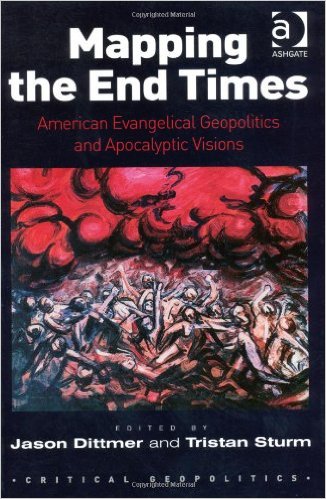
  • Jason Dittmer and Tristan Sturm’s edited collection, Mapping the End Times: American Evangelical Geopolitics and Apocalyptic Visions, is a contribution to political geography, specifically critical geopolitics. This subfield of human geography examines how political borders are constructed and maintained, often critiquing these constructions in the hope of mitigating warfare and making peace between nation-states.  This edited collection explores how American evangelicals contribute to these political formations through their eschatology, their theology of the end times, and seeks to unpack a diverse range of these eschatologies and their effects on global geopolitics.

  • Jason Hackworth’s Faith Based: Religious Neoliberaism and the Politics of Welfare in the United States is a contribution to economic geography, specifically critical political economy. This subfield of human geography examines how specific places function in economic flows, explores how those flows have been informed by and inform the grounding of various economic ideologies in global and national economies, and observes that economics is integral to an understanding of state governance. What is critical about critical political economy is its exploration of neoliberalism, a style of economic governance in which states practice the deregulation of the market in an attempt to free market forces to generate capitalist prosperity in a national economy. Hackworth’s book explains how some American evangelicals have partially cooperated in the proliferation of neoliberal ideologies in the United States.

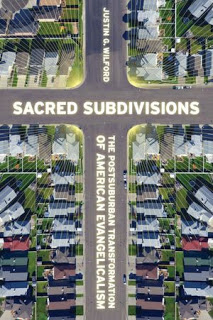
  • Justin G. Wilford’s Sacred Subdivisions: The Postsuburban Transformation of American Evangelicalism is a contribution to cultural geography, specifically a style of the new cultural geography practiced by the late renowned cultural geographer at the University of California, Los Angeles, Denis Cosgrove. This subfield of human geography examines how the interaction of people with material artifacts in the spaces they inhabit shapes both their perception of place and their active construction of physical landmarks. The new cultural geography observes that these processes are political and contested and that the word ‘culture’ is itself often under contestation. Wilford’s book examines how Saddleback Church in Orange County, California, takes the spatial fragmentation of postsuburbia (a hyper-fragmented metropolis) and recasts it as what Pastor Rick Warren calls ‘purpose-driven.’

The angle that I take in my book review focuses on how successful these books are in capturing the range of evangelical theologies being grounded in America. Accordingly, I have questions for each author about how the version(s) of evangelicalism that they explore all have counter-examples that embrace different takes on theology and place. I recognize and commend the books as good introductions to a multi-faceted theological phenomenon that has long gone neglected in human geography, but I am insistent that these are just ‘starting points’ for further research that needs to capture the range of evangelicalisms being grounded in the United States.

I also note that this is the first of three unique and original book reviews that I have written on Wilford’s Sacred Subdivisions. I have worked carefully with the editors of the AAG Review of Books, as well as forthcoming reviews in Religious Studies Review and the Social and Cultural Geography review forum on Wilford’s book to guard against self-plagiarism. The result is that I have written three reviews that open up and critique three different aspects of Sacred Subdivisions. That it is possible to write three unique book reviews of Wilford’s account of Saddleback Church speaks volumes about what a multi-dimensional text it is, and though I provide critical comments on the book in each of the reviews, Wilford is to be commended for writing such a rich ethnography.

Finally, that this week’s news has been dominated in part by the interaction among Rick Warren, Asian American evangelicals, and evangelicals in Hong Kong is a matter of sheer fortuitous timing. This review, as well as the one forthcoming in Religious Studies Review, was authored in May, and the contribution to Social and Cultural Geography was submitted two weeks ago. The events of this week simply reinforce my argument in this review essay regarding the urgency for geographers to study the American evangelicalisms that have been introduced, but not fully unpacked, by these books.

UPDATE: the SCG review forum piece was substantially revised and submitted in November 2013 to better reflect the events surrounding the Asian American evangelical open letter. It should be published in 2014.

Religion News Service: Rick Warren gets backlash from Asian American Christians for posting photo

Yesterday, Sarah Pulliam Bailey posted an article on Religion News Service detailing a controversy that has been generated by Pastor Rick Warren, the founder and senior pastor at a Southern Californian megachurch called Saddleback Church.  The article quotes me, as well as Professor Sam Tsang (Hong Kong Baptist Theological Seminary), Intervarsity Christian Fellowship staff worker and blogger Kathy Khang, Seattle church planter Pastor Eugene Cho, and Asian American evangelical blogger and compiler Grace Hsiao Hanford (click on all of the links to find them all).  What I want to do here is to provide some context for these remarks so that what is geographical about the events of this week can be more fully understood.

Here is what happened. On the morning of 23 September, Warren posted a picture of a Chinese Red Guard captioned with, ‘The typical attitude of Saddleback Staff as they start work each day.’ Drawing initial criticism on the comments section of the photo itself, Warren responded by saying, ‘People often miss irony on the Internet. It’s a joke people! If you take this seriously, you really shouldn’t be following me! Did you know that, using Hebrew ironic humor, Jesus inserted several laugh lines- jokes – in the Sermon on the Mount? The self-righteous missed them all while the disciples were undoubtably giggling!’ This drew the response of several blog posts (see here, here, and here) that outlined for Warren the extent of his offence. Warren then responded on one post that was especially shared–Professor Tsang’s–where he said, ‘Thanks so much for teaching us! It was removed instantly. May God bless you richly. Anytime you have guidance, you (or anyone else) can email me directly.’ While Tsang accepted this response as an apology, Warren’s lack of public apology and explanation to his supporters drew more criticism. This story was then picked up by Religion News Service’s Sarah Pulliam Bailey.  In addition to doing due diligence through interviews and the reading of relevant posts (our interview was also very pleasant, as we had already been in contact to talk about my academic research), she also contacted Warren’s publicist. After the story broke on Religion News Service, Warren issued a public apology on his wall. (If you need this story in bullet point form, Kathy Khang outlines it here.)

Here is what I said. In my interview with Bailey, I said that, as Bailey elegantly phrases it, the ‘controversy over the photo raises questions about how public or private the evangelical conversation on ethnicity should be.’ Indeed, this scenario has raised two key issues for me. The first is that the place of Asian American evangelicals in American evangelicalism has already become a central conversation and item of debate in American religion. While Asian Americans were once target populations for missionaries to evangelize, events since the mid-2000s have shown that Asian Americans are not ‘the other’ to American evangelicalism, or to American religion more generally. Instead, they are part and parcel of it, and they are making their voices heard. Within American evangelicalism, their voices were especially pronounced in protesting Lifeway’s ‘Rickshaw Rally’ Vacation Bible School curriculum in 2004 (minor clarification on Bailey’s article: promotional materials were pulled, while the curriculum was in fact circulated), youth specialties’s ‘Mee Maw’ skit in Skits That Teach in 2007, and Zondervan’s Deadly Viper: a Kung Fu Survival Guide for Life and Leadership in 2009. These protests are indicative of larger developments within American evangelicalism itself. Within academic circles, it has been commonly noted by scholars like Rudy Busto, Karen Chai Kim, and Rebecca Kim that university campus ministries are increasingly dominated by Asian Americans. Academics such as Antony Alumkal, Russell Jeung, and Sharon Kim have also studied the emergence of second-generation Asian American congregations, which themselves have been the subject of reflections by people like journalist Doreen Carvajal, evangelical writer Helen Lee, and theologians Jonathan Tran and Amos Yong. Indeed, this sea-change in American evangelicalism has prompted pastoral theologian Soong-Chan Rah to term this the ‘next evangelicalism,’ a challenge to what he terms the ‘white captivity of the evangelical church’ in America that finds difficulty with the changing geographies of American religion.

I said that what happened this week is a key episode in this unfolding conversation. In other words, the events of this week are not ‘conversation-starters.’ They are an invitation to a conversation that is already vibrant and that is objectively happening regardless of whether its existence is acknowledged.

However, the debate in this conversation revolves around how public or private it should be. This gets to the meat of what I said to Bailey:

The offensive image was public, and Warren’s initial response to it (that Asian Americans should have more humor) was also public, so the Asian American response to Warren was appropriately public. However, the apology is only semi-public because Warren has not addressed the 4,021 followers who liked the post and explained to them why he took it down.

Over the last week, there has been contention over whether this ‘backlash’ is an Asian American way of attacking Warren’s ministry and whether the blogposts that went up were indicative of Christian practice; indeed, some thought that Warren should have been approached privately and that this affair should not have boiled over into the public sphere. While I have argued in the past that all geographical debates are theological (see my piece on ‘grounded theologies‘), the question here is really a geographical one at heart. As I said in my interview, that these events began on an online public makes it uniquely appropriate that the response also happened on an online public. However, Warren’s supporters suggest that what would be Christian would be to approach this affair privately. This was my other comment, that ‘those supporting Warren [could be] part of a larger narrative that Asian Americans should assimilate into a broader white mainstream,’ that is, that instead of seeking to re-orient the racial contours of American religion through public conversation, private strategies should be pursued to preserve a status quo into which Asian Americans should integrate. While this is theologically intriguing and requires more theological reflection by competent scholars who study the Christian tradition, the larger debate that this gets at is whether Rick Warren and Saddleback should be considered as private individual institutions whose private governance insulates them from public opinion or public figures involved in a vibrant public conversation on American religion that is already happening. These are competing visions for how to make conversation in evangelical circles, and these geographies should be more thoroughly interrogated and discussed.

Yet what this means is that there must be absolute clarity that Rick Warren is neither under attack by Asian American evangelicals nor being defended by his ardent supporters. What is really going on is a conversation about two questions, the first of which concerns the place of Asian Americans in American evangelicalism, and the second of which interrogates the extent to which this conversation should be public or private. On all sides, there is the attempt to invite Rick Warren into these conversations, albeit on different geographical terms, with some pushing for a public conversation while others seek to keep it in the private sphere. Sarah Pulliam Bailey’s article sheds very clear light on those geographies, and for that, her work in engaging this issue should be appreciated while she deserves the gratitude of everyone working in and on American religion.

Update: this story has been picked up by Christianity Today and given due diligence by Her.meneutics editor, Kate Shellnutt.
Update #2: this story has been picked up by The Huffington Post. The title is overly melodramatic, though, and does not capture the spirit of conversation that any of the parties involved intend.
Update #3: a version of this story has been picked up by Hong Kong’s ecumenical-evangelical newspaper, The Christian Times.  While I am not quoted, that the other three who are cited were originally part of the RNS piece suggests that there is some cross-fertilization. (I understand that Khang was unfortunately not cited by name in the original piece, but the first link in Bailey’s article takes the reader to Khang’s blog, More Than Serving Tea.) What follows is an analysis of that piece that I originally posted on Facebook. Reflecting the genre of social media, the writing at points is a bit more informal and has been slightly edited for the purposes of this post:

Well, our story is now in Hong Kong’s (in)famous evangelical-ecumenical newspaper, The Christian Times. That’s pretty cool. Sam Tsang, Kathy Khang, and Eugene Cho all get a mention.

Let me tell you two things that are cool about it and one that I am worried about.

First, this is Sam in a context that knows him for his sharp critiques of dubious church practices. If you thought Sam was on fire this time, you haven’t seen Sam in Hong Kong. That guy spearheaded the exposure of a major fraud in Hong Kong evangelicalism, and those with Chinese reading skills can read it here, and those with Google Translate can get the gist without reading into every mistranslated word: http://arkwhy.org/. In short, this post doesn’t see Sam as an emerging figure. It sees Sam as doing what he’s been doing all along. And this one was mild.

Second, it includes Kathy Khang by name and homes in on her most important point: that this is not just about Chinese people affected by the Cultural Revolution, but that what’s at stake is the place of Asian Americans in American evangelicalism. It is also sensitive to Kathy’s central contention as a co-author of the book More Than Serving Tea that Asian American evangelical women have agency and dignity and that they are not invisible figures. It also rightly subordinates Eugene Cho’s reflective contribution about the need for humility to identify blind spots.

But now let me tell you my worry. It has to do with me not being quoted, but it’s not about me. I’d rather they’d have stolen my analysis without mentioning my name than leaving it out altogether.

I don’t mind at all that this piece does not mention me, but I do mind that the Hong Kong situation, especially the planting of Saddleback HK, makes it seem like this whole thing is another episode in which the radical pro-democracy people in Hong Kong are challenging those in collusion with the established regime. Indeed, as a researcher with commitments in Hong Kong, I am slightly worried that this piece reads this Rick Warren incident through the lenses of intra-Christian politics in Hong Kong (and my, it is tempting because of Sam’s involvement). For what it’s worth, keep in mind that this is not Kung Lap Yan and Narrow Road Church against the rationalists. Daniel KT Cheung has certainly been following the story on the wall, but this is not a one-to-one comparison of his critiques of Truth-Light Society and Co. Kathy Khang is an evangelical feminist who brings a justice and solidarity element, but she is not Rose Wu Lo Sai. This is not about contesting Saddleback HK; it’s about involving Warren and Saddleback in a conversation so that their work at Saddleback, including Saddleback HK, might be more evangelically fruitful.

And that gets back to what I said in the Religion News Service piece and in my own post above. The real question here revolves around the place of Asian Americans in American evangelicalism, and the central concern is whether this conversation is going to happen in the public sphere or in a private domain. That is what this debate is about; it is not another episode in the democratic contestation of Hong Kong’s evangelical geographies. There are certainly linkages because of Sam’s work and my research, but the involvement of Kathy Khang and Eugene Cho precludes that interpretation. That’s all to say that I don’t mind not being quoted. But I wish that they would have at least stolen my sentiments, if only to frame this piece outside of a hegemonic intra-Hong Kong Christian conversation.

Update #4: my evangelical contacts in Hong Kong have kindly reminded me that while a ‘hegemonic intra-Hong Kong Christian conversation’ should not colonize the Asian American one, there is a conversation happening among evangelicals in Hong Kong that is producing a geography worth probing. The following open letter written by T.r. Mak is an important node in this conversation.

Update #5: the blogger David Hayward, who goes by the pseudonym, the Naked Pastor, has covered this incident on his blog on the Patheos Progressive Christian Portal. While this coverage has been appreciated by those seeking a public conversation with Warren, Hayward’s framing of Tsang as a ‘Chinese pastor’ (he is a noted New Testament theologian in both Anglophone and Sinophone academic circles) and Khang originally as a ‘Korean Christian blogger’ (this has now been amended to ‘an American of Korean descent’), as well as the lack of coverage of this incident on Patheos more generally, has generated a discussion among some Asian American theologians and pastors over the place of Asian American theologies on Patheos, especially because it is frequently omitted.

Update #6: this incident has been covered again on Patheos, this time by Unreasonable Faith on the Atheist Channel.

Update #7: Xinhua New China News Agency in Beijing has picked up on the story from the Huffington Post. Emphasizing that Warren was the pastor who gave the invocation for American President Barack Obama’s inauguration in 2009, the piece goes on to narrate the back-and-forth interaction between Professor Sam Tsang and Rick Warren. It concludes by quoting ‘a Chinese’ (一名華人), who says, ‘照片是公開的,華理克最初的回應也是公開的(指讓華人增加點幽默感),華人對華理克的評論也是公開的,但華理克的道歉卻是半公開的,他並沒有向那4021名點讚的教友解釋清楚,’ which reads in English, ‘The photo was public, and Warren’s initial response to it (that the Chinese should have more humor) was also public, so the Chinese response to Warren was appropriately public, but the apology is only semi-public because Warren has not addressed the 4,021 followers who liked the post and explained to them why he took it down.’ Doctoring my original words to substitute ‘Chinese’ (華人) for ‘Asian American’ and thus achieving a unique ideological twist, this means that my contribution to the original Religion News Service article has been edited and translated for the purposes of this article.

CFP: AAR 2013: ANARCS

Call for Papers | AAR 2013: Asian North American Religions, Cultures, and Society Group

The Group invites and welcomes individual papers, panel proposals, and nontraditional ways of sharing scholarly work that address:

  • Issues of empire, militarization, after-war trauma and memory;
  • Creative resistance practices;
  • Asian American Catholic life and Baltimore as the bastion of American Catholic life;
  • Asian American religious life in the greater Baltimore-DC metropolitan area;
  • Multiracial/Interracial bodies and theologies;
  • Exploring categories of “North” or “Asian” in Asian North American religion, culture, and society;
  • Intersections with Native American and indigenous critiques of settler colonialism; and
  • Any other critical aspect of Asian North American religion/s, culture, and society.

In addition to paper and panel submissions, we encourage the submission of nontraditional ways of sharing scholarly work and welcome a variety of formats to promote interactive sessions. Submissions are made directly to AAR.