International Conference on Paulo Freire 2016: Mechanizing Conscientization in Hong Kong’s Occupy Central with Love and Peace: failures of pedagogy, theology, and solidarity in contemporary social movements

I’m at a conference at the University of British Columbia (UBC) at Vancouver organized by my friend and colleague Sam Rocha (UBC). Titled the ‘International Conference on Paulo Freire,’ it has a stellar lineup of philosophers of education and other people who think about pedagogy. I usually treat these as my super-enhanced teaching workshops as I sit and learn from people who think about teaching all day in a way that is philosophically smart. The keynotes are phenomenal – Eduardo Mendieta (Penn State), Deborah Britzman (York), and Eduardo Duarte (Hofstra) – with an undercurrent of theologies of liberation carrying through all the talks and paper sessions.

freire-1

I’m happy to also be presenting this afternoon. My paper is titled: ‘Mechanizing Conscientization in Hong Kong’s Occupy Central with Love and Peace: failures of pedagogy, theology, and solidarity in contemporary social movements.’ Here’s the abstract:

Critics of Anglophone critical pedagogy have suggested that North American readings of the word conscientizaçao in Freire’s Pedagogy of the Oppressed tend to reduce the building of a liberating consciousness to a liberal ‘mechanization of Freire’s revolutionary pedagogical proposals’ (Macedo 2000: 24). These critiques also apply to activists attempting to use technical educative approaches for conscientization, mistakenly framing the use of religious overtones in such mechanized pedagogies as liberation theology while foregoing a ‘communion with the people’ that ‘is really human, empathetic, loving, communicative, and humble, in order to be liberating’ (Freire 2000: 171). However, these liberal misreadings of Freire may also be fostering the contemporary phenomenon of ‘occupy’ movements, said to be primal eruptions of a collective consciousness while also failing to actually overturn oppression before their dissipation. My case study is Hong Kong’s Occupy Central with Love and Peace (OCLP), an initiative noted for its Christian leadership that attempted to ‘conscientize’ (as its founder Benny Tai put it) the Hong Kong public through a mechanistic model of civic dialogue and ultimately failed to deliver on its promises of civil disobedience. Instead of stifling activism, the disappointment of OCLP arguably generated the protest occupations in 2014 known as the ‘Umbrella Movement,’ said to be a primal (and theological) explosion of the Hong Kong populace’s discontent with oligarchic oppression, but which ultimately met its demise due to internal dissension. I argue that OCLP’s misappropriation of conscientization as a liberal mechanistic pedagogy generated an ‘occupy’ movement that externalized the primal unconscious of the oppressed without a cognate sense of solidarity derived from the communion for which Freire actually calls. Contemporary ‘occupy’ movements may thus manifest incomplete processes of conscientization due to mechanistic readings of Freire leading to activist expressions that may even be religious, but are not truly theological in the humanizing tradition of liberation theology. Closely re-receiving Freire’s call to communion may in turn yield pedagogies of the oppressed with more primal depths, perhaps generating the ontological revolutions that can truly negate the oppressions ineffectively protested by contemporary social movements.

I’m looking forward to learning a lot this weekend. I’m also going to attend many of the Spanish- and Portuguese-language sessions, even though I am in no way competent in any of those languages, in order to broaden my horizons. Many thanks, Sam, for letting me play along!
Seattle Pacific University: Guest Lectures, Asian American Ministry Program Church Leaders Class with Soong-Chan Rah

I’m very happy to announce that I’ll be giving some guest lectures in Soong-Chan Rah’s ‘Church Leaders Class‘ at Seattle Pacific University’s new Asian American Ministry Program (AAMP). The course is being held on two weekends in February and March 2016: Rah kicked off the course during the February 5-6 session (which I did not attend, but I heard went extremely well), and I will be joining the March 4-5 session. I’m especially thankful to the AAMP’s director Billy Vo for making this happen.

Church20Leaders20Class1

This is a very interesting endeavour because Rah and I probably come at the question of Asian American ministry from very different disciplinary and philosophical perspectives. Rah lays out his framework very clearly in his books like The Next EvangelicalismMany Colors, and his commentary on Lamentations Prophetic Lament. From what I understand of this work, he uses a sociological understanding of culture – think Peter Berger and Thomas Luckmann on ‘plausibility structures’ and ‘externalization’ – and understands his work on Asian American theology as coming out from an immigrant church experience, especially a Korean American one. My understanding is that the first session was devoted to explicating this framework under the banner of a ‘theology of culture’ and ‘contextual theology,’ showing that all theology is done within a sociological, cultural context.

I’m coming in as a dialogue partner who is trained as a human geographer as well as in Asian American studies. My plan – which may get happily derailed by class discussion (which I understand to be very lively) – is to give two lectures. The first will be on what geography has to do with Asian American studies (answer: everything), and the second will try to locate the doing of evangelical theology in relation to (and perhaps even within – which will be an interestingly awkward fit) Asian American studies. I suppose this isn’t an altogether new endeavour; one sociologist who has achieved this remarkable synthesis throughout his career is Russell Jeung (San Francisco State).

Rah tells me that the class is mostly composed of theology students seeking to do some kind of Christian ministry, as well as by pastors who are actually practicing ministry. Because this is a class on race and pastoral ministry, part of my motivation for helping to teach this course is to get a sense of how to navigate my new postdoctoral research on Asian Americans and Black Lives Matter with a focus especially on Seattle. I’m looking forward to meeting the course – and of course, keeping Soong-Chan up until the wee hours of the night in discussion.

CLASS: Geography 420, Cultural Geography (Simon Fraser University)

From January to April 2016, I’m teaching a course at Simon Fraser University (SFU) called Geography 420: Cultural Geography. It’s a four-hour class that happens on Thursdays from 2:30 PM – 6:30 PM at SFU’s downtown campus at Harbour Centre. I have 21 exceptionally smart students who regularly challenge me, which is brilliant as a form of intellectual engagement as they give me many ideas for my own research and thinking about the discipline of cultural geography more generally.

You are free to view the syllabus. Here’s the course description:

In this course, we will attempt to practice cultural geography in a Vancouver setting. To do that, we will first have to figure out what we mean by ‘practice’ and who or what gets to ‘practice’ the making of spaces and places. Though we might end up having a productive disagreement as a class (unless we reach some consensus, which, given the state of human geography as a discipline, is not likely), I will propose in the second half of the class that we channel our possible tension into projects in cultural geography in Vancouver. Students will have an opportunity to choose case studies from Vancouver, including (but not limited to) geographies of affordable housing, the international property market, ethnic and migrant communities, intercultural initiatives, mediated publics, spaces of consumption, gendered spaces, simulacra, etc., and the final assignment will be a project to be submitted in some material form, either as a paper or in a creative medium discussed with the instructor.

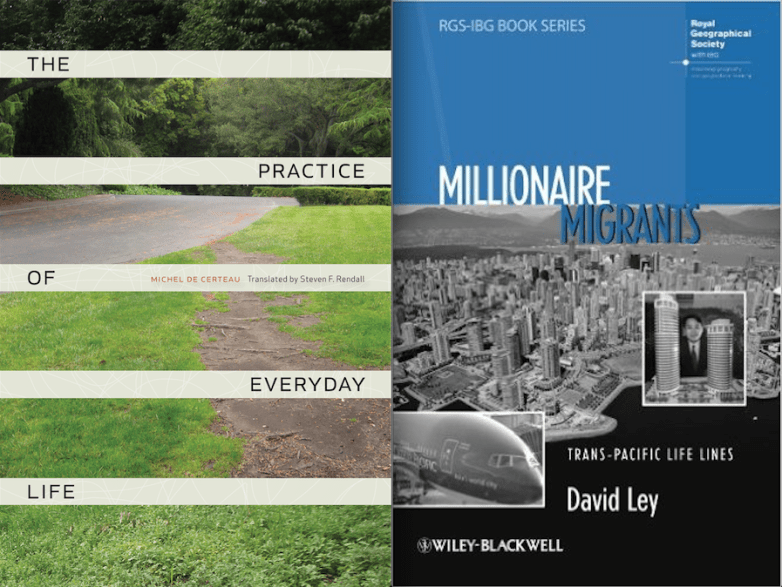
Our key texts are Michel de Certeau’s The Practice of Everyday Life and David Ley’s Millionaire Migrants: Trans-Pacific Life Lines,  among other short articles I’ve selected to supplement these readings.

certeau_ley

The way that I’ve imagined the class is as an exercise in actually having students get experience in the practice of cultural geography. Instead of having traditional exams, the course is (like the course on ‘Trans-Pacific Christianities‘ I taught at the University of Washington) oriented toward a final project. The ground rules for the project are that it has to be in Vancouver and the methodology must be ethical. I’ve broken down the project in several stages: a proposal due early in the course, a literature review, a class conference from which students get feedback, and a final material form (usually a paper, but there is some variety, such as GIS mapping, a choose-your-own adventure book, video documentaries, and photo essays). The weekly reading reflections are also geared toward reflecting on the project, which allows me to give students constant feedback about the direction they are taking on this project.

With such a structure, I’m finding that most of my teaching tends to wax on the theoretical side, instructing students in the theories that have been used in the discipline so that they can make use of them in their practice of cultural geography. This is a novel form of teaching for me, and I am having fun with this experimentation and learning a lot. The students seem to be very invested in making their projects theoretically and practically sound, and this makes me a very happy instructor. In this sense, I feel that I am developing as a teacher and crystallizing a philosophy of education for my own purposes as an educator in geography, religious studies, and Asian and Asian American studies, hopefully empowering students to discover their own agency as they engage the world around them as active practitioners of thought and mapping.

NOTE: At present, I am teaching as a Sessional Lecturer at Simon Fraser University, while also simultaneously retaining my affiliation as an Affiliate Faculty Member at the University of Washington in Seattle.

CLASS: JSIS C 490C: Special Topics in Comparative Religion: Trans-Pacific Christianities

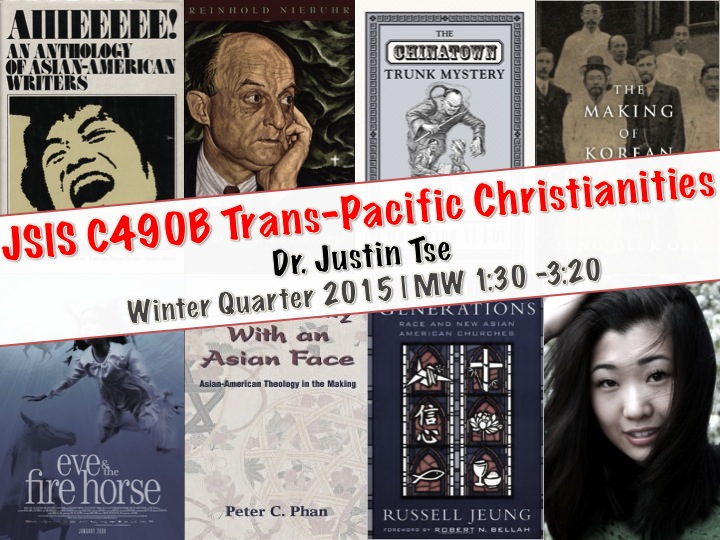
I am teaching a course next Winter Quarter 2015 at the Henry M. Jackson School of International Studies at the University of Washington in Seattle. It’s a fourth-year special topics class in comparative religion, and it will focus on what I call ‘trans-Pacific Christianities.’

TSE JSIS C490B POSTER

Here’s the syllabus. We will have quite the variety of literary, historical, sociological, and even theological readings. We will read both the Open Letter to the Evangelical Church and Killjoy Prophets’ critique of it à la Suey Park and Andy Smith. We will read both Reinhold Niebuhr’s Irony of American History and the irreverent/bombastic/Asian American nationalist anthology Aiiieeeee! We will watch both Wong Fu Productions’ Just a Nice Guy and Julia Kwan’s Eve and the Firehorse. We will read both the histories of sex in Chinatown and spirits in Korea. We will plough through both Catholic and Protestant sociologies of Asian American Christianities and explore the callings of Asian and Asian American liberation theologies. We will read the Proposition 8 trial transcript featuring Dr. Hak-Shing William Tam, and we will examine both ‘silent exodus‘ and Sa-I-Gu. Our assignments are blog comments and a paper on a topic of your choice. We will criticize all of these people and ideas to no end, and we will let ourselves be criticized by them to no end.

If you are at the UW and want to come have some fun making trouble with us, please consider taking this course. If you have friends at the UW who want to make some trouble, please consider telling them to take this course. The trouble we will make will magnify as we come closer to both discovering and deconstructing what this term ‘trans-Pacific Christianities’ means.

This is going to be fun. I’m excited. I am also heavily indebted to the philosophers of education (especially Sam Rocha) that I met in Chicago last week at the Society for the Philosophical Study of Education for the crafting of this syllabus and for helping me think through how to teach – I’m experimenting with this society being my annual teaching workshop, and I’m anticipating good things coming out from these critical pedagogical conversations.

UPDATE: A previous version of this course was listed as JSIS C 490B. The administration, however, saw fit at the last moment to change it to JSIS C 490C. The poster describes the previous course number, but the content in the transfer from ‘B’ to ‘C’ stayed very much the same.

The Model Minority and the Gospel of Schoolvation | Society for the Philosophical Study of Education | Columbia College, Chicago, IL, November 8-9

I’m thrilled to be presenting at the upcoming Society for the Philosophical Study of Education at Columbia College in Chicago, IL, from November 8-9. This is a bit of a new foray for me. I am a geographer who is currently housed in religious studies, and I never thought that my work would also be considered ‘philosophy of education.’ However, my colleagues in educational studies have convinced me that my work on Asian American, Asian Canadian, and Asia-Pacific Christians and their public activism around schools means that I have something to say.

Ellen Wu’s The Color of Success is a very important takeoff point for my paper. It’s a book I’ve also reviewed.

My paper critiques the internalization of the model minority mythology among conservative Asian Americans because they have deployed it in their politics as a generator of grounded theologies. It’s titled ‘The Model Minority and the Gospel of Schoolvation.‘ Here’s the abstract:

This paper explores the circulation of philosophies of education among upwardly mobile Asian Americans. Despite the stated axes of political difference among liberal and conservative Asian Americans on sexual politics, tax revenue, and the role of government in welfare provision, one point of philosophical convergence among Asian Americans is that public education plays what Sam Rocha (forthcoming) calls a ‘salvific’ role in delivering young people from downward class mobility. Preaching the ‘gospel of schoolvation,’ Asian Americans such as Michelle Rhee (a Democrat) and Hak-Shing William Tam (a Republican and one of the five official proponents of California’s Proposition 8) use positivistic empirical criteria to declare that schools must do more to save their students from racial marginalization. Indeed, this paper’s central argument is that this version of the gospel of schoolvation grounds a racially constituted philosophy of education to construe Asian Americans as a model minority, a racialized group that models how empirically rigorous education can lead a racialized community out of marginalization from a white mainstream. Showing that this philosophy has in turn been exported to Asia-Pacific nation-states to fuel their participation in a global economy, I probe how race is wrapped up with soteriological accounts of schools, challenging philosophers of education to explore how educational theories construct grounded political realities.

All are welcome. Here’s the schedule. I look forward to the interaction at this conference, especially because other scholars of religion and the social sciences (especially Silas Morgan) will also be there masquerading as philosophers of education.

UPDATE: At this conference, I was made secretary for the group for one year, which means that at least persons at this conference might consider me to some extent an ex officio ‘philosopher of education.’ However, I prefer to say that the SPSE is the society that is my ‘teaching workshop,’ a group that I try to attend where people help me think through how I teach. Certainly, this has helped with the preparation of teaching statements, but more importantly, it has helped me become more intentional as a teacher, and for that I am grateful.

JSIS C254: American Religion

In less than two hours, I will give the introductory lecture in my first course ever. This is a course on American religion, and it is listed as Jackson School of International Studies (JSIS) C254 in the comparative religion unit.

jsis_c_254_tse

This course is about how religion in America may well constitute American civil society more than we might think.  The key course question that the students and I will explore together is: what is the role of American religion in the construction of American civil society? While there has been a lot of interesting work on lived religions in America and how Americans may have reshaped religion via the constructs of a voluntary society, this course will look at how religion in America affects American public life.

There are four main units in this course. In the first unit, we will explore the making of an Anglo-Saxon Protestant consensus in American religion, and we will do that by reading David Hackett Fischer’s massive tome, Albion’s Seed: Four British Folkways in America. We will then do a second unit in which we look at how this consensus may have broadened out to non-Protestant religions, developed liberal and neo-orthodox strands, and formed some form of American religious pluralism, and to do that, we will read Will Herberg’s class text, Protestant-Catholic-Jew. After that, we’ll problematize the Protestant consensus by looking at race and religion in America. Our key text in this third unit will be James Baldwin’s civil rights book, The Fire Next Time, and we will supplement this unit with articles in Asian American, Chicana/o, and indigenous religions authored by Jane Iwamura, Andrea Smith, Tom Tweed, and David Yoo. Finally, our fourth unit will be on American fundamentalism as we explore the reassertions of the Protestant consensus, and we will read George Marsden’s Fundamentalism and American Culture.

To teach a course on American religion is to initiate students into a widely debated field of research. I understand, for example, that the emphasis of my course seems to be on the Protestant consensus in America may lead some to dispute whether I am privileging certain geographies or religions in America, and I am fully cognizant of revisionist histories that provincialize New England (e.g. Jon Butler’s Awash in a Sea of Faith), that seek to frame American religion via the geography of the Americas (e.g. Manuel Vásquez), and that seek to unsettle settler colonialism by emphasizing indigenous religions and relations. My reply would be that to do revisionist history implies still that there is a historical narrative to be revised, and I would argue that my course seeks to do that by positioning the traditional narratives of American religion via the Protestant consensus alongside the revisionist work on race. Scholars of American religion will recognize, then, that the first two units on the broadening of the Protestant consensus can be traced to Sydney Ahlstrom’s seminal Religious History of the American People. However, with the material on race, this Protestant consensus is actively being challenged and revised by groups with different senses of American geography, whether through a trans-Pacific framing (Asian American religions) or an Americas framework (a Chicana/o and indigenous religions). The idea is to look at how the conventional narratives can be juxtaposed with the alternate geographies.

As such, this course is a course on how religion can be seen as grounded in American civil society. It is not a history course, and it is not a course where we will tick off each of the religions in America. Instead, it asks the broader question of how American civil society is shaped by American religion, and my hope is that students will emerge from the course with the ability to articulate their perspective on that question critically.

Posting with Jim Wellman on Niebuhr and Obama

My friend and supervisor for next year’s post-doctoral fellowship, Jim Wellman, and I collaborated on a post for his Patheos blog on American religion. It’s titled ‘Drones, Mr. Niebuhr, and President Obama.

As we watched Barack Obama justify drone warfare as a just war policy yesterday, we were struck by how many allusions there were to the work of mainline Protestant theologian, Reinhold Niebuhr. Wellman is arguably one of the current top authorities on Niebuhr, and generously, he took on some of my comments in his blog, including some work on Christian pacifism that responds to Niebuhr. If you have not seen Obama’s speech, do watch it here:

I see these comments as continuous with my work in geographies of religion, a field that I have theorized as not only as a subfield within cultural geographies (as it is more popularly conceived), but as an analytical axis by which political, economic, and cultural geographies can be interpreted. As I argued in my piece on ‘grounded theologies,’ geographers who use religion and secularization must reveal modern geographies to be theologically constituted, as the ‘secular’ can also be read (as per the Immanent Frame) as a theological orientation. Obama’s speech on security, counterterrorism, and geopolitics is a prime example. While it is ostensibly non-religious and non-theological, that he uses Niebuhr’s ‘proximate justice’ theory to argue that drone warfare is a form of just war policy suggests that he is in fact doing theology through public policy. Wellman and I argue that whatever you think of Obama, you really have to contend with Obama’s theological framework if you want to seriously engage him in democratic conversation and debate.

The implication here is that religious and theological literacy is a primary task for any ‘secular’ discipline. While there are hard secularists who may scoff at this notion, that even those parties lay claim to something called ‘secular’ is to say something about ‘religion’ or ‘theology’; if those statements are said ignorantly, it does a disfavour to everyone in the public forum. This is why I feel so happy that I’ll be working with Wellman. Recently, he had me sit in a seminar class that he’s teaching on American megachurches, where we conversed with non-geography students with arguably one of the most important books to come out in geographies of religion, Justin Wilford’s Sacred Subdivisions. As we covered a lot of ground exploring how Wilford conceptualizes Saddleback Church’s usage of space as a cultural geographer, I couldn’t help but be cheered that a discipline like human geography–one that has been conceptualized as uncritically secular until very recently–was contributing to public religious literacy in the form of these students grappling with this geography text. I think this signals good times ahead for geographies of religion, if I might be so presumptuous.

Working with Wellman will allow me to sharpen some of my own theological and religious reading, especially in American mainline Protestant theology, which will supplement what I currently know about geographies of evangelicalism and the critical crypto-Catholic conversation on secularization in theology and religious studies. This in turn will help refine what I have to say about Asian American, Asian Canadian, and Asia-Pacific religions. All of this is not a deviation from my work in geographies of religion and grounded theologies. It’s an extension and refinement, as all of this stuff is very spatially oriented and thus very geographical.

Thank you, Jim, for the opportunity. I look forward to the fun times ahead.

Migrant Faith (Jeremia Chow and Sarah Crutchfield): helping out with a History 485 Final Project

I had the privilege of being a key informant and informal adviser to an exciting undergraduate class project for UBC’s History 485 course. Taught by Asian American historian Henry Yu (Thinking Orientals, 2001), the course focuses on Asian migrant communities in Vancouver, understanding them in the context of what Yu calls “Pacific Canada.”

Two students, Jeremia Chow and Sarah Crutchfield, approached me with an idea for their final project in that course, one that has successfully come to fruition through this website. They wanted to focus on Chinese churches, and fortuitously, they found my blog and contacted me (unaware, it seems, that Henry Yu is one of my committee members and ardent supporter of my various projects). Their research question focused on how Chinese churches integrated new immigrants, a concern that has run throughout my M.A. project on a transnational Hongkonger congregation in a Vancouver suburb, the collaborative Highway to Heaven project on new suburban religious landscapes and immigrant integration, and the PhD dissertation on how Cantonese Protestant theologies are grounded in Pacific Rim civil societies.

My modest contribution to this project was an interview I granted them on March 26. We met in Vancouver for coffee and Thai food. Their questions revolved around how to approach congregations with the question of immigrant integration. I gave a two-pronged answer.

Theoretically, I told them that they might need to disentangle the assumptions that congregations are de facto parts of civil society, that they provide institutionalized social services, and that their theologies support civil society engagement on the part of the church. Instead, I advised them to look from the ground up, inquiring about grounded theologies and being open to the reality that social services provided by churches might be informal. (This was a similar point I raised in my BBC Heart and Soul interview.)

Methodologically, I emphasized that positionality is important when conducting interviews. Because of the way that interviewees read interviewers for race, class, gender, sexuality, and religion, Jeri and Sarah had to be aware of their own positionalities and understand that their self-awareness could be important for the dynamics of data collection. Because they needed to disentangle their own assumptions about how churches contributed to immigrant integration, I suggested that if Sarah conducted the interviews, then interviewees would find themselves explaining more to her without presuming prior knowledge. In turn, this would enable their data collection to be more thorough so that they could see exactly where their assumptions are dissonant with the data.

I’m happy to report that I am overall very pleased with the end result. Not only was the data collection thorough enough to challenge their own prior assumptions, but they have stumbled upon the next frontier of Chinese church research in Vancouver: Mandarin-speaking charismatic churches. Because of the dominance of Cantonese churches, Mandarin churches have been understudied. Their data provides an important window into Mandarin-speaking churches, enabling comparisons with existing work on Cantonese Protestant congregations and engagements with civil society.

This is my second foray into helping undergraduates design a research project. My prior experience took place in another course taught by Henry Yu comparing transnational migration in Vancouver and Singapore in the summer of 2011. I led a group documentary project on religion and migration, from which we produced a short film Moving Faith (we are working to disseminate this project!). These experiences have been formative for my own pedagogical convictions, as these public presentations are an excellent venue for demonstrating the value of undergraduate public education. I will certainly use field work as a required component of courses I teach in the future, and these two projects have given me valuable insight into how field work can be presented to a public outside of the classroom.

Thanks, Jeri and Sarah, for including me in this very insightful project.

Social Geographies of Religion: guest lectures

This week, I gave two lectures on the social geographies of religion for the University of British Columbia at Vancouver’s Geography 357.  The instructor is my friend, Elliot Siemiatycki, a labour geographer who has been doing a fantastic job teaching a course focused on what social geography is and what social geographers do social geography in the context of neoliberal urbanisms.  The course has covered theoretical themes (such as the move from positivism to the humanist/Marxist debates in social geography, feminist themes of embodiment and intersectionality, and the neoliberal restructuring of post-1980s cities) and empirical themes (such as segregation, homelessness, crime, architecture, work and leisure spaces, urban political ecology, and cyber-geographies).  He gave me an opportunity to deliver two lectures for the course on the social geographies of religion.

In these lectures, I simply reviewed the field, where we’ve been and where we’re going.  In the first lecture, I spoke on geographies of religion and intersectionality, how religious practitioners intersect their religious social spaces with other spaces like family, work, leisure, as well as spaces marked by gender and class.  In the second lecture, I introduced the current debate on post-secularization in social geographies and approached this through José Casanova’s (1994) work in Public Religions in the Modern World as he disaggregates the secularization thesis.  I am aware, of course, that discussions of secularization theory are wide-ranging, but to adequately cover the major theorists in theology and religious studies (e.g. Berger, Cox, Eliade, JZ Smith, WC Smith, Casanova, Asad, Taylor, Habermas, Milbank, Pickstock, Cavanaugh, Ward, Bruce, Davie, Lilla, Bellah, Butler, Brown, Mahmood, Hirschkind, Modood, Jakobsen, Connolly, Calhoun, Lilla, West, Herberg, Finke/Stark, R. Stephen Warner, Michael Warner, Fraser, etc.), I would need a whole course devoted to this (if not several), if not a graduate seminar (if not two).  I also presented some of my own original PhD research on Cantonese-speaking Protestants and the public sphere in the second class.

The material was very well-received by the instructor, the students, and my supervisor.  The sense that I got was that this material is very new and fresh to them, which speaks to the need for this material to actually be taught at the undergraduate level.  I was happy to hear that I was both clear and passionate–I would refrain from self-commenting on my own performance, but these seem to be the anecdotal consensus–and after delivering these lectures, I hope to be doing this long-term.  Indeed, my hope is one day to teach courses on geographies of religion and secularization where I can adequately cover the field in its emerging breadth, as well as to host graduate seminars where the material can be adequately debated by emerging scholars joining the effort.

Guest Lecture: Asia-Pacific Transnationalisms and Urban Geography

Tonight I am giving a guest lecture on Asia-Pacific transnational migrations and urban geography in a course on urban geography (Geography 350) at the University of British Columbia at Vancouver taught by my friend, Nicholas Lynch. I’ll be discussing transnational urbanisms, the feminization of migrant labour, Chinese transnationalisms and alternate Asian modernities, and the desire for global cities in the Asia-Pacific.  Of course, I have a plug on religion, migration, and the city toward the end as well.

I’m hoping to be able to do a few more guest lectures so as to have some talks prepared for when I get to teach a full-on course in topics such as urban geography, migration studies, and ethnic studies.