AAR 2013: Asian North American “Conservative” Christian Communities, Masculinities, and Gender Issues

I had the privilege of organizing a panel for the upcoming American Academy of Religion (AAR) meeting in Chicago, IL.  It is sponsored by the Asian North American Religion, Culture, and Society (ANARCS) Group and will feature a very diverse panel of scholars speaking about masculinities and gender issues in “conservative” Asian American and Asian Canadian communities.  Here is our abstract:

This panel session explores the “conservatism” of certain Asian North American religious communities, particularly evangelical and fundamentalist Christian ones, around gender issues. By gender “conservatism,” we refer to attempts to reinforce heteronormative, patriarchal practices both within Asian North American religious communities and without in civil society.

Our panelists will discuss 1) the usage of evangelicalism by Korean American men to restore a sense of empowerment, 2) the appropriation of Asian American tropes of mixed-martial arts and “linsanity” (following the recent stardom of Jeremy Lin) by conservative evangelicals at large to reconstitute masculinities, 3) the experience of a trans-male in a Korean American Christian community in New York, 4) the activism of conservative Asian Americans in opposing LGBTQI rights in America, and 5) the exploration of conservative Asian North American religious groups in a Canadian context who oppose sexual equality despite its federal legal status. A feminist ethicist will respond.

The panel will be chaired by Michael Sepidoza Campos (GTU) and will be responded to by Grace Yia-Hei Kao (Claremont School of Theology).  The panelists themselves come from very diverse backgrounds and espouse fairly different academic approaches; they are: Mark Chung Hearn (Azusa Pacific University), Steve B. Hu (UC Santa Barbara), Sung Won Park (Union Theological Seminary), Patrick S. Cheng (Episcopal Divinity School), and myself.  Our aim in assembling this very diverse set of voices is to encourage conversation on a topic that has been seldom discussed in Asian North American religious studies, not to mention academic discussion more generally.

I will be speaking on the intersection of Asian Canadian studies and the need to contextualize the traditional sexuality activism of Cantonese Protestants in Vancouver, British Columbia, within their engagements with Canadian civil society.  My take on the panel is that these issues require a fair, accurate, and scholarly interpretation from the academy and are not served well by caricatures, particularly as stereotyping often leads to the very forms of socially unjust orientalizing racism that are increasingly unacceptable in our civil society.

The panel will take place Sunday, 18 November 2012, from 9 AM to 11:30 AM and all those registered for the AAR meeting are warmly invited to join in what promises to be an exciting conversation.

——-

On Monday, 19 November 2012, I will also be presiding over another ANARCS panel entitled “Boundary Crossings: New Directions in Asian American Theologies.”  This panel will feature Barbara Yuki Schwartz (Garrett-Evangelical Theological Seminary), Simon Joseph Kierulf (Union Presbyterian Seminary), Yeon Yeon Hwang (Graduate Theological Union), and Ren Ito (University of Toronto), and the respondent will be Nami Kim (Spellman College).  The panel will be held from 1-3 PM, and it will be followed by the ANARCS Business Meeting.

Vancouver Sun: Census: Mandarin, Cantonese top immigrant tongues in Metro Vancouver (Kelly Sinoski)

Jun Xiao, who immigrated to Canada from Nanjing, China in 2011, speaks Mandarin at home with his wife Dan, 19-month-old child Michael, and mother-in-law Aiping at their suite in East Vancouver.
Photograph by: Mark van Manen , Vancouver Sun
(Source: Vancouver Sun: http://www.vancouversun.com/Census+Mandarin+Cantonese+immigrant+tongues+Metro+Vancouver/7442441/story.html)

I was quoted in today’s Vancouver Sun on census data that indicates a high concentration of Cantonese and Mandarin being spoken in the Metro Vancouver area. The online version was published yesterday. You’ll find the article in today’s paper on p. A4.

Kelly Sinoski’s article is part of a series she’s doing on emerging census data.  As Henry Yu (UBC History) her, many of the sites where these languages are spoken are in Chinese churches.  Sinoski followed-up with an interview with me on Tuesday morning and then printed this yesterday.  I told her about Chinese churches as extended family sites, as I had written about in my 2011 Population, Space, and Place article on “Making a Cantonese-Christian family.”  She included arguably the funniest quote that I received during my MA research for the article:

Justin Tse, a UBC grad student who is studying the phenomenon, said the church often provides newcomers with a sense of family and connectedness. One of his research subjects, for instance, told him that he often attends church, but usually falls asleep during the sermon and wakes up when it’s over.

“It’s a lot like going to your dad’s house,” he said. “There’s a strong sort of familial feeling.”

You’ll find the exact transcript quote on p. 761 of the academic article.  Thanks, Kelly, for the quote–it was fun chatting! And thanks, Henry, for making the connection!

HKReporter: 天外有天 第19集 [The Sky Beyond the Sky, Ep. 19]- 快必、David、偉業、大曹 / 嘉賓: Justin [Fastbeat, David, Wai Yip, “Big Cho” / Guest: Justin]

I should have posted this earlier. On 5 April, at the tail end of my field work period in Hong Kong, I was interviewed by a bunch of people I had interviewed for my PhD project. They had all finished theological training at Chung Chi Divinity School (崇基學院神學院) in Sha Tin, Hong Kong and were mostly associated with a progressive church movement known as Narrow Road Church (路小教會). I made most of my interviewees, including the theologically and socially conservative ones, aware that I had this interview in my schedule, and most were fine with it, which speaks to a good level of civil discourse among Christians who might disagree otherwise on various issues.

I went to their studio at HK Reporter in Wan Chai, where they interviewed me for about an hour on my PhD work. We talked about practicing cultural geography, social conservatism among Chinese Christians, and the idea that Chinese Christian activism might take place along multiple subjectivities.

The interview is in Cantonese.  You can hear it here. (Note: there are two parts.)

The comments are fun to consider too. The most frequent comment was that my accent is Singaporean and that the hosts had mistaken me for a joksing (“flying bamboo”) North American Chinese. They need to read my post with Schema.

I am open to engaging people from a variety of perspectives about these interviews that I’ve done, and I am happy to be corrected or given alternative perspectives as I develop my thoughts and write them up.

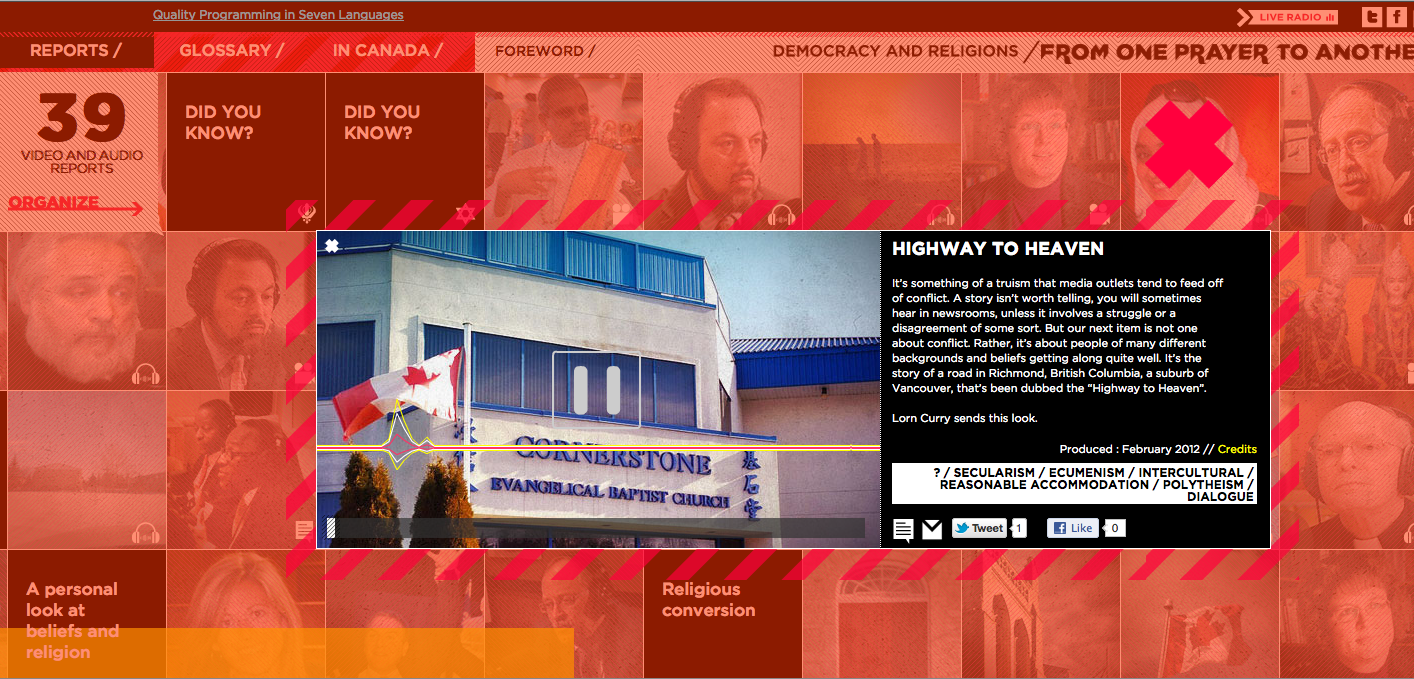
Radio Canada International: Highway to Heaven

ImageI was recently interviewed, along with multicultural activist Balwant Sanghera, by Lorn Curry at Radio Canada International. We spoke about No. 5 Road in Richmond, dubbed the “Highway to Heaven.”

You can hear the piece here. As you’ll hear, I implicitly sneaked in a few fun insights from scholars associated with The Immanent Frame.

I think Lorn did an excellent job putting this together, and I am very happy with the overall final product, although if I were to be just a little bit nit-picky, I found it interesting that he referred to the “rituals at the evangelical Christian churches.” But overall, it’s great. Thanks, Lorn!

Asia-Pacific Worlds in Motion IV: Fluidities and Fixities, Feb 2012

I was recently at the National University of Singapore’s (NUS) 2012 conference, Asia-Pacific Worlds in Motion IV: Fluidities and Fixities.  This is a conference jointly organized by UBC and NUS students working in migration studies.

There was a stellar lineup of keynote speakers, which include Adrian Bailey (Hong Kong Baptist University/Leeds University), Elspeth Graham (University of St. Andrews), Rhacel Salazar Parreñas (University of Southern California), and Dan Hiebert (UBC).

I was part of a paper session on Transnational Identities and Subjectivities, chaired by Tracey Skelton (NUS) and responded to by Rhacel Parrenas.  I presented a paper entitled ‘A Minority Challenging Multiculturalism: The Social Conservatism of Cantonese-speaking Evangelical Christians in Metro Vancouver.’  Here’s the abstract:

Studies of transnationality in the Asia-Pacific region have recently focused on migration through a given social field over the lifecourse, some nodes centred on education, others on work (Waters 2002; Ley and Kobayashi 2005; Preston et al 2006; Waters 2006; Ley 2010; Lin 2011). While such approaches rightly highlight these migrants’ ties to their places of origin, they seldom explore their commitments to their new destination nation-states. Using qualitative data collected from 40 key informant interviews and four focus groups in Metro Vancouver, this paper demonstrates that one particular, influential migrant group in Vancouver—migrants from Hong Kong who are of evangelical Christian faith—are in fact more committed to Canada than Hong Kong. However, their involvement in Canadian civil society, far from celebrating Canada’s multicultural policy, has sought to challenge multiculturalism on the grounds that their rights of religious freedoms and parental choices in their children’s education have been overshadowed by agendas concerning gender and sexuality. Such political voices have included journalistic postings in English- and Chinese-language media in Vancouver, activist organisations, and the success of Cantonese-speaking evangelical Christian candidates for the Conservative Party in federal elections. Given such a wide range of political participation, I argue that the social conservatism of Hongkonger evangelicals, while contextualised by a transnational social field, signifies an attempted integration into Canadian civil society by challenging the state’s multicultural policy. This paper advances discussions of fixities and fluidities in Asia-Pacific migrations by outlining the development of a socio-political agenda by transnational migrants for their destination countries, not only their places of origin.

For more information about the conference, please see the Asia-Pacific Worlds in Motion website. We hope to have the fifth installment at UBC Vancouver.

PhD Field Work: Hong Kong Special Administrative Region

Greetings from Hong Kong!  I have been here since 22 February and will be here until April 17 doing field work for my PhD on Cantonese-speaking Christians, their conceptions of civil society, and their concrete networks and political practices.

During this time, I will be interested in any leads on the following:

  • How various churches and denominational bodies see their role in civil society
  • Christian involvement (both Protestant and Catholic) in the Chief Executive elections
  • Christian activism around “moral” issues, such as homosexuality and gambling
  • Christian work in poverty, both in areas of charity and social justice
  • Christians in post-80s movements
  • Christian discourse around democracy
  • Christian activism for and against the right to abode for migrant workers and China mothers
  • Christian work in education

I am interested in speaking with pastors, Christian organization leaders, and politicians.  I am also interested in gathering focus groups from the Christian laity.  If you would like to speak with me, or know of any people with whom I should speak, please contact me at jkhtse@interchange.ubc.ca.

PhD Field Work: San Francisco Bay Area II

I am returning to the San Francisco Bay Area for field research from 16 November to 20 December.

During this time, I am hoping to do the following:

  • Finish key informant interviews at Chinese Christian organizations and churches that I didn’t get to in the first round this summer
  • Conduct focus groups with Cantonese-speaking evangelicals on their feedback on what’s going on in civil society and politics
  • Amass an archive of media(print and audio-visual) reports, city planning documents, and church records to help with my project
If you have any leads or would like to be involved, please contact me at jkhtse@interchange.ubc.ca.  I will be staying on the East Bay as a home base but will be able to commute throughout the Bay Area.

American Academy of Religion + Society of Biblical Literature, San Francisco, CA, 19-22 November 2011

This year, I am presenting two papers at the joint meeting of the American Academy of Religion and the Society of Biblical Literature. It will take place from 19-22 November 2011 in San Francisco, CA at the Moscone Center and surrounding hotels.

Here are my abstracts.

For the American Academy of Religion:
Sunday, 20 September 2011, 3:00-4:30 PM.
Sponsored by the Asian North American Religion, Culture, and Society, our theme is: Evangelism, Education, and Leadership: Transnational Strategies and Local Adaptations in Asian North American Religious Communities.
Drawing from case studies of Evangelical Diasporic Chinese in Vancouver, Indo-Caribbean Hindu practices in New York City, and Japanese and European American Buddhists in Seattle, the papers in this interdisciplinary panel provide a comparative framework for considering ways that local Asian North American religious communities utilize cross-cultural and transnational strategies and frameworks in adapting to changing circumstances and traversing divisions shaped by generational, migration, ethnic, racial, and national boundaries. The papers also consider new challenges and tensions created by these strategies.

Courtney T. Goto, Boston University, Presiding
Russell Jeung, San Francisco State University, Discussant

Evangelism, Eternity, and the Everyday: Ambivalent Reconciliation in a Chinese Canadian Christian Church in Metro Vancouver, BC
Christian evangelism and proselytism has often been seen as a problematic form of religious imposition. Recent scholarship in religious studies, however, has been more ambivalent toward proselytization as they are caught between the tension of allowing religious duty while cognizant of colonial advances (Han 2009; Casanova 2010; Sturm and Dittmer 2010; Megoran 2010). This paper examines the grounded practice of Christian evangelism in a transnational Hongkonger church in Metro Vancouver in British Columbia through a nine-month congregational ethnography in 2008 that included 38 semi-structured interviews with 40 participants. First, evangelism is articulated as a strategy for eternal family togetherness that has created a demand for transnational speakers from Hong Kong at evangelistic meetings as well as a debate over the nature of second-generation English-speaking ministries. Second, Hongkongers practicing evangelism have unexpectedly found that this Christian practice breaks down everyday geopolitical barriers between themselves and new migrants from the People’s Republic of China (PRC). This paper thus portrays Christian proselytization as an ambivalent practice of intra-family and geopolitical reconciliation within a Chinese Canadian congregational context.

Other presentations in this session:
Michele Verma, Rice University
How Transnational Education Shapes Indo-Caribbean Hindu Traditions in the United States

Sharon Suh, Seattle University
New Euro-American Dharma Protectors: Jodoshinshu in Transition

For the Society of Biblical Literature:
Saturday, 19 November 2011, 5:30-7:00 PM, Hilton Hotel, Van Ness Room
Sponsored by the Institute for the Study of Asian American Christianity (ISAAC), the session is entitled: ISAAC Fifth Anniversary Celebration.
As we prepare for the next five years of advocacy for the study of Asian American Christianity, we would like pause for a moment to reflect on our work. Please join us for our Fifth Anniversary Celebration in San Francisco two Saturdays from now.

America, Return to God? Chinese American Christian conservatives and Asian American Christianity
America, Return to God was a publication released by the Great Commission Center International in the late 2000s. Its premise was that the declining morality of American civil society, mainly in sexual practice, will lead to eschatological disaster for the nation. While praised by some evangelical leaders, it also garnered attention both in the secular press and among some Christians as what was perceived as a homophobic publication. What is seldom interrogated, however, is America, Return to God as a Chinese Christian missionary publication in the tradition of the Lausanne Movement. Such an analysis reveals a dilemma in Asian American Christianity by problematizing the conservative-progressive divide in these circles. This paper fills that gap in the literature. It argues that America, Return to God should be read as a Chinese evangelical compilation of American Christian articles on public morality as part of an effort to fulfill the Great Commission with social and cultural awareness of American issues. First, I perform a critical reading of America, Return to God, highlighting the theology of the nation at work in its articles. Second, I demonstrate that this publication is part of a Chinese Christian missionary effort on the part of its founder, Christian evangelical patriarch Thomas Wang, underscoring the integral role of Chinese Christians to global evangelical movements. Third, I reveal that America, Return to God presents Asian American Christianity with the dilemma of whether or not to allow conservative evangelical voices to speak for Asian American evangelicals. This paper advances Asian American Christian studies by beginning a conversation on how Asian American Christians have engaged America with their own particular theology of the nation.

Other presentations in this session:
Tim Tseng, ISAAC
ISAAC’s First Five Years

Book Announcements:
Young Lee Hertig, Fuller Theological Seminary, Mirrored Reflections: Reframing Biblical Characters (Wipf and Stock, 2010)

Russell Yee, Graduate Theological Union, Worship on the Way: Exploring Asian North American Christian Experience (Judson Press, 2012)

I welcome engagement on both of these papers and can be reached at jkhtse@interchange.ubc.ca.

PhD: Autumn 2011

This autumn, a few things are in the works for the PhD:

  • A new set of articles on geographies of religion and Asian Canadian studies, both theoretical and empirical: more information as these are submitted!
  • Transcribing the interviews that with Cantonese Christians in Metro Vancouver and the San Francisco Bay Area.
  • Focus groups with lay Chinese Christians in Metro Vancouver and the San Francisco Bay Area.
  • Preparing for the American Academy of Religion conference in San Francisco from November 19-22.
If you’d like to be part of a focus group of Chinese Christians on social and political issues in either Vancouver or San Francisco, do contact me at jkhtse@interchange.ubc.ca.  I will be back in San Francisco in late November and early December 2011.

PhD Field Work: San Francisco Bay Area

I have been in the San Francisco Bay Area since 4 June 2011 and will be here until 19 July 2011.  I am continuing to conduct field work for my PhD project on Cantonese-speaking evangelicals, their conceptions of civil society, and their engagement in society and politics.

I am interested in the following things (although this list is by no means exhaustive):

  • Chinese Christian engagement in local neighborhood politics and social services, including advocacy for the marginalized, entrepreneurial work, and inter-Christian cooperation
  • Engagement with the perceived secularism of San Francisco
  • The issue of same-sex marriage and other family values politics (including anti-gambling activism)
  • Demographic shifts within Chinese Christian communities
  • Interactions between Chinese mainline Protestant groups and Chinese evangelical groups, including the similarities and differences of their engagement with society and politics
  • Chinatown Christian political and social activism
  • Activism around the 1989 Tiananmen incident
  • Comparisons among the City, the East Bay, and the South Bay
  • Engagement with American politics, especially self-identifications with Democrat and Republican
  • Engagement with the People’s Republic of China
If you’d like to be interviewed for this project or know of any leads related to these issues, please contact me at tse.justo@gmail.com or jkhtse@interchange.ubc.ca.