I am happy to announce the airing of a radio show episode in which I was honoured to participate. The show is the BBC’s Heart and Soul. The title of the episode is “Chinese Christians in Vancouver.”

It is interesting that the episode is airing in the midst of Holy Week. The show host, Matt Wells, interviewed his participants over the Chinese New Year weekend in February. I am pleased to recognize friends, acquaintances, and even some research correspondents in the show, especially Stephen Cheung, the Rev. Simon Lee, Fr. Paul Chu, and Bill Chu.
The episode presents a fairly comprehensive view of Chinese Christianity in Vancouver. It tracks the growth of Chinese evangelicalism in Vancouver, drawing from early Chinese Canadian history to the growth of wealthier Hongkonger migrants to the current influx of people from the People’s Republic of China (PRC). It also compares Catholics and evangelicals, as well as generational and geopolitical divisions.
My contributions also ranged across these topics. The soundbite that Matt pulled from our fairly lengthy interview concentrated on the growth of second-generation English-speaking ministries within and without Chinese churches and their comparisons with the Southern Californian ‘silent exodus.’ I am happy to say that this serves as a preview into post-doctoral research I will be conducting next year.
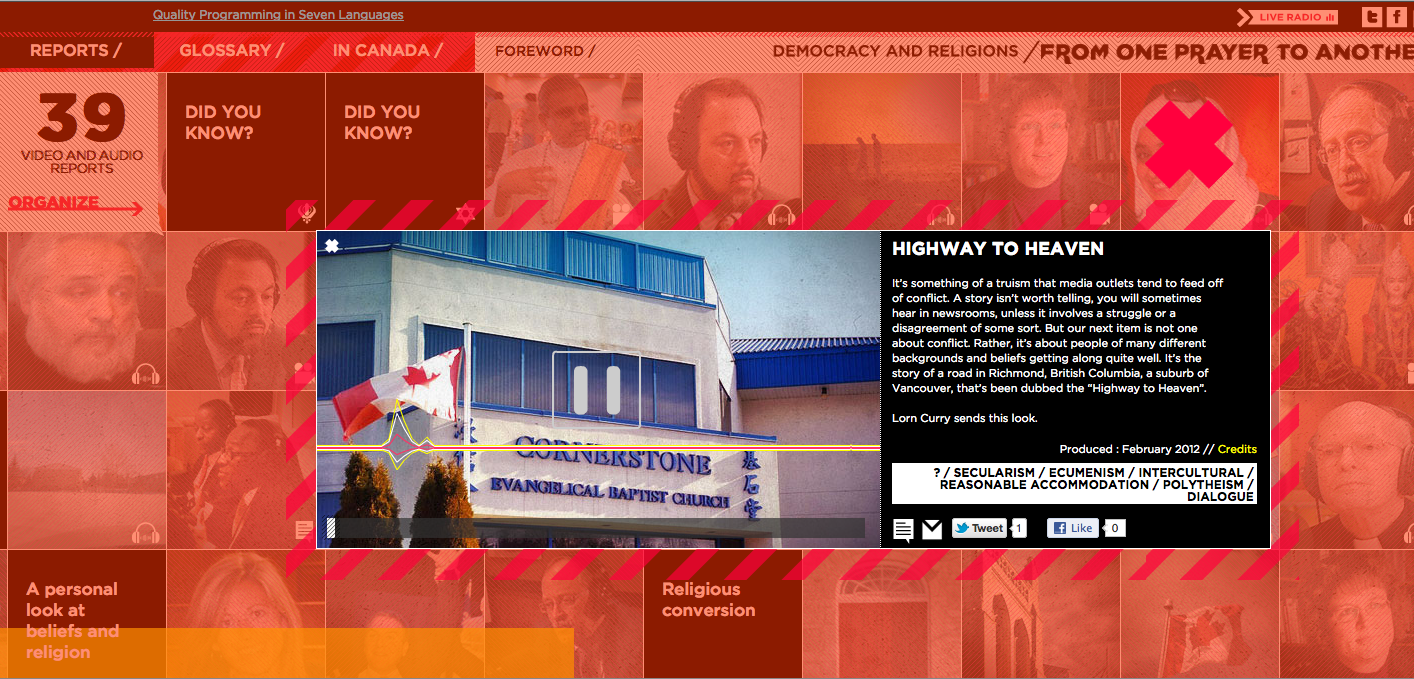
It was also fascinating to see how Matt covered the other parts of my research through the other respondents’ voices. My master’s research into transnational Hongkonger evangelical churches was adequately covered by interviews with Cantonese communities and the comparisons between Protestant and Catholic voices. My PhD thesis on engagements with the public sphere, especially around sexuality issues and the provision of social services, was covered through interviews with Bill Chu, SUCCESS, and Vancouver Sun religion writer Douglas Todd. The work that I have been doing with Claire Dwyer and David Ley on the Highway to Heaven also made it into the program through the interview with Peace Evangelical Church.
As always, I need to provide a few caveats.
First, Matt always returns to China as the homeland for people in the Chinese diaspora. This needs to be more critically assessed. As Laurence Ma and Carolyn Cartier point out in their book The Chinese Diaspora, the issue of homeland is actually very complicated for people in the Chinese diaspora, as ideological claims that China is home don’t always match the material realities of multiple homelands.
Second, Matt seems to think that the church is the place where politics and social services emerge. I don’t blame him for assuming this, but the relationship between church and civil society for Chinese Christians in Vancouver is very complicated and needs to be more critically assessed. This is especially true for the sexuality issues, where it’s assumed that protests against sexual orientation discrimination bills, same-sex marriage, and anti-homophobic curricula emerge from congregations and are driven solely by a conservative theology. The reality is much more complicated, as religious values don’t always emanate from the church, but can be individually held and combined with secular factors.
Third, I worry about the near-portrayal of Chinese as homogeneously wealthy in Vancouver. While it is very true that wealthy Chinese migrants have transformed Vancouver’s urban landscape, the existence of organizations like SUCCESS that provide social services, employment help, and English-language and citizenship training indicates that there are economically disadvantaged Chinese people in Vancouver too. As a result, not all Chinese in Vancouver are of the same economic and political stripe, not even within church congregations.
However, overall, I am very pleased by the program. I am especially happy to see that Matt has inferred with good insight the central issue here in Vancouver (though I am picky about the details): how does a multi-faceted Chinese evangelical population relate to Vancouver’s secular mainstream? To what extent is this about racialization vis-a-vis whiteness, and to what extent is it about religion? I am glad that Matt hasn’t provided definitive answers to these questions, but has framed them as starting points for further and deeper conversation and debate. In other words, Matt isn’t telling us what to think about Chinese Christians in Vancouver; he’s asking us to listen in and start a thoughtful conversation. Because of this, though I have caveats, I am happy to recommend this program as an introduction to the work that I have been doing in Vancouver. I would encourage listeners then to get in on the debate.
 Justin K.H. Tse