SCMP: Religion on the Occupy Central front line puts faith into practice

Photo: Sam Tsang (SCMP)

I am very grateful for the good work that SCMP journalist Jennifer Ngo has done on religion in the Umbrella Movement protests currently in Hong Kong. She has interviewed an array of religious sources on the Occupy movement. Here were my comments:

Justin Tse, a social geographer and postdoctoral fellow at the University of Washington, conducted extensive research on the relationship of Christians to civil disobedience in Hong Kong including the “Umbrella Movement”. He said Christian influence went beyond the initial participation of believers.

“This is not to say that official church institutions are deeply involved,” he wrote in an email. “Instead, what it means is that Hong Kong people have been so deeply influenced by Christianity through a variety of civil society channels – schools, media, social services – that they are able to practice and articulate their activism in Christian terms.”

Calls made by official church bodies may be modest, while individual clergy or parishes showed more support, he said.

South China Morning Post: Chinese parents clash with striking Canadian teachers as school year fails to start

Photo: CBC

Yesterday in The South China Morning Post, Ian Young did another spectacular job trying to suss out some of the intricacies of the trans-Pacific social field that we find in Vancouver. In this most recent article, he wrote on how some Chinese parents associated with the British Columbia Parents’ Federation (BCPF) protested the teacher’s union, the British Columbia Teachers’ Federation (BCTF), for the strike that is finally starting to come to an end. Young reached out to me for a comment, and this is what I noted about the BCPF:

Dr Justin Tse, an academic who has studied activism within the British Columbia Chinese community, said that although the BCPF’s desire to get children back in class was shared with other opponents of the strike, there was also a strong undercurrent of anti-unionism in general that ran through the protests.

“My sense is that there is a view that unions disrupt business, and most Chinese migrants have this view that unions get in the way of the free market,” said Tse, a post-doctoral fellow at the University of Washington. “For them, it’s not really just the educational stuff – it’s the union stuff.”

The BCPF has garnered supporters via Chinese-language social media, and the couple of dozen members at Sunday’s protests all appeared ethnically Chinese. The federation has attempted to widen its outreach to non-Chinese parents, but these efforts appear to have been aborted, for now. A Facebook page and an English-language website seeking new BCPF members were visible on Sunday, but were taken offline that night.

“A lot [of Chinese immigrants] are kind of scared of public protest,” said Tse. “They want the media to capture their numbers at a protest, but they don’t want to be singled out as individuals, so you get the face mask thing. You can’t really have it both ways, but that is the sentiment.”

Tse said conservative Chinese political activism in BC was informed by “a specific vision of democracy” that focused on majority rule alone, without emphasising some of its other aspects, such as deliberation, consensus and accountability.

“There is this sense that democracy means you get to say your private views in public, no matter how outrageous, because that’s free speech, and that it is all about getting numbers,” said Tse. “This view is that democracy just means majority wins, majority rules.”

My comments here need to be read in conversation with a piece that I wrote on my blog, Religion Ethnicity Wired, arguing that the constitutional issues swirling around the BCTF strike provide a remarkable mirror to the democratic movement in Hong Kong, Occupy Central with Love and Peace. This is because what I said there qualifies what Ian Young and I talked about in relation to Chinese immigrants.

The impression that I do not want the public to get is that there is something about this nebulous term Chinese culture that is against labour unions, public protest, and deliberative democracy. Such a statement would not only be irresponsible — it would be empirically unsubstantiated. After all, if that were the argument, then movements such as the May Fourth Movement, the Beijing Spring of 1989 in Tiananmen Square, and the recent democratic movements in Taiwan and Hong Kong would have to be marked as un-Chinese. As Craig Calhoun insists in Neither Gods Nor Emperors, it would be more accurate to say that these democratic movements constitute a strand of Chinese tradition. So too, Asian American author Frank Chin observes in his novel Donald Duk that even Confucian concepts like ‘the Mandate of Heaven’ are a de facto form of democratic consciousness because it is a term that can be deployed by the people to criticize unjust power.

However, it is true that many of those associated with the BCPF were ethnic Chinese — its spokespeople seem to be Putonghua-speaking, and as their name suggests, they represent parents. Here, I also rejected the discourse of the ‘tiger parent’: Amy Chua’s essentialist caricature of Asian American (and Asian Canadian) parenting has simply reinforced notions of the ‘model minority’ that should have been put to bed in the late 1960s right where it started. This is not to deny that Asian Americans and Asian Canadians themselves take on the discourse of the ‘model minority’ as an identity statement — indeed, my work explores that at an ethnographic level — but using the ‘model minority’ as an essentialist explanation for Chinese parental behaviour stops the conversation at several points. First, it conveniently isolates Chinese parents from the general population, blinding us to how Chinese parents are saying some of the similar things as even Anglo-Canadians. The second is that it doesn’t get at the specific undercurrents that make up the discourse of the ‘model minority.’

What I’ve done here is to try to listen to what these parents are actually saying. They agree with the general population that the BCTF strike has crippled education in BC. However, while public opinion has been turning against the BC Liberal Government for its flouting of the Canadian constitution and the bargaining rights of the teachers, these parents are placing the blame squarely on the teachers for striking and thus using collective bargaining as a bullying tactic that has put their kids out of school. This sounded a lot like my dissertation research, in which conversations about the BCTF in 2011 (well before this set of strikes) quickly led into discussions of how a variety of labour unions tended to obstruct the free market.

Moreover, it sounded a lot like how many of my interview subjects and focus group participants wanted to participate in public protests, but were shy about having their pictures taken or being interviewed by the press. When members of the public engaged them in debate, they tended to see this as an attack on their freedom of speech instead of an opportunity for public deliberation. Their goal, as they told me, was to build an awareness that the majority in fact supported their positions because that was the point of democracy.

While this could be called ‘Chinese’ in some senses of the word, I prefer to think of it as part of a debate about the relationship between Chineseness and democracy. After all, while such majoritarian and non-deliberative arguments about the nature of democracy certainly comprise one faction in Greater Chinese and trans-Pacific contentions about democracy, there are movements as old as the 1970s — and dare I say, even the May Fourth Movement in 1919 — that advocated for a more deliberative form of democracy that also pays attention to minority rights. In other words, there is a political spectrum among ethnic Chinese views on democracy, and the BCPF represents one strand in a larger conversation. I was asked about the BCPF, so I answered along the lines of what the BCPF represented. But you have to read my blog post on Religion Ethnicity Wired to get the catch on what I said.

In short, I am very happy that Ian Young got me on record about the BCPF. As always, I enjoy my collegial relationship with journalists like Ian who are at the top of their craft. This incident certainly was of public interest in Vancouver, as well as in the trans-Pacific social field, and I look forward to this conversation piece doing what it’s intended to do — engender more conversation!

Vancouver Sun: Douglas Todd, ‘We Must Stand On Guard for Canada’

In the Vancouver Sun, Douglas Todd has given the Canadian public a fascinating discussion piece on the limits of liberal multicultural democracy. I’m quoted in the piece, so I thought I might offer a few critical reflections in light of what Todd says.

Todd’s piece takes its departure from what he describes as the rise of ‘religious extremists’ and what Immigration Minister Jason Kenney calls ‘homegrown religious radicals’ due to contemporary Canadian migration policy. Interviewing Liberal politician Ujjal Dosanjh and the Laurier Institute’s Farid Rohani, Todd finds these liberals of colour are themselves concerned that new migration trends to Canada are bringing more forms of abusive patriarchy within families, opposition to interracial and interreligious marriage, refusal to fit into the unspoken secular sartorial code in Canadian workplaces, and homophobic discrimination. On that last point, Todd reaches out in collegial fashion and quotes me: ‘Both Rohani and Dosanjh are aware of widespread anti-homosexual beliefs among many religious immigrants, which can lead to actual discrimination. And University of B.C.-trained scholar Justin Tse has cited the strong degree to which many Chinese Christian immigrants find Canada’s human rights laws regarding homosexuality “ridiculous.”’ The main point of the article, in turn, is that Canadian liberal democratic values are under strain from these new migrations and thus needed to be guarded more carefully. What’s smart about the article is that Todd seldom quotes from white Canadian public figures; all of the quotes are from people of colour, including me.

In many ways, Todd represents me fairly well. The attitude that Canadian human rights legislation is ‘ridiculous’ is a direct reference to my dissertation, which was cited in the South China Morning Post saying the same thing – that many of conservative Cantonese evangelicals with whom I spoke in Vancouver felt that Canadian human rights legislation was ‘ridiculous.’ That this is what my dissertation actually finds among conservative Cantonese evangelicals in Vancouver means that I feel very well-quoted and thankful that Todd has reached out yet again in a such a fine showing of collegiality.

But because this is a discussion piece, I also feel that I’m allowed to register a bit of collegial dissent from Todd’s conclusions. This is because I think Todd and I, while recognizing each other as colleagues in the public forum, are working on two fundamentally different social projects.

Gérard Bouchard (left) and Charles Taylor (right) listen intently.

While Todd makes the case that Canada has to guard its liberal multicultural democratic values, my project is to interrogate why it is that some migrants — in my case, some (but not all) Cantonese-speaking Protestants — were opposing the very liberal things that Todd wants to guard. I don’t pass judgment; I ask why. This is because the social (and arguably, political) thrust of my academic project is in many ways informed by Canadian philosopher Charles Taylor and his call for mutlicultural societies to practice the ‘politics of recognition.’ What this means is that various communities in the modern world have taken on certain identities that they don’t want to be unrecognized or misrecognized; misrecognition, in fact, can be viewed as an insult. What we have to do, Taylor proposes, is to recognize the other — to get past simple disagreements to understand precisely how the other’s identity is formed and how that othered identity is in fact part of the ‘we’ in this society. Taylor himself has put that into political practice: at a time when controversy erupted in the mid-2000s over head-coverings in Quebec (as Todd notes about Quebec’s proposed Charter of Values, it’s still under contestation), Taylor teamed up with Gérard Bouchard to form a commission to get every voice possible on the record about the practice of multiculturalism/interculturalism in Quebec, including all the nasty stuff people wanted to say about the hijab, niqab, and sundry. The result was a report titled Building the Future: A Time for Reconciliation, in which Taylor and Bouchard painstakingly detail the problems with interculturalism in Quebec, report on every possible voice that they heard during their time on the commission, and propose that what’s needed is an open secularism, a sort of society where religion is not excluded but in fact included in everyday public deliberations.

In many ways, that’s what that section in my dissertation on Cantonese evangelicals in Vancouver calling Canadian human rights legislation ‘ridiculous’ is trying to do. To stop at that assertion of ‘ridiculousness’ is to cut the project short right at the beginning. If you read the dissertation (yes, it is publicly accessible), you’ll find that my question then goes to why these Cantonese evangelicals thought that Canadian human rights legislation tended to be ‘ridiculous.’ As the South China Morning Post succinctly quoted me in May, it’s because the sort of rights-based legislation around sexuality (hate crime bills, same-sex marriage, transgender rights, etc.) went against a certain vision of a ‘rational, orderly society.’ As I discovered, this wasn’t so much a ‘culture’ thing — ‘Chineseness’ was frequently invoked and qualified by my interviewees — but a performative agenda that understood best practices in civil society to be the creation of private, family-based economic units in which the second generation could be trained to become productive, private citizens in Canada. This means that sexuality is only the tip of the iceberg; other issues that contributed to what they might call the ‘irrationalization’ of society included the legalization of marijuana (medical or otherwise), harm-reduction drug treatment (some spoke of methadone; a few contested halfway houses in their neighbourhoods; most spoke of Vancouver’s inSite safe-injection program), the Anglican Church of Canada’s embrace of religious and sexual pluralism, and the building and expansion of casinos. The Cantonese evangelical public activism that propels this vision is certainly not un-Canadian; it is Chinese Christians wading into the fray of the partisan debates around what it means to be Canadian. That is, the fact that it is a socially conservative, privatized understanding of Canadianness does not make it un-Canadian; it makes it part of the debate around how Canada should be constituted as a nation.

My dissent, then, from Todd’s otherwise excellent, provocative discussion piece is that Todd seems to be portraying new immigrants, including the Chinese Christians that I studied, as bringing their religiously-based homeland politics to contest our hard-won liberal, multicultural, democratic Canadian values. But as my dissertation clearly states, the reasons that some Cantonese evangelicals thought that their rational, orderly vision of society was under assault tended to be modern and secular. It wasn’t a sort of backward homeland politics being imposed onto Canadian values. After all, this sort of politics of privatization comes from the need not to protect ‘culture,’ but as a business strategy in a globalizing world. This sort of rationality may be ideologically ‘conservative,’ but it is rooted in a very modern version of how society should operate. It may be theologically informed (as I argue elsewhere, what isn’t?!), but the reasons given for this rational, orderly society sound rather more to do with the very secular goal of maximizing private participation in the market economy. One may not agree with this sort of vision for a ‘rational, orderly society,’ especially one so rooted in the politics of privatization. But one cannot disagree that it is a vision.

In other words, I’m collegially dissenting from Todd’s piece because I don’t think that Canadians need to stand on guard for liberal, democratic, multicultural values. Instead, what’s more needed is a recognition that the ‘other’ is one of us, locked into the deliberations of democracy of which we are all a part. Contrary to Todd’s interview with Tung Chan in which Chan says that we need to ‘educate’ people and then let them go their merry way, this public deliberation is itself educative. It’s because it’s in deliberation — public, honest, open, and even heated deliberation (like the Bouchard-Taylor Report) — that we realize that the solution is never ideological entrenchment, but openness to the other as fellow citizens, persons even. Talking softens us. What perhaps needs emphasis is not so much the part of the national anthem to ‘stand on guard’ for Canada. It’s rather that if this is indeed ‘our home and native land,’ well, then, it is ours together. We need to keep talking.

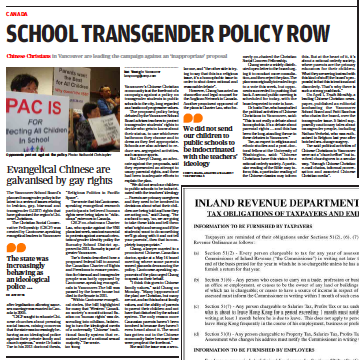
South China Morning Post: School Transgender Policy Row

I have received quite a warm welcome back to Vancouver for my doctoral graduation today. Ian Young has done a masterful job of quoting me in today’s edition of the South China Morning Post.

scmp_ianyoung

The article is about how Chinese Christians — in particular, Cantonese-speaking evangelicals — in Vancouver are contesting the Vancouver School Board’s proposed policy for transgender faculty, students, and staff. There is both a main article and a side column based mostly on a reading of chapter 5 of my dissertation.

The controversy centers on those who have opposed the policy because they feel that their ‘parental rights’ to educate their children primarily in the private sphere have been violated. As I explained to Young:

This is not really a debate about homophobia. It’s a debate about parental rights … and this has been the long-standing theme in these debates in Vancouver…Chinese Christians have this vision for a rational orderly society. A particular reading of the Bible may inform this, a particular reading of the Chinese classics may inform this. But at the heart of it, it’s about a rational orderly society, where parents are the primary educators for their children. What they are seeing instead with this kind of stuff [the board’s proposals] is that this is irrational and disorderly. That’s why there is such a strong pushback.

In addition, I emphasized that these political activities ‘were not a “church effort” but involved churchgoers in a secular way, “through Chinese Christian e-mail chains, informal conversation and assorted Chinese Christian media”.’

I am very thankful to Ian Young for our collegial relationship. He first contacted me last year about an article on youth transitioning to adulthood between Hong Kong and Vancouver, a topic that Jo Waters and I had written on in Global Networks. I found Young’s questions very perceptive and incisive, always pushing me to draw out my points, to illustrate with examples, and to pose counter-illustrations. I suppose I should expect no less from the former International Editor of the SCMP, but I must say that it is always a pleasure to work with someone at the height of his craft.

I also appreciate how Young engages multiple sources in his account in order to draw out the multi-sided complexity of this debate. His interview with Cheryl Chang is revelatory both because of how Chang insists on her secularity as a concerned parent activist and because she was the legal advisor for the Anglican Network in Canada, a realignment group that sued the diocese for their property because they insisted that it was they who were holding to historic Anglican orthodoxy on theological doctrine and sexual praxis. He not only quotes me about the non-church-based Chinese Christian networks, but goes right to the source, Truth Monthly, one of the two premier Chinese Christian newspapers in Vancouver (the other is Herald Monthly). He has done his research on Charter Lau, mostly through my dissertation, but instead of just quoting the thesis, he has used it to trace the precedents for this poobah in both Burnaby’s Policy 5.45 controversy in 2011 and the ongoing debate about Bill C-279 to amend the Canadian Human Rights Act and the Criminal Code (my dissertation fieldwork took place during the C-389 controversy).
[UPDATE: May 23, 2014: These items have been corrected in the online edition.]

As this information develops, however, I do want to make two very minor clarifications to the record, none of which affect Young’s larger point. The ‘CSCF’ that Young mentions is the ‘Christian Social Concern Fellowship,’ not the ‘Christian Social Conservative Fellowship.’ While many of its members are politically conservative and some are card-carrying members of the federal Conservative Party of Canada, ‘social concern’ is a term derived from mainline Protestantism in Hong Kong to talk about the church getting involved in social action. The second is that the Truth Monthly post date is from the January 2014 issue. That this post predates the debate by four months instead of several weeks in fact strengthens Young’s point about this transgender issue being widely discussed in Chinese Christian media.

Again, many thanks to Ian Young for a very thorough article and sidebar for SCMP. I look forward to further collaboration in the future.

South China Morning Post: Children of rich Chinese home alone in Canada face challenges

I am grateful to the South China Morning Post‘s Ian Young for writing an article last Monday on the publication that Jo Waters and I coauthored in Global Networks on transnational youth transitions between Hong Kong and Vancouver. More on the actual article can be found here.

Illustration: Sarene Chan

After the piece published by Douglas Todd in the Vancouver Sun came out, Ian Young contacted Jo and me for a follow-up article in the South China Morning Post. While Doug went mostly with what our academic publication said, Ian wanted to learn more for himself about the phenomenon in a sort of boots-on-the-ground way. In addition to interviewing Jo and me (and props to him for noting that Jo is a fellow of Kellogg College, Oxford), he also interviewed a Taiwanese young man in order to round out the picture. This asymmetry between the Taiwanese and Hongkonger examples is only slightly problematic because Ian was cognizant of the difference and because he was suggesting that this phenomenon had more to do with a sort of Greater China geography than Hong Kong. The jury is still out on that, though the original theorists like Aihwa Ong and Donald Nonini in fact presume it, and I would like to see more research on different Chinese transnationalisms (pace Weiqiang Lin) to provide even more differentiated portraits.

I am grateful to Ian for writing up this piece as a work of long-form journalism, which (as he tells me) is often hard to come by these days. I’m fairly happy with the way it turned out. My comments were based mostly on the literature and our findings, and references to the economic calculations of transnational migrants from Hong Kong can be found throughout the work of David Ley, Jo Waters, Katharyne Mitchell, and Kris Olds. I am also glad that Ian was fairly careful about not having Jo and me give definitive advice for those contemplating transnational family arrangements; far be it from us to tell any family what to do! Instead, both Jo and I were quoted as emphasizing the possible emotional consequences of split families as factors for consideration. Finally, my only regret with my comments has nothing to do with Ian, but rather in my forgetfulness to mention that this emphasis on material familial bonds has long been a subject of discussion in Chinese American and Chinese Canadian history, and the go-to work on that is Madeline Hsu’s Dreaming of Gold, Dreaming of Home.

Again, I am very glad that Ian Young contacted us about this story. To reiterate my previous posts, I am finding that these connections between academia and journalism are proving very educational for me, helping me learn about issues that are both similar and different between academic conversations and what is happening in public discourse. What is fascinating about Ian’s work is that as he is based in Vancouver, he is interested in chronicling events in the transnational social field between Vancouver and Hong Kong as a public sphere of sorts, and I will be reading with interest how he will implicitly theorize this public. These public connections are never about private publicity; they are about understanding why academia is a public good that can collaborate with other sectors, such as journalism, to inform a larger public conversation. To that end, I look forward to working with Ian Young in the future as we keep the conversation going.

Vancouver Sun: The struggles of affluent East Asian youth in Canada

In this post, I’ll discuss the Vancouver Sun‘s publication of some of the findings in a paper that Johanna Waters and I co-authored in Global Networks. I’ve written about the actual article here, and that’s where I discuss our experimental methodology and some of our key findings.

I like the article that Douglas Todd has written about our piece. This wasn’t something that I set him up to do; in fact, I didn’t even know that he was working on it until he emailed me telling me that it was in that very day’s paper and that he had already gotten feedback on it. As I said, I have been on vacation, so I hadn’t seen a Vancouver Sun where I was vacationing and am relying on the online copy.

The article rightly situates our piece in a longer literature that includes pioneering work done by my supervisor, David Ley, as well as Audrey Kobayashi and Elaine Ho (who incidentally edited the first article I ever published). As those who have read this literature will know, our piece takes seriously this recent literature’s attention to the ’emotional turn’ in cultural geography, an approach to studying space and place that takes seriously how perceptions and constructions of geographies are constituted by emotions. In particular, our piece focuses on the emotional geographies of young people transitioning to adulthood between Hong Kong and Vancouver. Todd reads our two empirical sections fairly and carefully. First, the young people we interviewed described their experience of their family’s supervisory practices as ‘sporadic’ and ‘fragmented’ because while they were grounded in Vancouver, their families often lived at a geographical distance. Second, the young people said that they felt attached to Vancouver, whereas Hong Kong often felt like a ‘hostile’ environment where they didn’t have friends and where they could imagine work hours being unbearable. I am happy with the way that Todd has read our article.

What I’d like to reflect on here is the relationship between academia and journalism. In the past few weeks, I’ve been thinking quite a bit about this, especially because Douglas Todd’s work and my work are starting to have points of convergence and because Sarah Pulliam Bailey has been doing so well covering the Asian American evangelical activism of which I have been a part. As I said when Todd first interviewed me, I felt that the relationship that we were developing was collegial, and I continue to feel that way. To work with journalists is not to seek publicity. It is to be committed to an academia that engages the public sphere and that demonstrates that academic freedom is vital to our democratic discourse. Working with my colleagues in journalism, I’ve gained a greater appreciation of why the press needs to be free, why it’s important that private entities should not control the press’s discourse (this includes when they read my work), and how the academic conversation is enriched when more public voices are brought into the picture.

For this article, I’m glad that Todd decided to give the article his own read without consulting me. I got a sense of why this research was important to our public discourse. Jo Waters and I had our angle, of course, and that was that our public discourse should not simply assume that children growing up in transnational social fields necessarily desire to live transnational lifestyles. But with Todd bringing it to the public sphere, I’ve been impressed by how important it is that this message gets out, especially in our public conversations about migration and citizenship. I write with gratefulness for Todd’s journalistic craft (and for Bailey’s, for that matter). They are teaching me so much about their trade and how we can work together between our different guilds, and I am grateful for their patience and for their collegiality.

UPDATE: After writing this post, I had the opportunity to read some of the comments about our research. I’m thankful for the many people who resonated, and I’m also grateful for those who posted critical comments that might help us refine our future endeavours. Two comments stick out for me, and I’d like to address them here. First, there is the observation that we ‘forgot’ to interview migrants from the People’s Republic of China (PRC), as the ‘astronaut’ phenomenon encompasses more than Hongkongers and there are Hongkongers who work in major cities on the mainland. Second, some noted that this research describes a long phenomenon that can be observed since 1990 (and perhaps before).

Allow me to respond to both, as both can serve as a teaching moment for what we do in academia.

Both Jo Waters and I focused on Hongkongers in our respective projects. This was a practical consideration, as we wanted to limit ourselves to one segment of the Chinese diaspora, and as Weiqiang Lin notes, there are many other Chinese cosmopolitanisms to explore (such as, for Lin, Singapore’s ‘global schoolhouse’). Moreover, we have colleagues who do work on PRC migrants to Vancouver, such as Elaine Ho and Sin Yih Teo. Our study is thus not a comprehensive one that looks at every facet of Chinese transnationalism; instead, academics work with literatures–whole bodies of work–and our contribution is partly to the literature on Chinese transnationalism (as well as literatures on unconventional youth transitions to adulthood, emotional geographies, and cross-border movements more generally). In addition, studying Hongkongers allows for interesting comparative work with the PRC migrants, as well as the ability to unpack how Hongkongers perceive PRC migrants, a theme that was very much part of my master’s work (see this article also) and that has made it obliquely into my PhD work.

We are also aware of how dated the phenomenon that we are studying is. However, it’s partly because we’ve had such a long time to reflect, including the time elapsed between our two projects, that we’ve been able to make some of the claims we make. Again, this provides good comparative material for the new research emerging from our colleagues as well as a call to our fellow researchers to pay attention to the voices of young people in these transnational social fields.

Exponential and the Open Letter

It has been one week since the Asian American Open Letter to the Evangelical Church was released on Nextgenerasianchurch.com.  I am one of the original signatories and part of the planning committee for this open letter.

cover3

Because I have been on vacation over the last two weeks, I apologize for my delay in blogging about this important event, as well as an article in the Vancouver Sun that featured some research that Johanna Waters and I did on transnational youth between Hong Kong and Vancouver.  This post will cover my involvement in the publication of the open letter.  A forthcoming post will focus on the Vancouver Sun article.

My involvement in the Asian American open letter began when Religion News Service’s Sarah Pulliam Bailey contacted the group of us who had blogged about the Rick Warren ‘Red Guard’ fiasco and said that she had obtained information about an orientalizing incident at Exponential, a church planting conference that was incidentally being hosted at Saddleback Church but had no connection to the actual church itself.  Kathy Khang has provided a rundown here of what happened.  The gist of things is as follows: the Rev. Christine Lee, a Korean American Episcopal priest and assistant rector at All Angels’ Church, New York, tweeted that she had seen a skit at the conference where a white pastor used an orientalizing accent, but when she reported her concerns, her comments were brushed off.  This tweet was shared by Asian American writers Kathy Khang and Helen Lee, who proceeded to write the open letter.  Sarah Pulliam Bailey directly obtained the story from these tweets.

My comment to Bailey was that this second incident demonstrates the necessity for why the conversation must remain public.  I said: ‘It is worth observing that it has almost been 10 years since ‘Rickshaw Rally,’ and there are prominent American evangelical publishers, conferences, and pastors who still use Orientalizing imagery’. What I was doing was to place this incident in a historical trajectory that dates back to the Asian American evangelical campaign to pull ‘Rickshaw Rally’ from Lifeway Publishers’ Vacation Bible School publications in 2004. I am thankful that the open letter also uses this trajectory, because the concerns of Asian American evangelicals focus on whether they in fact have a place in American evangelicalism, especially if prominent pastors and publishers feel free to orientalize them despite a decade of protests. (It would be a worthy academic history project to check if there is activism that predates this decade, and whether those activists are connected to the ones at present.) As I have said repeatedly, each of these incidents were public, which makes a public response to them, including one via the press, extremely appropriate.

Over the week after Bailey’s article was published, the planning committee for the open letter gathered signatures. Exponential also issued a public apology after gathering a group of Asian Americans to talk about the skit, at which the story is that Jeya So’s story about her past of being bullied as an Asian American resonated with the conference organizers. I signed the letter to indicate my public support for this public response to these public cases of orientalization. The signatories comprise people gathered from diverse points on the theological spectrum. It is worth noting that this is a letter to the evangelical church and thus includes those conventionally labeled the ‘mainline’ and those whose theological orientations are ‘liberal’ and ‘liberationist.’

The idea now is to keep this conversation about the place of Asian Americans in American evangelicalism–and indeed, in American religion–public.  Indeed, the letter indicates that this is not so much a letter that goes on an attack, but rather, it is an invitation to a public conversation. As some noted to me, the letter struck them as conciliatory, and I agree; it should not sound a note of aggression.  Instead, it signals that while private conversations are necessary, like the one that led to Exponential’s informed apology, they are insufficient. If a decade has passed since Rickshaw Rally, then this conversation about race and orientalization must be had with American evangelicals in a public forum, one whose openness provides some accountability for actual change to happen.

This public conversation is in turn not a niche conversation. It is good for our public sphere. In a social and political situation where evangelicals are themselves the subject of public discourse, this conversation fits within key debates that are being had in American civil society, especially regarding the intersection of faith and politics. The openness of the open letter is one way to enter into this conversation because it interrogates whether the word ‘evangelical’ in our public discourse is inclusive of Asian Americans. If it is not, that would be curious indeed, given the observations in the social science of religion that Asian Americans are a quickly growing group of evangelicals and have historically been part of key American Protestant conversations. This open letter is thus an invitation to a broader conversation about American religion, especially because American religion concerns every person in the American public, and if that’s the case, then it is an imperative to know what we’re talking about when we talk about ‘evangelicals,’ including the fact that there are many Asian Americans who are very much included in that term.

UPDATE: Those interested in how these initial thoughts turned into reflections on how ‘the private consensus is unraveling’ should read my post on Religion Ethnicity Wired. Admittedly, the framing of the ‘private consensus’ and its undoing in this blog post is limited to American religion. My postdoctoral framework for the concept has to do with the Pacific Rim.

Religion News Service: Rick Warren gets backlash from Asian American Christians for posting photo

Yesterday, Sarah Pulliam Bailey posted an article on Religion News Service detailing a controversy that has been generated by Pastor Rick Warren, the founder and senior pastor at a Southern Californian megachurch called Saddleback Church.  The article quotes me, as well as Professor Sam Tsang (Hong Kong Baptist Theological Seminary), Intervarsity Christian Fellowship staff worker and blogger Kathy Khang, Seattle church planter Pastor Eugene Cho, and Asian American evangelical blogger and compiler Grace Hsiao Hanford (click on all of the links to find them all).  What I want to do here is to provide some context for these remarks so that what is geographical about the events of this week can be more fully understood.

Here is what happened. On the morning of 23 September, Warren posted a picture of a Chinese Red Guard captioned with, ‘The typical attitude of Saddleback Staff as they start work each day.’ Drawing initial criticism on the comments section of the photo itself, Warren responded by saying, ‘People often miss irony on the Internet. It’s a joke people! If you take this seriously, you really shouldn’t be following me! Did you know that, using Hebrew ironic humor, Jesus inserted several laugh lines- jokes – in the Sermon on the Mount? The self-righteous missed them all while the disciples were undoubtably giggling!’ This drew the response of several blog posts (see here, here, and here) that outlined for Warren the extent of his offence. Warren then responded on one post that was especially shared–Professor Tsang’s–where he said, ‘Thanks so much for teaching us! It was removed instantly. May God bless you richly. Anytime you have guidance, you (or anyone else) can email me directly.’ While Tsang accepted this response as an apology, Warren’s lack of public apology and explanation to his supporters drew more criticism. This story was then picked up by Religion News Service’s Sarah Pulliam Bailey.  In addition to doing due diligence through interviews and the reading of relevant posts (our interview was also very pleasant, as we had already been in contact to talk about my academic research), she also contacted Warren’s publicist. After the story broke on Religion News Service, Warren issued a public apology on his wall. (If you need this story in bullet point form, Kathy Khang outlines it here.)

Here is what I said. In my interview with Bailey, I said that, as Bailey elegantly phrases it, the ‘controversy over the photo raises questions about how public or private the evangelical conversation on ethnicity should be.’ Indeed, this scenario has raised two key issues for me. The first is that the place of Asian American evangelicals in American evangelicalism has already become a central conversation and item of debate in American religion. While Asian Americans were once target populations for missionaries to evangelize, events since the mid-2000s have shown that Asian Americans are not ‘the other’ to American evangelicalism, or to American religion more generally. Instead, they are part and parcel of it, and they are making their voices heard. Within American evangelicalism, their voices were especially pronounced in protesting Lifeway’s ‘Rickshaw Rally’ Vacation Bible School curriculum in 2004 (minor clarification on Bailey’s article: promotional materials were pulled, while the curriculum was in fact circulated), youth specialties’s ‘Mee Maw’ skit in Skits That Teach in 2007, and Zondervan’s Deadly Viper: a Kung Fu Survival Guide for Life and Leadership in 2009. These protests are indicative of larger developments within American evangelicalism itself. Within academic circles, it has been commonly noted by scholars like Rudy Busto, Karen Chai Kim, and Rebecca Kim that university campus ministries are increasingly dominated by Asian Americans. Academics such as Antony Alumkal, Russell Jeung, and Sharon Kim have also studied the emergence of second-generation Asian American congregations, which themselves have been the subject of reflections by people like journalist Doreen Carvajal, evangelical writer Helen Lee, and theologians Jonathan Tran and Amos Yong. Indeed, this sea-change in American evangelicalism has prompted pastoral theologian Soong-Chan Rah to term this the ‘next evangelicalism,’ a challenge to what he terms the ‘white captivity of the evangelical church’ in America that finds difficulty with the changing geographies of American religion.

I said that what happened this week is a key episode in this unfolding conversation. In other words, the events of this week are not ‘conversation-starters.’ They are an invitation to a conversation that is already vibrant and that is objectively happening regardless of whether its existence is acknowledged.

However, the debate in this conversation revolves around how public or private it should be. This gets to the meat of what I said to Bailey:

The offensive image was public, and Warren’s initial response to it (that Asian Americans should have more humor) was also public, so the Asian American response to Warren was appropriately public. However, the apology is only semi-public because Warren has not addressed the 4,021 followers who liked the post and explained to them why he took it down.

Over the last week, there has been contention over whether this ‘backlash’ is an Asian American way of attacking Warren’s ministry and whether the blogposts that went up were indicative of Christian practice; indeed, some thought that Warren should have been approached privately and that this affair should not have boiled over into the public sphere. While I have argued in the past that all geographical debates are theological (see my piece on ‘grounded theologies‘), the question here is really a geographical one at heart. As I said in my interview, that these events began on an online public makes it uniquely appropriate that the response also happened on an online public. However, Warren’s supporters suggest that what would be Christian would be to approach this affair privately. This was my other comment, that ‘those supporting Warren [could be] part of a larger narrative that Asian Americans should assimilate into a broader white mainstream,’ that is, that instead of seeking to re-orient the racial contours of American religion through public conversation, private strategies should be pursued to preserve a status quo into which Asian Americans should integrate. While this is theologically intriguing and requires more theological reflection by competent scholars who study the Christian tradition, the larger debate that this gets at is whether Rick Warren and Saddleback should be considered as private individual institutions whose private governance insulates them from public opinion or public figures involved in a vibrant public conversation on American religion that is already happening. These are competing visions for how to make conversation in evangelical circles, and these geographies should be more thoroughly interrogated and discussed.

Yet what this means is that there must be absolute clarity that Rick Warren is neither under attack by Asian American evangelicals nor being defended by his ardent supporters. What is really going on is a conversation about two questions, the first of which concerns the place of Asian Americans in American evangelicalism, and the second of which interrogates the extent to which this conversation should be public or private. On all sides, there is the attempt to invite Rick Warren into these conversations, albeit on different geographical terms, with some pushing for a public conversation while others seek to keep it in the private sphere. Sarah Pulliam Bailey’s article sheds very clear light on those geographies, and for that, her work in engaging this issue should be appreciated while she deserves the gratitude of everyone working in and on American religion.

Update: this story has been picked up by Christianity Today and given due diligence by Her.meneutics editor, Kate Shellnutt.
Update #2: this story has been picked up by The Huffington Post. The title is overly melodramatic, though, and does not capture the spirit of conversation that any of the parties involved intend.
Update #3: a version of this story has been picked up by Hong Kong’s ecumenical-evangelical newspaper, The Christian Times.  While I am not quoted, that the other three who are cited were originally part of the RNS piece suggests that there is some cross-fertilization. (I understand that Khang was unfortunately not cited by name in the original piece, but the first link in Bailey’s article takes the reader to Khang’s blog, More Than Serving Tea.) What follows is an analysis of that piece that I originally posted on Facebook. Reflecting the genre of social media, the writing at points is a bit more informal and has been slightly edited for the purposes of this post:

Well, our story is now in Hong Kong’s (in)famous evangelical-ecumenical newspaper, The Christian Times. That’s pretty cool. Sam Tsang, Kathy Khang, and Eugene Cho all get a mention.

Let me tell you two things that are cool about it and one that I am worried about.

First, this is Sam in a context that knows him for his sharp critiques of dubious church practices. If you thought Sam was on fire this time, you haven’t seen Sam in Hong Kong. That guy spearheaded the exposure of a major fraud in Hong Kong evangelicalism, and those with Chinese reading skills can read it here, and those with Google Translate can get the gist without reading into every mistranslated word: http://arkwhy.org/. In short, this post doesn’t see Sam as an emerging figure. It sees Sam as doing what he’s been doing all along. And this one was mild.

Second, it includes Kathy Khang by name and homes in on her most important point: that this is not just about Chinese people affected by the Cultural Revolution, but that what’s at stake is the place of Asian Americans in American evangelicalism. It is also sensitive to Kathy’s central contention as a co-author of the book More Than Serving Tea that Asian American evangelical women have agency and dignity and that they are not invisible figures. It also rightly subordinates Eugene Cho’s reflective contribution about the need for humility to identify blind spots.

But now let me tell you my worry. It has to do with me not being quoted, but it’s not about me. I’d rather they’d have stolen my analysis without mentioning my name than leaving it out altogether.

I don’t mind at all that this piece does not mention me, but I do mind that the Hong Kong situation, especially the planting of Saddleback HK, makes it seem like this whole thing is another episode in which the radical pro-democracy people in Hong Kong are challenging those in collusion with the established regime. Indeed, as a researcher with commitments in Hong Kong, I am slightly worried that this piece reads this Rick Warren incident through the lenses of intra-Christian politics in Hong Kong (and my, it is tempting because of Sam’s involvement). For what it’s worth, keep in mind that this is not Kung Lap Yan and Narrow Road Church against the rationalists. Daniel KT Cheung has certainly been following the story on the wall, but this is not a one-to-one comparison of his critiques of Truth-Light Society and Co. Kathy Khang is an evangelical feminist who brings a justice and solidarity element, but she is not Rose Wu Lo Sai. This is not about contesting Saddleback HK; it’s about involving Warren and Saddleback in a conversation so that their work at Saddleback, including Saddleback HK, might be more evangelically fruitful.

And that gets back to what I said in the Religion News Service piece and in my own post above. The real question here revolves around the place of Asian Americans in American evangelicalism, and the central concern is whether this conversation is going to happen in the public sphere or in a private domain. That is what this debate is about; it is not another episode in the democratic contestation of Hong Kong’s evangelical geographies. There are certainly linkages because of Sam’s work and my research, but the involvement of Kathy Khang and Eugene Cho precludes that interpretation. That’s all to say that I don’t mind not being quoted. But I wish that they would have at least stolen my sentiments, if only to frame this piece outside of a hegemonic intra-Hong Kong Christian conversation.

Update #4: my evangelical contacts in Hong Kong have kindly reminded me that while a ‘hegemonic intra-Hong Kong Christian conversation’ should not colonize the Asian American one, there is a conversation happening among evangelicals in Hong Kong that is producing a geography worth probing. The following open letter written by T.r. Mak is an important node in this conversation.

Update #5: the blogger David Hayward, who goes by the pseudonym, the Naked Pastor, has covered this incident on his blog on the Patheos Progressive Christian Portal. While this coverage has been appreciated by those seeking a public conversation with Warren, Hayward’s framing of Tsang as a ‘Chinese pastor’ (he is a noted New Testament theologian in both Anglophone and Sinophone academic circles) and Khang originally as a ‘Korean Christian blogger’ (this has now been amended to ‘an American of Korean descent’), as well as the lack of coverage of this incident on Patheos more generally, has generated a discussion among some Asian American theologians and pastors over the place of Asian American theologies on Patheos, especially because it is frequently omitted.

Update #6: this incident has been covered again on Patheos, this time by Unreasonable Faith on the Atheist Channel.

Update #7: Xinhua New China News Agency in Beijing has picked up on the story from the Huffington Post. Emphasizing that Warren was the pastor who gave the invocation for American President Barack Obama’s inauguration in 2009, the piece goes on to narrate the back-and-forth interaction between Professor Sam Tsang and Rick Warren. It concludes by quoting ‘a Chinese’ (一名華人), who says, ‘照片是公開的,華理克最初的回應也是公開的(指讓華人增加點幽默感),華人對華理克的評論也是公開的,但華理克的道歉卻是半公開的,他並沒有向那4021名點讚的教友解釋清楚,’ which reads in English, ‘The photo was public, and Warren’s initial response to it (that the Chinese should have more humor) was also public, so the Chinese response to Warren was appropriately public, but the apology is only semi-public because Warren has not addressed the 4,021 followers who liked the post and explained to them why he took it down.’ Doctoring my original words to substitute ‘Chinese’ (華人) for ‘Asian American’ and thus achieving a unique ideological twist, this means that my contribution to the original Religion News Service article has been edited and translated for the purposes of this article.

Vancouver Sun: Metro Vancouver’s Chinese Christians wrestle with morality of homosexuality

I had the great pleasure of being interviewed by the Vancouver Sun‘s religion and diversity journalist Douglas Todd. His column piece on me was posted online on Friday; the print version should be out in the next few days. As usual, I’ll say a bit here about how the whole interview process went, what I think of the piece, and how this feeds into academic work. For my part, it certainly was an interesting experience being in the interviewee’s seat after talking to some 140 Chinese Christians in the Pacific Rim region and conducting 13 focus groups there as well, and it’s certainly very stimulating to read how my work is being interpreted in the press. The interpreter is being interpreted; how fun!

Douglas Todd contacted me back in May when the Statistics Canada release came out on ethnicity, language, visible minority status, and religion. We had a brief conversation about the statistics, and my hint to him at the time was to make sure that whatever he did with the large Chinese population that identifies as ‘not religiously affiliated’ (about 61%), don’t write them off as ‘non-religious,’ as many engage in popular familial religions, may hold various views of the supernatural, and may even be influenced by Christian environments, such as schools in Hong Kong, Taiwan, and various parts of Southeast Asia. Although he did not incorporate my comments at the time, we developed a professional and collegial relationship through the process, and I’m fairly pleased with the series of articles generated from the statistics, although I had the occasional question about differences of opinion that I had about how to interpret the data. I suppose that’s how we academics are trained–to be critical, but always in a spirit of collegiality.

In any case, Todd said even at that time that he wanted to do a longer piece on my work, which, after a conversation with my supervisor David Ley, we decided would be good practice for these late stages in my doctoral studies. Indeed, I reviewed some of my comments to Todd during our conversation about statistics and found that I had given him a fairly technical academic answer to his questions. Yet as we spoke, Todd reassured me that my academic comments were exactly what he wanted (which, as I’m told, is unusual for a journalist) and that we would bridge academia and journalism in our piece, as he had himself been awarded an honorary doctorate from the Vancouver School of Theology (congratulations, Doug!), and thank you for being able to pull quotes from what I imagine must be a very difficult interview from which to pull, as I like to qualify many of the things that I say.

His call came last Friday. We set up a time for this Monday, and we spoke at length for about two hours about my thesis work, as well as my various theoretical and popular interests. I also sent him various academic articles I had written, emphasizing my interest in both ‘grounded theologies’ and in the empirical work of Cantonese migrations in the Pacific region with a religious spin. There were also popular articles in the batch as well, such as the Schema autobiographical piece and the Ricepaper pieces on Ken Shigematsu and on ‘how Asian religions aren’t that exotic.’ I suppose this may be why he calls me a ‘scholarly dynamo,’ although I certainly do not feel that way most days.

Because the conversation revolved around my thesis’s interest in how Cantonese-speaking Protestants engage the public spheres and civil societies of Metro Vancouver, the San Francisco Bay Area, and Hong Kong SAR, the discussion naturally veered toward the sexuality issues without us even attempting to get there. As you will see in the piece, we spoke at length about some of the pressing issues in Vancouver around parental rights activism, the drama between Liberal and Conservative Chinese Christian politicians vying for the vote in Richmond, and the Anglican crisis in the Diocese of New Westminster.  What I did was to try to shed light on the internal conversations that I have been hearing in relation to what I have read in more popular and academic portrayals. Todd is right to say that the press has been interested in this story for quite some time, himself being one of this literature’s main contributors. There are also other journalists like Marci McDonald (in The Armageddon Factor), John Ibbitson and Joe Friesen at the Globe and Mail, and Chad Skelton at the Vancouver Sun, who have all written about Chinese Christians engaging the Canadian public sphere, and sexuality has often come up as an item of interest. Indeed, one might say that their work lies somewhere close to the genesis of my doctoral project, for if they were examining the conversation as outsiders, I thought that it might be interesting to tackle the question of what imaginations and practices constitute Cantonese Protestant public engagements from within the community itself.

I should note that this body of journalistic work has often been met with mixed reviews by both conservative and progressive Asian Canadians for different reasons, yet both because of the work’s philosophically (and arguably, politically) liberal framework. By ‘liberal,’ I don’t mean the archetypal open-minded opposition to ‘conservatism,’ but the philosophical bent that attempts to seek an ‘overlapping consensus’ from various groups that have bracketed their communities of identity to seek some sort of abstract common ground for political life together. On the right, this work has been seen as ‘liberal’–as in too far to the left–because it is viewed as generally unsympathetic to a case against gay rights; some Chinese Christians have often decried how they have been portrayed as a propaganda-spreading community that is generally top down and unwilling to integrate into Canadian civil society, while many others protest the ‘overlapping consensus’ approach as not paying attention to how their views might be part of a majority Canadian view that is being contested by a vocal minority.  A relevant situation was in 2011, when Todd’s Chinese New Year piece was read as saying that Chinese Christian communities were unwilling to integrate into a liberal society, sparking outrage within Chinese Christian churches and a fairly assertive rebuttal from the Vancouver Chinese Evangelical Ministerial Fellowship that Chinese Christians were Canadian too. On the left, however, this body of literature has also been criticized as overly ‘liberal’–as in too far to the right–in their critique of Asian Canadian identity politics and their recent assertions that the racializing wrongs of the past can be attributed purely to economic reasons. In either case, this body of work has often been done by those who are not themselves Asian Canadian, writing often as outsiders attempting to write about a complex community. With that view in mind, I also regard this work critically while valuing it precisely for its outsider perspectives, views that can come into very interesting conversation with insider accounts, for at a methodological level, there is no monopoly on knowledge by either insiders or outsiders to a community.

All that is to say that it was pleasantly interesting to be interpreted by someone with likely a different philosophical, political, and theoretical bent from mine. As he notes, I do thank ‘the Lord Jesus Christ’ in my MA thesis (and my B.A. [Hons.] as well, and it will probably make it into my PhD), and I have a whole chapter there detailing my theological orientation at the time. (I also have a positionality chapter in my PhD.) As those who have read the grounded theologies piece will know, my theological leanings are heavily shaped by the new critical re-assessments of the secularization thesis at the nexus of theology and religious studies, a reformulation of concepts like ‘theology,’ ‘religion,’ and the ‘secular’ in ways that on the one hand promise to transcend the culture wars of our time and on the other have potential to demonstrate that ‘secular’ and ‘liberal’ are veiled theological concepts themselves. I’m not saying that my views would be diametrically opposed to Todd’s, but I am saying that our theoretical and philosophical approaches are probably fairly divergent. That said, with the exception of the blow-up around Todd’s 2011 piece, he has followed the Chinese Christian story very closely since the 1989 Tiananmen Square incident, covering stories such as the Chinese New Year celebrations at Oak Ridge Mall in the early 1990s, Bill Chu’s work with First Nations since the late 1990s, shifting immigrant voting patterns in the 2000s, Chinese Christian involvement in the Anglican Communion’s woes since synods in the late 1990s and early 2000s, and the activism around Tenth Avenue Alliance Church’s challenge to the city’s requirement for them to obtain a social services permit to feed the homeless from 2007 to 2008. In other words, I’m a bit flattered that my PhD work is the latest episode in Douglas Todd’s long career of covering Chinese Christians, and I was delighted and honoured to converse with him, especially because I knew that we would have a fun conversation given our theoretical differences. (It is hard to have conversations with those who are exactly the same as oneself.)

Now for the piece itself: I am generally pleased by how the article panned out (if you must know, ‘generally pleased’ in academic-speak is generally high praise). The headline of the piece is ‘Metro Vancouver’s Chinese Christians wrestle with morality of homosexuality,’ and the new tagline just posted reads, ‘Community has been in the forefront of opposition to gay rights, but it’s not a unanimous stand.’ As I’d point out to the editors, while the title is catchy and will certainly lead to the article being more read to my dully titled blog posts, the article is not only about homosexuality, nor is my thesis work, and Todd understands that and tries to signal that as well. After all, my thesis work is about ‘the public sphere,’ not only about sexuality issues, although it is true that sexuality issues are fascinating theoretical cases for studies of the public sphere as they challenge public-private boundaries. To that end, I hope that the small, yet necessarily incomplete, picture we painted in the article of the Chinese Christians does not make it sound like they are only concerned about sexuality issues, but about a broad range of topics that generally surround how they negotiate the boundaries between public and private spheres.

As for the content of the comments, here is a brief word for the methodologically curious. The Vancouver research is based on 50 key informant semi-structured interviews with either Cantonese-speaking Christians or those who have worked closely with them, and they are supplemented by three focus groups among Cantonese-speaking Protestants whom I met in Burnaby, Coquitlam, and Richmond. As my project is limited to ‘Cantonese,’ I did not expound on the Mandarin-speaking Christians (both Catholic and Protestant) in Vancouver, although my MA project touched on how Cantonese-speaking congregations deal with their Mandarin-speaking newcomers and neighbours (and a comment from that work made its way into the article). As this is a qualitative project, my approach was to ask key informants to share their stories and to put together the picture of their public engagements from their responses; I think of them as people who can shed insider knowledge on various churches, organizations, and networks from whose information a general portrait of their public activities can be extracted. Each of the statements in the article is defensible from the data; in fact, reading through the piece, I think immediately of key quotes from the data that come to mind. I am especially happy that Todd went to the nuance of talking about the balance of ‘rights,’ as this was one of the core issues in the Vancouver site.

The tagline ‘Community has been in the forefront of opposition to gay rights, but it’s not a unanimous stand,’ is admittedly a bit cheeky, but I see how the editors might get that impression from the piece itself. For my part, my reading of the situation is that there is no one ‘Chinese community’ as a monolithic body. Instead, respondents often spoke of the Chinese population in Vancouver as a ‘pot of scattered sand’ (一盆散沙) and of their frustrations that it was difficult to mobilize people for any sort of political action, even when it came to the sexuality issues. Moreover, some were upset that their second generation did not hold to their strong views on sexual normativity, be it for biblical reasons or for essentialized cultural reasons. Breaking down this conversation, what I found was that the fissures among Chinese Christians became extremely important for telling the story, especially to counteract the narrative in the press that a unified ‘Chinese community’ with well-defined ‘Chinese community leaders’ were able to mobilize effective ethnic political action. Quite the contrary: I found that there were debates about what was religious and what was secular, what was public and what was private, how children should be educated and what parents should do about it, who their leaders were and why they should be (or should not be) acknowledged, etc. While some also complained to me that this disunity lacked a sort of harmony, my sense was that these internal deliberations were themselves the stuff of democracy. In other words, bringing out these internal complexities and conversations is a way of demonstrating that Chinese Canadians are actively grappling with how to be democratic citizens, hardly the picture of a community that is uninterested in ‘integration.’

In other words, I’m fairly happy about the level of complexity with which Todd is willing to grapple. As I said, I’m often told that journalists do not have the patience for academic ramblings (that is to say, our closely argued theses), and I’m grateful that Todd was willing to take the time to wrestle with the nuances.

And that brings me finally to a word about public academia. My sense is that journalists and academics both perform a remarkable service to democratic deliberations because they seek to inform the public forum. My hope is that this piece can be taken as a sort of model for how the two sectors can engage each other (or perhaps, how journalists can ask pointed questions to academics to get the quotes they need!), as journalists and academics are not the same, but we can certainly complement each other. In fact, we need each other. Where we academics perform the service of close argument and teaching students and readers to do the same, journalists have a sort of immediacy in their dissemination that is also a profound public service; they are fast and direct, where we are slow and cautious, and I think that’s where we strike an excellent balance when we work together. This experience has been a good first lesson for me in interacting with a very patient journalist who is actually willing to hear my complex thoughts and to represent them with careful nuance and skill; I suspect that some in the future will be less patient with me. I also appreciate how Todd demonstrates in this article how one can represent someone from a different philosophical bent studying people who are very different from himself and come out with this level of insight.

So thank you, Doug, and I certainly hope that this piece will feed nuance and complexity into an ongoing public conversation that seriously needs that level of depth to be able to grapple with the difficult issues so skillfully articulated in this article.

Introducing: Religion. Ethnicity. Wired.

I am pleased to announce that I’ve started a public blog. It’s called Religion. Ethnicity. Wired.

Religion. Ethnicity. Wired. is where I’ll be blogging about current events in light of what I work on in geographies of religion, ethnicities, migrations, politics, and Pacific cities. I explicitly apply the grounded theologies axis of analysis wherever possible to some of the things I discuss. As you’ll see, the issues there are broader than the Cantonese-speaking Protestant Christians on which I’m actively writing in my doctoral dissertation. It’s a chance for readers to be able to see the breadth of what my seemingly narrow doctoral topic can actually encompass.

It’s also an exercise in public academia. On the blog, I routinely articulate how I think academia should be conceptualized as a public good. While academics are often perceived as impractical theoreticians pontificating from their revolving chairs, I make the case every so often on the blog that academics are interested in contributing the knowledge of their fields to an ongoing public democratic discussion, one that often results in concrete policy implications. This is not to say that academics pitch policy solutions–more often than not, we refrain from doing that–but this means that academics have a vital contribution to make to the public sphere that should not be overlooked by either the public or the university. In my posts, then, I try to be explicit about precisely where the academic contributions lie in the issues I’m raising.

So do follow me, and find me on Facebook and Twitter. And (I can’t resist this tagline) remember, if you stalk this page long enough, religion and ethnicity will wire you like coffee too.