Metropolis Canada: 23-26 March 2011

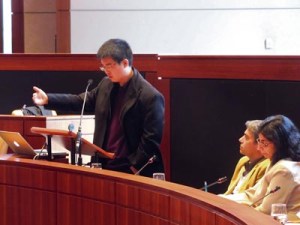
Just wanted to check in and report on the success of a paper session I co-organized with my friends Claire Dwyer, David Ley, and Paul Bramadat at Metropolis Canada.  Here’s the session information:

Immigrant Integration, Religious Diversity and the Suburbs
This session brings together academics and policy makers to discuss the ways in which the civic engagement and integration of immigrants is facilitated through religious institutions and organisations. It focuses on the emergence of new religious spaces in the suburbs of many Canadian cities and the challenge of planning for diversity.

Organizer | Organisateur
Claire Dwyer, University College London
Justin Tse, University of British Columbia
David Ley, University of British Columbia
Paul Bramadat, University of Victoria

Participants
Claire Dwyer, University College London, Justin Tse and David Ley, University of British Columbia
‘Highway to Heaven’: The Making of a Transnational Suburban Religious Landscape in Vancouver

Ranu Basu, York University
Kali in the Legions to Eid with Christmas Lights: Integrative Multiplicity in Toronto Suburbs

Meharoona Ghani, Ministry of Regional Economic and Skills Development, British Columbia
Multiculturalism and Inclusive Communities

Alan Hill, City of Richmond
Cultural Diversity and Integration

Chair | Modérateur
Paul Bramadat, University of Victoria

Discussant | Commentateur
Balwant Sanghera, Interfaith Bridging Project

A CLAIM TO FAME: our session was mentioned by Douglas Todd in The Search for our presentation on religion.  Thanks so much, Douglas, and yes, it provoked some great discussion on religion, secularism, migration, and the suburbs in Canada!

Asian Canadian Writers’ Workshop

On Saturday, 19 February 2011, I joined the Board of Directors at the Asian Canadian Writers’ Workshop (ACWW).

The ACWW was started in 1979 by a group of creative writers who had been influenced by the rise of Asian American movements in the United States.  The term “Asian American” was coined in their first publication with the Powell Street Revue, Inalienable Rice.  Since then, the ACWW has also been the publisher of the only Asian Canadian magazine in Canada: Ricepaper.

The current discussion in the ACWW is to continue the good work of promoting Asian Canadian writing and making Ricepaper more well-known.  My story with Ricepaper began in Fall 2004 shortly after I had moved from the San Francisco Bay Area to Vancouver.  I attended an event with the Chinese Canadian Historical Society of British Columbia (CCHSBC) at the Vancouver Museum, where Ricepaper was also being promoted.  Back then, I was interested in continuing my own creative writing work that I began in high school when I co-founded the literary magazine Sea Changes at Moreau Catholic High School.  Even back then, I was interested in writing on Chinese church experiences as well as moving into academic studies of Chinese Christianity in North America.

Since then, I was aware of Ricepaper, but it was not until I took an Asian American directed studies course with Henry Yu that I began thinking about the CCHSBC, the ACWW, and Ricepaper again.  The president, Allan Cho, got in touch with me in January 2010, and as he was putting together a new board for the next generation of Asian Canadian writers, he was interested in seeing if I wanted to get involved.  It took me about a year.  And so now, I’m on the board.

For now, I understand the mandate of the ACWW to promote Asian Canadian writing, both through Ricepaper and the writing workshops.  If you’re interested, do get in touch with either me or with the rest of the board.  We’d love to get more subscriptions and ideas for promotion.

UPDATE: I left the ACWW board of directors in 2012 because I needed to focus on other personal and professional commitments. However, I still think the world of this board and this magazine and always read their work with interest.

Sing Tao Daily (3 Feb 2011)

At the Metropolis BC conference, I was interviewed by a journalist for Vancouver’s Sing Tao Daily (星島日報).  He asked for supplemental information to our talk on No. 5 Road and wanted to discuss especially the Chinese Christian organizations in the talk.  He asked specifically about new migrants from the People’s Republic of China.

Most of what I said was fairly represented in the following article.  The Chinese version is here.  I have translated most of it (with assistance from family and girlfriend) into English here:

New immigrants are changing the culture of religious communities
Chu Lam (Sing Tao Daily, Vancouver)

An immigration research organization has pointed out that as NGOs and religious communities become increasingly concerned about multiculturalism, multiple levels of officials need more attention and understanding as they make new policies toward minorities’ religions and cultures.

Metro Vancouver’s immigration research organization invited Canadian academics, the government, NGOs, and religious communities for a dialogue on Wednesday.  They spoke from the perspective of all three levels of government on what they should pay attention to in policymaking.

The provincial economic and capacity development organization [Embrace BC] and immigration research Metropolis BC on Wednesday was entitled: Religion and society: a policy research symposium on immigration, multiculturalism, and social change in Canada.  This academic symposium invited the academics, government officials, and NGO leaders from all over the nation to participate in researching minorities and immigrant religious cultures and their impact on the changing Canadian social landscape.

UBC Human Geography’s doctoral candidate Justin Tse used ‘tsunami’ to represent the increasing numbers of PRC migrants to Canada.  He pointed out that Canadian Chinese religious organizations are mostly Cantonese-speaking and are mostly from Hong Kong, and that new migrants from the PRC find a gap in language and political values.  Although there are barriers, Chinese religious organizations are step-by-step incorporating new migrants, and the new migrants are participating willingly and happily because of their curiosity and need for religion, so the religious culture is changing from the inside, and it changes people’s view of politics and culture, causing the policymakers to pay attention.

Ryerson University’s urban planning professor Sandeep Agrawal expressed that up till now, the government has planned insufficiently for religion.  For example, in the Greater Toronto Area, there are 147 religious organizations, but there are only 123 religious places of worship, so on average one of these organizations must serve 10,000 people.  Many religious organizations can only hold their events in residential areas.

Agrawal said that when the government plans the city, they need to have the right amount of religious sites planned, so that they can ensure that multicultural and different religions are incorporated into the city development plans.

——

A FEW CLARIFICATIONS:

Sadly, and perhaps fortunately, I was not the one who coined the term “tsunami.”  I got it from another article written on 5 February 2010 in a Christian newsletter on Canadianchristianity.com on Chinese churches by Meg Johnstone entitled “Chinese churches thrive.”  In my own interviews for my master’s project on a transnational Hongkonger church, there were also people who expressed the phenomenon as new migrants “flooding into” the church “all of a sudden.”  We found similar sentiments expressed by some of the Cantonese-speaking churches on No. 5 Road.  A similar phenomenon was also noted by a fourth-year undergraduate geography student I helped who studied a prominent Cantonese-speaking church in Vancouver for his Research Methods: Migration course in Geography.  So no, “tsunami” is not from me; it is common parlance from the ground.

My comments on language also need to be taken in the context of Chinese Christianity in Metro Vancouver, not religion as a whole.  Most of the Buddhist places I’ve been studying on No. 5 Road are actually Mandarin-speaking: the Lingyen Mountain Temple is mostly from Taiwan (although there is a Cantonese tour guide, as well as a prominent figure who is non-Chinese), as is the Dharma Drum Buddhist Meditation Centre; some of the monks at Thrangu Monastery are proficient in Mandarin in addition to Tibetan.  But 74% of the Chinese Christian churches in the 2007 Vancouver Chinese Evangelical Ministerial Fellowship’s directory are Cantonese-speaking; the major Chinese Christian events also seem to be in Cantonese.  This situation is quickly changing as we speak, though, as many churches have started Mandarin ministries.  Moreover, far from all Mandarin ministry being new, there are also very well-established Mandarin-speaking churches in Metro Vancouver, such as Evangelical Chinese Bible Church (ECBC); I also have some very good Taiwanese Christian friends in the area as well; and Stream of Praise (讚美之泉), a very popular Taiwanese Christian music group based near Irvine in Orange County, CA, comes here to tour quite a bit too (and their Mandarin songs are sung in many Cantonese churches too!).

Christianity is important within the Chinese population because according to the 2001 census, there were more Christians (24%) than Buddhists (15%) within the Chinese population in Metro Vancouver.  For further reading, see Yu Li’s chapter on “Christianity as Chinese religion” in the edited 2010 volume on Asian Religions in British Columbia as well as my 2010 article in Population, Space, and Place on “Making a Cantonese-Christian family.” David Ley also has a section in his new book Millionaire Migrants: Trans-Pacific Life Lines (2010: pp. 213-217) on Chinese Christian churches as new civic spaces as well as a 2008 article in Urban Studies on the immigrant church as an urban service hub that focuses on German, Korean, and Chinese churches in Metro Vancouver.

On the difference of “political values,” I was referring to what my respondents had noted as a difference of political sensibilities between Hong Kong and the People’s Republic of China.  Of course, the PRC is a big place, and Hong Kong is also very diverse, but this was also a common sentiment on the ground.  As I told the reporter, I think the jury is still out on whether PRC migrants are more politically conservative, liberal, apathetic, etc. than their Hongkonger counterparts in Vancouver.  That may partly comprise some of my doctoral research.  Stay tuned.

The paragraph also seems to suggest that I think that Chinese religious organizations in Vancouver will completely change from Hongkonger to PRC.  I think it’s messier than that, although with new migrants coming into the church, some things will inevitably change.  I am starting to see that already.  But will it completely change?  That also remains to be seen.

Lastly, on the policymakers paying attention, yes, I think this was a hopeful sentiment.  I spoke with a policymaker today, however, who couldn’t care less.  But I think this is perhaps the main thrust of my upcoming doctoral project: what are the civic imaginations and practices of Hongkonger Christians in the Pacific region?  If there is change from new, non-Cantonese migration, then perhaps some things may change politically in perhaps swinging religious votes or perhaps affecting land use or perhaps engagement in new forms of civil participation.  Perhaps.  I still have to do the research there.  But yes, like the article, I hope that policymakers do pay attention to Chinese Christians.

All this said, I think this article is overall a fair representation of the interview I gave and the symposium as a whole (at least the morning portions).  My hope is that the comments quoted especially by Sandeep and myself will not be taken as written in stone by the experts but will prompt further research by academics and policymakers as well as deeper reflection on religion and society by the people reading this in their daily newspaper.

Religion and Society: a policy symposium on immigration, multiculturalism, and social change in Canada (Metropolis BC and Embrace BC)

On Wednesday, 2 February 2011, I had the pleasure of being the lead presenter on work done in collaboration among Dr. Claire Dwyer (University College London, Geography), Dr. David Ley (UBC Geography), and myself on Richmond’s No. 5 Road, otherwise known as the “Highway to Heaven” for its over-20 religious institutions on three big blocks of converted Agricultural Land Reserve (ALR).

The talk we chose to give was entitled: Talking infrastructure: another topic for interfaith dialogue on Richmond’s “Highway to Heaven.” I was the lead presenter.

Our main point was that because the “Highway to Heaven” lay on mostly newly-converted ALR, its lack of infrastructure often forced religious institutions to cooperate to get things built, often only as one-off projects.  We discussed three key issues.  The first was that while No. 5 Road has been portrayed as a miracle of interfaith cooperation (mostly in the sharing of parking lots), our research shows that there have been potentials for conflict, particularly within ethnic groups, although these clashes have also tended to be minor.  The second was a demonstration through the case of sewage lines that interfaith collaboration were often one-off projects and that failures and successes were usually not the product of theological or cosmological conflicts.  The third was that policy from the City of Richmond often had the unintended side effects of frustrating some religious practices, such as in the proposed Blundell Interchange onto Highway 99 or the requirement to farm the back third of the lots for tax exemption.

We got great feedback on this project.  People from the City of Richmond who were present were very receptive to our comments and are beginning to discuss with us more possibilities for collaboration to minimize those unintended policy side effects.  We have also begun to learn much more about the ALR as a result and are finding that rural and urban spaces really do matter for geographies of religion.  We also met many members of the Richmond community, including representatives from two interfaith organizations (one English-speaking, another Chinese), who encouraged us to do more thinking along the lines of theological reflection and interaction with the City as good neighbours.  We were very pleased with the turnout for the event and grateful for all the suggestions for our project, which is still a work in progress.

The PowerPoint should be available from Metropolis BC at some point, and I will keep you posted on when.

Other interesting talks of the day included talks by the co-organizers of the symposium, Paul Bramadat (University of Victoria, Centre for Studies in Religion and Society) and Meharoona Ghani (Embrace BC) on the necessity of a policy discussion of religion in a world where faith and politics are increasingly important, especially in British Columbia.  In our panel on Space, Place and the Sacred: Managing Religious Diversity in a Multicultural Society (chaired by Paul Bramadat), there were two colleagues whose work focused on the Greater Toronto Area as comparative sites for British Columbia: Heidi Hoernig (McGill University, Office of Research Services) and Sandeep Agrawal (Ryerson University, School of Urban and Regional Planning).  Another panel on projects from Embrace BC’s Interfaith Bridging Projects featured talks from Clare Whelan-Sadike (Embrace BC), Tahzeem Kassam (DIVERSECity, Surrey), Bruce Curtis (Community Justice Centre, Comox Valley), and Julie Papaioannou (CIC BC/Yukon).  The day was capped by an open discussion on post-secularism led by Paul Bramadat and Julie Drolet (Thompson Rivers University, Social Work), where much of the discussion focused on the need for education for religious literacy at all levels of schooling to address a multicultural, multi-religious society that is increasingly not following the patterns of secularization once prescribed for it in the 1960s and 1970s.

We are looking forward to a larger conversation that will happen at the Metropolis Canada conference to be held in March 2011.  Claire Dwyer and I are co-organizing a session on religion and migration, and our panel will include people from Embrace BC, the City of Richmond, and Richmond’s Interfaith Advisory Committee.

PhD Candidacy

I have some great news: on Friday, 28 January 2011, at 1 PM, I passed my PhD comprehensive exams.  This means that I advance to become what the department calls a PhD Candidate.  Many thanks to everyone who has kept me in their thoughts and prayers!

What does it all mean?

Well, first of all, what it doesn’t mean is that I already have a PhD.  So no, I am not Dr. Justin Tse yet, although the people who work at academic journals seem to like to address me that way (which is flattering, but terribly misleading!).  I’m projecting to finish in 2013, after which (hopefully) I’ll really have a PhD.

What it does mean is that I am now provisionally qualified to do research at the PhD level.  The provision is that in about a month, I need to submit a PhD dissertation proposal (a prospectus, as they’d put it in the States).  A dissertation is basically the integrated book that I need to write by the end of my PhD.  A dissertation proposal details the topic that I will write my PhD dissertation on, the fields that I will engage, and the approaches and methods I will use.  So that is forthcoming in March, and it will have something to do with Christians from Hong Kong in the Pacific region.  Details are being thought out as we speak!

Over the next month, my plan is to work on a few things.  First, there are several conference presentations that I want to squeeze out of a combination of these comprehensives and some work that I’ve been doing in collaboration with Dr. David Ley and Dr. Claire Dwyer on No. 5 Road in Richmond.  Second, there are some articles on religion, Asian Americans, and Hongkonger Christians that I want to see if I can draft this month.  Third, there is the dissertation proposal itself, but I’ve gotten used to thinking about this because of all the grant proposals I had to write from August to October 2010.

So it’s going to be a busy month, but what I can say is that the comprehensives have given me a bit of a boost in terms of knowing literatures on geographies of religion and secularism, Pacific geographies of migration and ethnicity, and urban geographies in the Asia-Pacific a lot better.  Now the task is to see if we can put legs on the literature.

Many thanks to everyone who has supported me thus far!  There’s still about two more years to go, and I’m excited for the real work that is to come!

Comprehensive Exams, 17-21 January 2011

Since 20 October 2010, I have been reading for comprehensive exams.

The PhD in Human Geography at the University of British Columbia requires three exams to be written in the second year of the PhD.  These three exams address three broad fields that will be addressed in the dissertation and that can serve as broad teaching areas for a future career in academia.

My exams are set for 17-21 January 2011.  I sit one exam for each of 17, 19, and 21 January.  These are written, take-home exams where I have to answer two questions about a broad field in human geography; the normal length of each answer is a 7-10 page literature review.  On the following week, I also sit a three-hour oral exam with my doctoral comprehensive exam committee.  Currently, my doctoral committee consists of: David Ley (UBC Geography), David Edgington (UBC Geography), Henry Yu (UBC History), and Claire Dwyer (University College London, Geography).

The rumour has gone around UBC that the Geography exams are among the most difficult in the Faculty of Graduate Studies.  I cannot confirm the truth of this rumour, but what I can say is that it is simultaneously difficult and rewarding.  The aim of these exams is to give a broad understanding of the field and to invite interdisciplinary approaches to the subject matter (which only goes to show how interdisciplinary Geography is as a discipline!).

The three fields I will sit are as follows:

COMPREHENSIVE EXAM #1:
GEOGRAPHIES OF RELIGION, SECULARISM AND SOCIAL THEORY

  • “Old” and “New” Cultural Geographies of Religion (the “old” refers to the Berkeley school of cultural geography led by Carl Sauer, the “new” to Jim Duncan’s turn toward process in the politics of placemaking)
  • Theories of religion
  • Anthropological and sociological approaches to religion
  • Political constructions of secularity
  • Islam and the West: liberal, feminist, and ethnographic approaches
  • Religion and transnational migration
  • Congregational studies (i.e. R. Stephen Warner’s “new paradigm”)

Major thinkers I address in this list include a diverse range: Wilbur Zelinsky, David E. Sopher, Lily Kong, Reinhard Henkel, Peter E. Hopkins, David Ley, Claire Dwyer, Kevin Dunn, Banu Gokariksel, Philip Kelly, Paul Bramadat, R. Stephen Warner, Helen Rose Ebaugh, Janet Chafetz, Peggy Levitt, Steven Vertovec, Peter Berger, Harvey Cox, Emile Durkheim, Mircea Eliade, Clifford Geertz, William James, Rudolf Otto, Karl Marx, Rodney Stark, Max Weber, Talal Asad, Jose Casanova, Michel Foucault, Jurgen Habermas, Stanley Hauerwas, John Milbank, and Charles Taylor.

While religion is the major focus of the list, such a diversity of sources also enables a broader address of the following in future research and teaching:

  • social and cultural geography
  • intellectual histories of the social sciences
  • multiculturalism and migration studies

COMPREHENSIVE EXAM #2:
PACIFIC WORLDS IN MOTION: ASIAN MIGRATIONS AND GEOGRAPHIES OF MIGRATION AND ETHNICITY

  • Theories of international migration
  • The “mobilities” paradigm (John Urry)
  • Multicultural theory and policy
  • Labour migrations
  • Transnational migration studies
  • Second-generation issues
  • Asian American studies
  • Race theory and race studies
  • Asian Canadian studies
  • Pacific Rim studies

Major thinkers I address include: Stephen Castles, Mark J. Miller, Catherine Bretell, James Frank Hollifield, Nancy Foner, John Urry, Ghassan Hage, Robert Putnam, Brenda Yeoh, Katie Willis, Christian Joppke, David Ley, Nina Glick Schiller, Linda Basch, Christina Szanton Blanc, Elaine Ho, Peggy Levitt, Mary C. Waters, Aihwa Ong, Ien Ang, Laurence Ma, Carolyn Cartier, Ronald Takaki, Glenn Omatsu, Sucheng Chan, Lisa Lowe, Jack Tchen, Robert G. Lee, Henry Yu, Helen Zia, Kay Anderson, Dorothy Fujita-Rony, Madeline Hsu, Alexander Saxton, Judy Yung, Peter Ward, Patricia Roy, Charles A. Price, Eiichiro Azuma, Carlos Bulosan, Yen Le Espiritu, Vijay Prashad, Chris Lee, and Peter Li.

While Pacific migrations and ethnicities are the major foci of the list, this list also enables me to address the following in future research and teaching:

  • Globalization theory
  • Citizenship in theory and practice
  • Global economics and geopolitics
  • Theories of social and cultural capital
  • Race and ethnic politics

COMPREHENSIVE EXAM #3
CITIES IN THE ASIA-PACIFIC: HISTORICAL AND POLITICAL ECONOMIC PERSPECTIVES

  • Asian cities in global and regional contexts
  • Colonial and post-colonial cities
  • Global cities/world cities
  • Pacific Rim studies
  • Cities and the welfare state in post-colonial Asia
  • Cities and the neoliberal state in post-colonial Asia
  • Convergence/divergence theory (e.g. Terry McGee’s desakota model)
  • Garden cities and urban utopias
  • Sustainable cities
  • Rural-urban relations and migrations
  • Labour in Asian cities
  • Urban development in Asia

Major thinkers I address are: Terry McGee, David Edgington, W.B. Kim, Anthony King, Fucheng Lo, Peter Marcotullio, Karen Y.P. Lai, Saskia Sassen, Brenda Yeoh, Fulong Wu, S.O. Park, Ryan Bishop, Abidin Kusno, Laurence Ma, Kris Olds, Manuel Castells, H.W. Dick, P.J. Rimmer, Michael Douglass, G.L. Ooi, John Gugler, Jonathan Rigg, Andrew Sorenson, and Dean Forbes.

Though the list focuses on Asian cities in particular, broader areas for future writing and teaching include:

  • Comparative Asian, North American, and European cities
  • Migrant labour
  • Pacific and Pacific Rim studies
  • Urban sustainability
  • Theories of “orientalism”
  • Colonial and post-colonial studies
  • State politics: welfare and neoliberal models

So now…it’s back to reading!  The labour is rewarding, the knowledge both intellectually stimulating and relevant to the contemporary situation.
Gu Xiong, Swimming the River @ Richmond Art Gallery

I am participating as moderator at the Richmond Art Gallery for a panel discussion on Gu Xiong’s Waterscapes on 28 October 2010 at 7:30 PM.  Our panel discussion is titled Swimming the River.

Gu Xiong’s artistic work focuses on the hybrid identities that come from a migrant experience.  He is himself a migrant from Sichuan who sought political refuge in Canada after the Tiananmen incident in 1989.  He makes his home base at the University of British Columbia, and his work has been internationally displayed.

Tonight’s discussion features Gu Xiong himself discussing his work, Parm Grewal from Richmond Multicultural Concerns Society speaking about her work on migrant settlement and anti-racism, and Dr. Glenn Deer from UBC English speaking about migration and hybridity in literature.  I will also speak on my own work in the transnational Hongkonger Christian church as well as the collaborative project on No. 5 Road (the ‘Highway to Heaven’) in Richmond.  The question we address is: what happens when large numbers of people migrate around the world? a question particularly relevant to Richmond, British Columbia, with its 61% visible minority population as of the 2006 Canadian census and its famed 43% Chinese population that has propelled its image as a Chinese ethnoburb.

Admission is free.  The Gallery opens at 7 PM, and the event starts at 7:30 PM.

More information can be found at: http://www.richmondartgallery.org/xiong.php.  A poster for the event is also available at: http://www.richmondartgallery.org/pdfs/RAG-waterscapes-panel-discussion-flyer.pdf.

Making a Cantonese-Christian Family: Quotidian Habits of Language and Background in a Transnational Hongkonger Church (Population, Space, and Place)

My first article is finally out in press.

It is entitled ‘Making a Cantonese-Christian family: quotidian habits of language and background in a transnational Hongkonger church.’ It is part of a special issue of Population, Space, and Place: A Journal of Population Geography on Migration and Everyday Matters: Materiality and Sociality.  Edited by Elaine Ho (Leeds) and Madeleine Hatfield (Royal Holloway, University of London), this issue represents an approach to geographies of migration from the ground up.  We investigate everyday lives and quotidian geographies: how is space materially and socially created by people who have moved from one place to another?

My contribution tackles geographies of everyday life in both the religious dimension and the Hong Kong-Vancouver migration network.  This is based on my MA research, which took place in a transnational Hongkonger church in Metro Vancouver I have anonymised as St. Matthew’s Church.

This paper looks at how St. Matthew’s Church became and is continually reinforced as a transnational Hongkonger church.  For the examination of everyday lives, I use the work of Michel de Certeau in The Practice of Everyday Life as an heuristic, differentiating between strategies in which ordinary citizens consciously plot political resistance and tactics in which people unconsciously and unreflectively use everyday habits to prop up their lifeworlds.  As I suggest in the paper, most of what goes into making a Cantonese-Christian family are everyday habits (de Certeau’s tactics) that are often subtle, unconscious, seemingly insignificant, and unreflected upon, but which turn out to be politically constructive at the end of the day. By advancing the geography of religion, I also am working within the boundaries of new cultural geography in which James Duncan famously showed in The City as Text that geographical landscapes, networks, and spaces don’t just exist superorganically in some abstract space above us, but are in fact constructed politically over time.

Here’s the abstract:

Studies of the Hong Kong-Vancouver transnational migration network seldom pay close attention to religion in the everyday lives of Hongkonger migrants. Based on 9 months of ethnographic fieldwork at St. Matthew’s Church, a Hong Kong church in Metro Vancouver, this paper examines the tacit assumptions and taken-for-granted quotidian practices through which a Hongkonger church is made. I argue that St. Matthew’s Church has been constructed as a Hong Kong Cantonese-Christian family space through the everyday use of language and invocations of a common educational background. This argument extends the literature on Hongkonger migration to Metro Vancouver by grounding it in a religious site whose intersections with Hong Kong migration to Vancouver consolidates the church as a religious mission with a specifically Hongkonger migration narrative. This consolidation is problematised as I show that contestations in church life by migrants from the People’s Republic of China over language and asymmetrical educational backgrounds both reinforce and challenge the church as a Hongkonger congregation. Through an examination of these everyday interactions at St. Matthew’s Church, this paper advances the geography of religion as I demonstrate that specific geographical narratives and networks shape quotidian practices in religious sites.

The paper is available on Wiley-Blackwell’s Early View.  Inquiries regarding the paper can be directed to: jkhtse@interchange.ubc.ca or tse.justo@gmail.com.

AAG 2011: Traveling Faith

Call for papers
AAG Annual Meeting: Seattle, April 2011:
Religion and Transnationalism/ Travelling faith: exploring the intersections of religion and migration

Session organizers: Betsy Olson (University of Edinburgh), Claire Dwyer (University College London) and Justin Tse (University of British Columbia)

This session provides an opportunity to explore the diverse intersections between religion and migration, and the geographies that are produced from this intersection. Within this session we hope to explore the ways in which religious practices and faith identities, practices, and organizations travel with migrants and shape their experiences of transnational lives, or how new religious engagements may be produced through the migration experience. We are also interested in how faith travels and the ways in which religious organisations and institutions are incorporated into or shape migration trajectories and flows.

The session seeks to build upon an ongoing conversation about the new geographies of religion in everyday and exceptional experiences of mobility.  Papers might address intersections of religion with other social and cultural processes in migrant lives; purposeful faith-based migration for proselytization or religious freedom; the technologies and networks of travelling faith; or the role of religion in leaving and arriving ‘home’.  Please email abstracts of 150-200 words to Betsy Olson (elizabeth.olson@ed.ac.uk) by 13 October.

Further information about the conference can be found on the AAG website:
http://www.aag.org/cs/annualmeeting/call_for_papers

APARRI 2010: McCormick Theological Seminary, Chicago, IL (5-7 Aug 2010)

I have returned from Singapore and Hong Kong, and I am leaving tonight for CHICAGO!

The conference is part of a movement called the Asian Pacific American Religions Research Initiative.  Started originally by religious studies academics at the University of California, Santa Barbara, the movement was taken on by the PANA (Pacific and Asian North American) Institute at the Pacific School of Religion at the Graduate Theological Union in Berkeley.  This year, the conference has moved to Chicago and is organized by the Centre for Asian American Ministries at McCormick Theological Seminary.  Some of the major publications from the movement include New Spiritual Homes: Religions and Asian Americans (1999, ed. David Y. Yoo), Religions in Asian America: Building Faith Communities (2002, ed. Pyong Gap Min and Jung Ha Kim), and Revealing the Sacred in Asian and Pacific America (2003, ed. Jane Naomi Iwamura and Paul Spickard).  The conversation every year is a very interesting dialogue among theologians, academics in other disciplines (like me!), and religious leaders.

This year, the conference theme is: Bridging Yesterday and Tomorrow: Memory and Generational Change in Pacific and Asian America.  As the call for papers has it:

Plenaries feature a discussion on memory, the role of personal faith in academia, and an intergenerational panel.  Plenary Speakers include Anju Bhargava (Member of President Obama’s Council on Faith Based and Neighborhood Partnerships), Bandana Purkayastha (Associate Professor of Sociology, University of Connecticut), Peter Cha (Associate Professor of Pastoral Theology, Trinity Evangelical Divinity School), Soong-Chan Rah (Milton B. Engebretson Associate Professor of Church Growth and Evangelism, North Park Theological Seminary), Roy Sano (Bishop, the United Methodist Church), and Mai-Anh Tran (Assistant Professor of Christian Education, Eden Theological Seminary). Concurrent sessions will showcase research-in-progress, and structured mentoring sessions will be available for students and junior faculty members.

I am presenting a paper entitled The Silent Exodus in a Trans-Pacific Migration Context: The Challenges of Youth in a Hongkonger Church in Canada.  It will be similar to the paper earlier this year I gave at the Association of American Geographers’ Annual Meeting in Washington DC.  It will focus more on Generational Change, the session I have been slotted in for 7 Aug at 8:30 AM (early!!!).  Here is my abstract:

Students of ethnic religious congregations in North America have often noted the phenomenon of “the silent exodus” (Carjaval, 1994), a quiet departure of the young people from ethnic religious congregations that has resulted in both diminishing numbers within ethnic congregations and the emergence of second-generation ethnic churches. The often-cited reason for this exodus is language: while the ethnic church tends to operate in an ethnic tongue, the second generation that has been educated in North America prefers English as a lingua franca. But the case of St. Matthew’s Church—the Hongkonger congregation in Metro Vancouver at which I conducted nine months of ethnographic research—has contributed nuance to this view in two ways. First, while the departure of English-speaking youth has been an ongoing concern to members of the church, I also note members of the second generation who have decided to learn Cantonese as a way of preserving their contribution to Canadian multiculturalism. Second, I demonstrate that trans-Pacific migrations also affect generational dynamics in the transnational Hongkonger church: 1) the second generation that knows Cantonese may migrate back to Hong Kong for work and become too geographically distant to attend the migrant church and 2) a ‘second wave’ of migrants from the People’s Republic of China currently takes up more attention in the Hongkonger church than issues of youth and generational transmission. This paper contributes to the study of generations in migrant religious congregations by placing their spiritual needs in the context of in a specific transnational geography of religion that problematizes the dominant view that young people pose the dominant challenge to the ethnic religious congregation in North America.

I’d love to see you there if you’re at APARRI! I can also make my paper available if you’d like a copy.

Chicago, here we come!!!!!