I’m writing this to thank Flyn Ritchie for his coverage of my work on Church for Vancouver even though I’m not one of the speakers at the 2015 Missions Fest Conference. Missions Fest is an annual conference in January started by evangelicals in Metro Vancouver to raise awareness for missionary agencies and Christian non-profit organizations, as well as to promote interactions between churches through large plenary sessions. Putting me alongside actual Missions Fest speakers like North Park Theological Seminary’s Soong-Chan Rah and Operation Mobilisation’s Lawrence Tong, Ritchie says that my work at Regent College this last week (as covered by Ian Young in his South China Morning Post blog) is consonant with an emerging theme at this upcoming MIssions Fest, even though I won’t be there.
This is a very interesting point to me, as I’ve never really thought of my work as having much in common with Rah and Tong. But Ritchie is making me think about how close the academy really can be to the ground. Just as the Regent College talk drew a standing-room only audience that was primarily constituted by members of the Chinese Christian community (both first- and second-generation), my sense is that there is a thriving interest in communities as to what members of the academy are thinking.
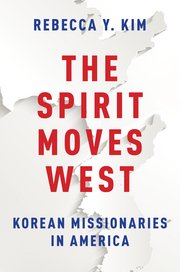
In particular, Ritchie’s post raises the stakes for debates in Global and World Christianity. Rebecca Kim, a sociologist at Pepperdine University, has just written a book called The Spirit Moves West: Korean Missionaries in America, where she details the emergence of three schools of thought in this area – Global Christianity, World Christianity, and American Global Christianity. As Kim sees it, academics with a ‘Global Christianity’ vein examine how Christians participate in processes of political, economic, and cultural globalization and may be complicit even with neocolonial processes in the global economy. By contrast, scholars of ‘World Christianity’ analyze how Christians in non-European and non-American contexts contextualize Christian practices within their own symbolic framework. ‘American Global Christianity,’ which is Kim’s work, looks at how non-Western Christians come to America having been educated in the context of the global political economy and attempt to change Christianity here in America. What’s interesting is that if you read Rah’s The Next Evangelicalism, most people will see his ‘cultural captivity of the Western church’ as a critique of people who participate in American Global Christianity, but he uses work in World Christianity (e.g. Lamin Sanneh, Andrew Walls, Phil Jenkins, and Dana Robert) to get the job done. To all this, I’ll also add a thriving field in the anthropology of Christianity, which is a field of study that Christian communities probably should be grappling with at some point, as it goes beyond contextualization to examining how Christians actually participate in the making of modern cultural practices; examples are Webb Keane, Omri Elisha, Pamela Klassen, Susan Harding, etc. I teach all the views in my trans-Pacific Christianities course, if you’re wondering.
I say all of this because Ritchie is making us think about why these debates matter. Does it matter to communities that there are schools of thought that differ on the question of colonization and Christianity? Does it matter to communities that academic need more funding to do ethnographic field work and quantitative data collection among ‘American Global Christian’ communities? How does it matter? Why does it matter?
Ritchie’s answer is probably that it does matter, which is why he interestingly lumps me, someone who is not speaking at Missions Fest, in with the Missions Fest speakers. In his words:
This has nothing to do with Missions Fest, but it is consistent with the messages of Soong-Chan Rah and Lawrence Tong, and is a good example of a situation in which Asian-influenced Christianity is affecting culture, both in Hong Kong and here in Vancouver.
This statement raises all sorts of questions about how what Ritchie calls an ‘Asian-influenced Christianity’ and ‘culture’ should be conceptualized. It makes me think about what would happen if Rah, Tong, and I ended up on a panel together. Would we really agree? What would be the lines of convergence? Where would we diverge? And, best of all, if this really happens, could we get Rebecca Kim to moderate?
A final thought: if Ritchie is wanting to get a sense of ‘non-Western voices,’ perhaps the Asian Americans on the panel aren’t the only people he should be looking at. Hidden in the program is the presence of my friend and colleague, University of British Columbia philosopher of education Sam Rocha. He is playing music at 1:30 PM before the 2 PM plenary session, and his set will be drawn from his recent soul/jazz album Late to Love, which is his cryptic ‘folk phenomenology’ reading of St. Augustine’s Confessions. For what ‘folk phenomenology’ means, see my review of the album. But folk phenomenology is not read about. It’s experienced – better, it’s encountered. If Ritchie wants to get a sense of what ‘non-Western voices’ feel like, here’s where he’s going to get it.
In short, even though I won’t be there, I’m making an argument about Missions Fest. If you’re going, perhaps the most important thing to see this year won’t be a plenary session or an evangelical charity. Perhaps it will be a little opening ‘Prelude of Praise’ by this Catholic among the evangelicals who will orientate you in precisely the ways that Ritchie wants to describe the ‘non-Western voices’ as doing.
1:30 PM, January 31, Saturday, right before the 2 PM plenary session. Be there.

 Justin K.H. Tse