Guest Lecture: Religion and the Hong Kong Protests (Dartmouth College)

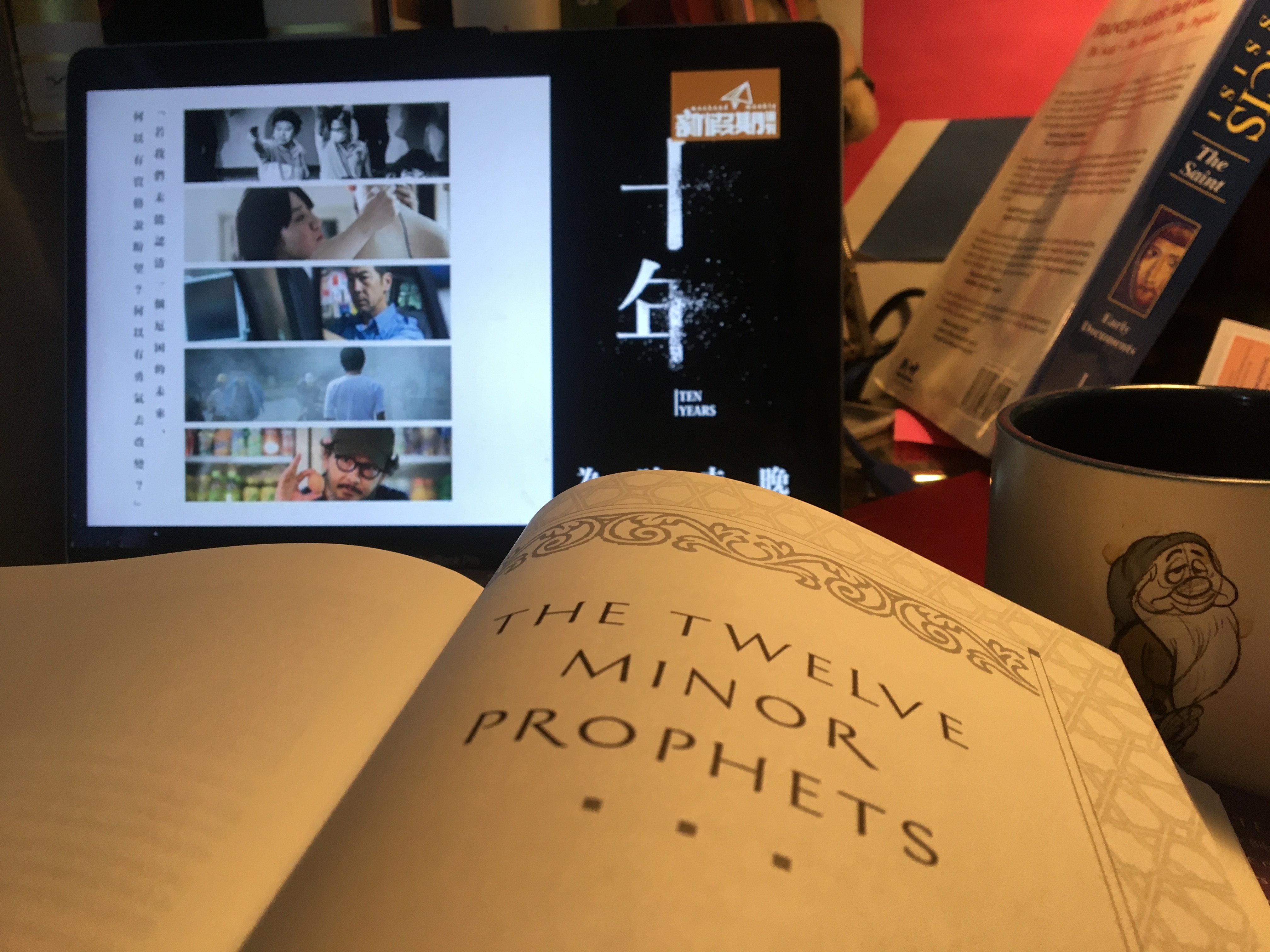
I am so thankful to my colleagues Devin Singh and Jeremy Sabella at Dartmouth College for inviting them to their course on Religion and Social Struggle to talk about Hong Kong. I was able to join into conversation with them some of my thoughts on the film Ten Years, which won many awards in Hong Kong when it came out in 2015.

It’s not the first time I’ve taught Ten Years. At a community event in 2016 in Vancouver, I was invited to offer introductory remarks bridging Ten Years with my edited collection Theological Reflections on the Hong Kong Umbrella Movement. Since then, I’ve taught the film in my courses on Global Chinatowns at Northwestern and Publics and Privates on the Pacific Rim here at Singapore Management University.

Every time I teach the short films that make up this collection, my interpretation gets a little deeper. I think there are some who think that the dystopian nature of the film has very easy geopolitical explanations. But the meditation is much more ontological, and over the time of preparation, it sent me to Robert Alter’s translation of the Twelve Minor Prophets in his Hebrew Bible translation project. In this way, I recognize that this work of teaching is an act of what I have called ‘grounded theologies.’

I’m deeply thankful to Devin and Jeremy for the opportunity to guest lecture in their course, as well as the brilliant engagement of their students with these important events around the world. It helped me to deepen my thinking, and in this time when the value of the academy is being called into question, such conversations reveal that collegiality is not dead and that perhaps we are being invited to develop an intellectual commons with ecological significance.
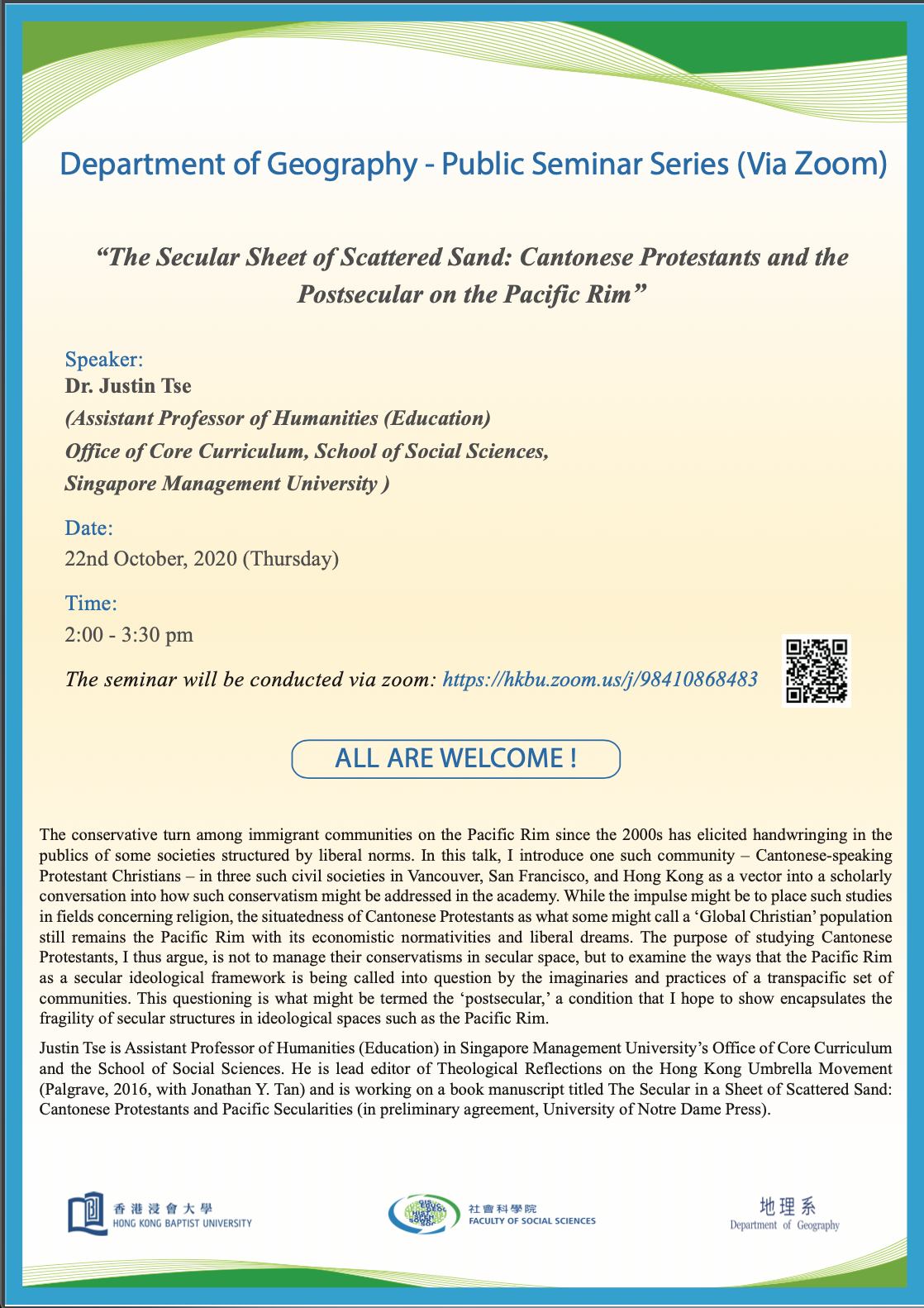
TALK: The Secular Sheet of Scattered Sand: Cantonese Protestants and the Postsecular on the Pacific Rim (Department of Geography, Hong Kong Baptist University)

I just gave a Zoom seminar to Hong Kong Baptist University’s Department of Geography on my book. The talk was titled The Secular Sheet of Scattered Sand: Cantonese Protestants and the Postsecular on the Pacific Rim.

I really enjoyed the conversation that followed. There were so many good friends in the audience. One thing that stood out to me was how, even though the concerns of my book are capped at the year 2012, how much conversation we managed to have about the Hong Kong protests over the last five years, as well as the emergence of nationalisms that might fray the Pacific Rim in the 2010s. Somebody even asked me about the song ‘Sing Hallelujah to the Lord’ and inquired if that was perhaps a form of ‘secular Christianity.’ I said that I had written a piece on The Immanent Frame with exactly that framework. This was, among the many highlights of the conversation, a particularly joyful moment.

Indeed, I insist on this 2012 cap on in my first book project precisely because I am interested in this book on how Cantonese Protestants operated in the heyday of post-1980s Pacific Rim ideology. My next project will be much more about how some have said that it’s all falling apart, even though, as I once said in another version of this talk to my colleagues at my home institution, the Pacific Rim dream might be better described, in the words appropriated from The Princess Bride, as ‘mostly dead,’ as opposed to ‘all dead.’ There I really got my comeuppance. One of my deans noticed that I had attributed the quote to Mad Max. It was, of course, Miracle Max who said these words. The two Maxes are very different, and if one claims professional interest in post-1980s ideology, the eighties references really have to be right. I do, after all, also teach Blade Runner.

I am thankful to Claudio Delang and Lachlan Barber for inviting me. With so many friends across our departments, I deeply look forward to when our paths will cross again.

Christianity Today: ‘Praying for Hong Kong Can Be Politically Disruptive—Even in America’

I am so pleased to have been interviewed by D. Cheng in a Christianity Today article that came out on November 18, 2019, entitled ‘Praying for Hong Kong Can Be Disruptive — Even in America.’ The title, admittedly, is a bit overdetermined. What the article is really about is how Chinese Christians in North America do not really seem to do much by way of explicitly addressing the recent protests in Hong Kong, almost, as I say, for the same reasons that Christians in Hong Kong appear to have been front and centre. ‘Just as Hong Kong Christians most want peace,’ I say to Cheng, ‘those in the diaspora also want peace in their churches and in Hong Kong.’ The question, of course, is what peace looks like.

To me, this Christianity Today article is interesting for its contributions to how Asian American Christianity is conceived. Almost as a follow-up to Helen Lee’s classic pieces also in this magazine on ‘the silent exodus‘ and ‘silent no more,’ terms that were original to the Los Angeles Times reporter Doreen Carvajal in her exploration of Koreatown’s communities in 1994, Cheng’s piece contrasts one clear case of Asian North American prayerful alignment with the Hong Kong protests — the case of the Vancouver Christians for Love, Peace, and Justice group being protested by pro-Beijing elements of the Chinese community at Tenth Church Vancouver — with the reticence of most Chinese Protestant churches in North America to say much publicly about them. Referring also to my journey to Eastern Catholicism in Vancouver, it is almost as if Cheng is making the case that the silence of Chinese churches generating a new silent exodus, a point that also aligns with Esther Yuen’s writing about how Tenth Church is a multi-ethnic congregation formed by ‘mass exodus’ from Chinese immigrant churches as well as my piece showing how Tenth’s senior pastor, Ken Shigematsu, was one of the original planters of Newsong Church in Irvine, California, with Dave Gibbons, who was the poster child of the original ‘silent exodus’ articles by Carvajal and Lee. Narrating my Eastern Catholic conversion in the terms of the silent exodus was indeed provocative for me, and I will have to think some more about its implications and its play on silencing and silences in Asian American Christianities.

I am grateful to Cheng for writing this piece, as well as to Christianity Today for publishing it. I’m also gratified that my communities, both scholarly and ecclesial, could be included in it, the former in the form of the towering figure of Fenggang Yang in the social scientific study of religion and the latter in the ecumenical bonds that tie our Eastern Catholic Church in Richmond to Christians across the theological spectrum. It has also made me reflect on how the book that I am writing on Cantonese Protestants in postsecular civil societies on the Pacific Rim speaks to these apparent silences and motivates me in light of what is happening in Hong Kong to shed light on these complexities.

Vancouver Sun: ‘Douglas Todd: Hong Kong protesters turn 1970s hymn into anthem’

I’m very pleased to have been interviewed as part of the journalist Douglas Todd’s piece ‘Hong Kong protesters turn 1970s hymn into anthem.’ My main role in this article is to sketch how the protests in Hong Kong have been using the Jesus Movement chorus ‘Sing Hallelujah to the Lord,’ which I also did with my colleague Melissa Borja on her Anxious Bench group blog on Patheos, and how Christians may or may not be part of the protests in personal and institutional ways.

I like how Todd positions my comments as the lead-in to the story that he really wants to talk about, which is the hundred or so pro-China protesters who picketed the evangelical Tenth Church Vancouver during a Hong Kong prayer rally organized by an inter-denominational and ecumenical group of clergy. Interviewing one of the clergy leaders Samuel Chiu, Todd sketches a broader picture of Chinese Christians in North America — and indeed, Chinese communities in a more secular sense — that are internally divided in terms of transnational politics.

In addition to the Hong Kong interest, this is a developing and interesting story in Vancouver. I’ve written about the senior pastor Ken Shigematsu before as a ‘different kind of evangelical‘ who emphasizes an Asian Canadian sense of social justice and contemplative spirituality, and I’ve also put an article on Tenth into the Brazilian journal Relegens ThrĂ©skeia. On this particular issue, Shigematsu has commented on the church’s solidarity with ‘justice issues’ in a non-partisan way, and Fr Richard Soo SJ — the Eastern Catholic priest who brought me into the Greek-Catholic church that has formed so much of my recent musings on the postsecular even while I continue to write, research, and teach on publics on the Pacific Rim — has written an op-ed in the Vancouver Sun about how religious solidarity with Hong Kong is not the practice of partisan politics.

I’m thankful to Douglas Todd for reaching out to me. Our first real conversation took place around my doctoral work on Cantonese Protestants, with a focus on the Vancouver case and their politics around sexuality. Since then, his stories have also engaged my work on the ‘Highway to Heaven‘ in the suburb of Richmond, the everyday lives of transnational Asian youth in Vancouver, and the wider implications of my work for the state of multicultural Canada. There was also a fun piece on the relationship between Christmas and ‘Chinese culture.’ I hope to return the favour for him writing about me — and more importantly, doing so with a constructive and critical eye in not so much giving me a megaphone, but really pushing me to figure out what responsibility I have to publics in Richmond, Metro Vancouver, and Canada that I study — by writing about how he has done the same, as I suggested in that dissertation of mine, for Chinese Christian communities in Vancouver.