James Wellman: The Oprahfication of Rob Bell? (University of Chicago Divinity School Religion and Culture Web Forum)

Rob Bell has gotten a lot of attention in the evangelical news cycle over the past few days. As Bell is releasing a new book and is solidifying his association with Oprah, the evangelical and ‘progressive Christian’ Internet networks have been ablaze. Books and Culture, for example, has mocked Bell. The Gospel Coalition has excoriated his new book on marriage. Danielle Shroyer has defended Bell as an evangelical. Sarah Pulliam Bailey has analyzed Bell. Tony Jones has analyzed the analysis.

My concern with much of this analysis is that it has left out the University of Washington’s resident expert on Rob Bell, James K. Wellman, Jr. True, Wellman is my postdoctoral supervisor, which might explain why I’m saying something about him.

But there’s more. It’s not only that Wellman has written a book on Rob Bell (and that the most sophisticated review I’ve seen on it is from my friend and colleague Sam Rocha on Patheos Catholic). The fact is that Wellman, Jon Pahl, and I have gone on record on the University of Chicago Divinity School’s Religion and Culture Web Forum in September to discuss Wellman’s ethnographic analysis of Rob Bell. You can find Wellman’s essay here. Jon Pahl gives a light critique of Wellman being star-struck by Bell’s celebrity. I give an analysis of Wellman’s approach through a distinctive University of Washington approach to religious studies and what I call ‘grounded theologies,’ especially by linking it to both Wellman’s previous work and his predecessor, Eugene Webb.

Have a look. This is no mere evangelical discussion. This is about the academic study of religion – and we have Wellman to thank for making that connection.

Ethika Politika: Hong Kong Catholicism interviews with Artur Rosman

It has occurred to me after I posted on the Missio entry that I have not yet put on this blog my work on the Catholic moral theology venue, Ethika Politika, courtesy of Artur Rosman. I’ve spoken to evangelicals, but I should say that I spend an equal amount of time with Catholics. Rosman interviewed me for a three-part series on the role of Catholicism in the Hong Kong protests. It seems to have also gotten the attention of UCA News, which bills itself as ‘Asia’s most trusted independent Catholic news source.’

The first post is titled ‘Hong Kong’s Moment of Zen‘ and deals with the protesters’ aims and whether religion has been deployed in protest. The ‘Zen,’ of course, refers to Joseph Cardinal Zen, the outspoken retired Bishop of Hong Kong who was with the student protesters from the beginning of their strike. As you will see in this first post, I tried to give a complicated view of the Umbrella Movement:

It depends on what you mean by the “protesters.” There are several different groups involved in this occupation, such as student groups like Scholarism and the Hong Kong Federation of Students and democracy groups from across the political spectrum like the more moderate Occupy Central for Love and Peace and the more radical Civic Passion, as well as individual citizens who aren’t associated with a group. There are also pan-democratic legislators who have joined in the protests. No one claims to be the single leader of this movement, and anyone who does is readily rebuffed.

The second post deals with the ‘Catholic Umbrella in Hong Kong‘ and examines how the Catholic Church has carefully engaged with the protests through the mode of ‘passive compliance‘:

My reading of passive compliance is that it’s taken straight out of the playbook of Zen’s predecessor, John Baptist Cardinal Wu. When Wu became bishop in the 1970s, the diocese was allied with the colonial British government in the provision of schools, hospitals, and charities. However, as the 1997 handover drew near, Wu penned a pastoral letter in 1989 called “March Into the Bright Decade.” The central contention of the letter was that even though the 1997 handover would divide Catholics ideologically between supporters of and protesters against the Chinese regime, the Church should focus on parish formation, developing grounded Catholic communities that could resist division. Passive compliance is taken straight out of Wu’s playbook because it’s the practice of balancing out the ideological divisions within the Church vis-à-vis the state regime.

The third post examines the ‘Theopolitical Chess Game in Hong Kong and China‘ and advances political scientist Beatrice Leung’s framework of Sino-Vatican relations as a geopoltical concern:

Here we see the heart of what passive compliance is about. Cardinal Zen developed ‘passive compliance’ ostensibly because he did not want to officially endorse or oppose the Hong Kong Government’s Election Committee. But what precluded active compliance was that fact that the Hong Kong Government, despite being in a ‘one country, two systems’ framework, was effectively under Chinese sovereignty, a state that persecuted unregistered religious minorities like the Falun Gong and the underground Catholic Church.

I’m thankful to Artur Rosman for these excellent interview questions, through which I got a sense of the kinds of questions a Catholic public would have for this, especially Catholics who think about political theology. I’m also very grateful to the Catholics with whom I got to engage through my field work in 2012, including Joseph Cardinal Zen. As with my engagements with academia proper, the public news, and evangelicals, Catholics are an audience with whom I have enjoyed engaging in conversation (see here and here). I’m glad that I’ve been on the record on this issue – indeed, ABC News and Ethics Report has also picked up on this conversation – and I’m thankful that this public discourse around Catholicism and Hong Kong is shaping publications that I hope to submit soon. In short, I’m thankful to be engaged with this audience, and I hope that this too is a conversation that is only beginning.

Missio: Can American Christians Support Hong Kong’s Umbrella Movement?

Photo: Antonio J. Alonso

This morning, a post that I wrote for Missio, the online publication of the Washington Institute for Faith, Vocation, and Culture, went live. It’s titled ‘Can American Christians Support Hong’s Umbrella Movement‘?

Here’s a sample:

It’s a delicate task to write about how American Christians, especially evangelicals, can care about Hong Kong’s Umbrella Movement. “I shan’t get into details,” the embattled Chief Executive C.Y. Leung told a local journalist, “but this is not entirely a domestic movement.”

Leung’s sentiments echoed the insinuations being passed through the Chinese press. The details, as it was said, were that foreign (read: American) forces had allegedly funded pro-democracy groups like Occupy Central with Love and Peace, Scholarism, and Apple Daily. As the story goes, the Umbrella Movement would end just like the Maidan and Color Revolutions: the supposedly American-funded leaders would lose control of the movement, and the ensuing chaos would destroy it from within.

This is an incredibly popular narrative: when the South China Morning Post interviewed Beijing tourists visiting Hong Kong, they replied confidently that they “of course” did not support the movement: “We know that it’s because university students are stirred up by the American government to take such actions,” they said. One might think that they were channeling Ivan Illich’s 1968 excoriation of America-China relations: “In Asia, the U.S. is threatened by an established power -China. The U.S. opposes China with three weapons: the tiny Asian elites who could not have it any better than in an alliance with the United States; a huge war machine to stop the Chinese from “taking over” as it is usually put in this country, and; forcible re-education of the so-called “Pacified” peoples. All three of these efforts seem to be failing.” Who counts as an “American Christian” is quite loose: if you are “American” and “Christian,” the allegation is that you just might be an interventionist, especially if you don’t actually physically live in America right now. Don’t try to follow up with me to say that you’re actually part of the British Commonwealth; let’s admit that the American empire is really quite the leviathan.

The problem, though, is that this America-in-Hong-Kong narrative’s details don’t add up. Sure, calls for democracy sound awfully American, but the society for which the protesters call looks nothing like America. The students are calling for civil nomination – the election of candidates chosen by the people themselves – which doesn’t really resemble the primary process in the United States, not to mention that the American president is actually indirectly elected by an electoral college.

Read the rest on the Washington Institute’s blog.

As with much of the Washington Institute’s audience, the readership are mostly Anglo-American evangelicals who have a global sensibility. It’s really a pleasure to address this audience as part of my attempt to reach multiple publics with my academic work, including the academy proper, the public media in both Anglo-American-Australian contexts and in Hong KongCatholics, and evangelicals. I’d also be happy to explore other publics as well.

Many thanks to Laura Fabrycky for making this post happen, and to my colleague Sam Tsang for making the connection. I’m as excited about speaking to this evangelical public as I am about my academic and Catholic audiences, and my hope is that this is the beginning of many conversations to come.

CLASS: JSIS C 490C: Special Topics in Comparative Religion: Trans-Pacific Christianities

I am teaching a course next Winter Quarter 2015 at the Henry M. Jackson School of International Studies at the University of Washington in Seattle. It’s a fourth-year special topics class in comparative religion, and it will focus on what I call ‘trans-Pacific Christianities.’

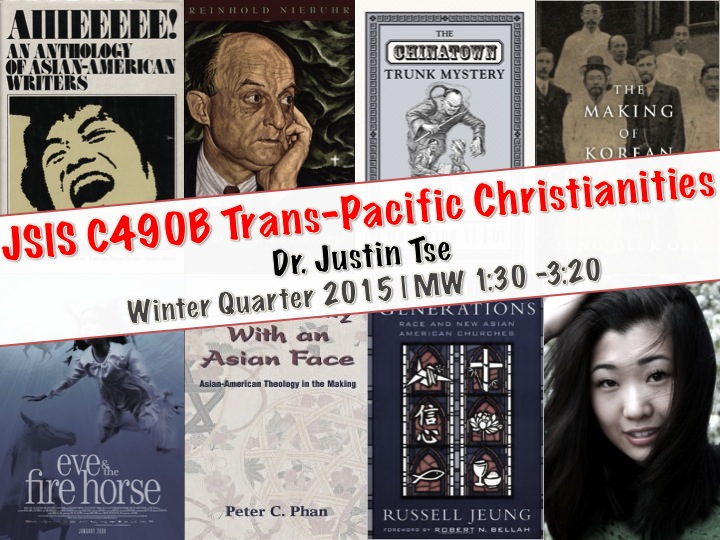
TSE JSIS C490B POSTER

Here’s the syllabus. We will have quite the variety of literary, historical, sociological, and even theological readings. We will read both the Open Letter to the Evangelical Church and Killjoy Prophets’ critique of it à la Suey Park and Andy Smith. We will read both Reinhold Niebuhr’s Irony of American History and the irreverent/bombastic/Asian American nationalist anthology Aiiieeeee! We will watch both Wong Fu Productions’ Just a Nice Guy and Julia Kwan’s Eve and the Firehorse. We will read both the histories of sex in Chinatown and spirits in Korea. We will plough through both Catholic and Protestant sociologies of Asian American Christianities and explore the callings of Asian and Asian American liberation theologies. We will read the Proposition 8 trial transcript featuring Dr. Hak-Shing William Tam, and we will examine both ‘silent exodus‘ and Sa-I-Gu. Our assignments are blog comments and a paper on a topic of your choice. We will criticize all of these people and ideas to no end, and we will let ourselves be criticized by them to no end.

If you are at the UW and want to come have some fun making trouble with us, please consider taking this course. If you have friends at the UW who want to make some trouble, please consider telling them to take this course. The trouble we will make will magnify as we come closer to both discovering and deconstructing what this term ‘trans-Pacific Christianities’ means.

This is going to be fun. I’m excited. I am also heavily indebted to the philosophers of education (especially Sam Rocha) that I met in Chicago last week at the Society for the Philosophical Study of Education for the crafting of this syllabus and for helping me think through how to teach – I’m experimenting with this society being my annual teaching workshop, and I’m anticipating good things coming out from these critical pedagogical conversations.

UPDATE: A previous version of this course was listed as JSIS C 490B. The administration, however, saw fit at the last moment to change it to JSIS C 490C. The poster describes the previous course number, but the content in the transfer from ‘B’ to ‘C’ stayed very much the same.

Video: Open Letter Meets Killjoy Prophets

I have had the privilege recently of meeting Suey Park, an activist whose online work is just the tip of the iceberg for a much deeper theological politics. Park’s new group, Killjoy Prophets, has been quite critical of the Open Letter to the Evangelical Church, an effort in which I was deeply involved last year.

Park and I decided to make a video to talk about how we came at the Open Letter differently. We also explored avenues for further collaboration. A blogpost is due to come out from the both of us in due course reflecting on this conversation, but I just wanted to post the video here for your convenience.

Thanks so much, Suey, for these great thoughts and for this conversation. I look forward to further critical convergences between our work.

UW Graduate Christian Fellowship: Two Hong Kong Umbrellas: Christian ecumenisms and democracy in Hong Kong

I spoke tonight at the Graduate Christian Fellowship at the University of Washington. My talk was titled ‘Two Hong Kong Umbrellas: Christian ecumenisms and democracy in Hong Kong.

Speaking at this event felt like a moment of completeness for me. Previously, I had spoken in a Catholic setting at the UW Catholic Newman Center and at a secular academic talk for the Jackson School at the UW. For the Catholic talk, I focused on the Catholic elements of the Hong Kong protests, and for the secular talk, I focused on the geopolitical imaginaries from Tiananmen that produced the sorts of grounded theologies we see emerging in the Umbrella Movement. Here at this talk hosted by InterVarsity, I zeroed in especially on the Protestants who were forming new ecumenisms, both with the state and among the grassroots people.

The talk was very well-received. While the Catholics asked about Catholics and the Jackson School audience focused their questions on China, this InterVarsity public asked much more about how the Umbrella Movement could be used to think about church-state relations in America. The discussion was very rich and included references to immigration politics, war and anti-war activisms, indigenous politics (with a shout-out to Suey Park and Killjoy Prophets), and African American and Asian American racial politics, including at Ferguson. One even asked about the connections between Martin Luther King, Jr. and the Umbrella Movement – there are many parallels to be explored there! I also got to tell the story about how UW’s Comparative Religion Unit was founded by a lawsuit.

I came away from this talk very encouraged about how my thinking on the Umbrella Movement is being received among various theological publics. I’m coming to appreciate how each of these publics contributes to our kaleidoscope of theologies here at the UW. Thanks, Geoffrey and Ashley Van Dragt, for your hospitality (as always!), and thanks to the attendees of the Graduate Christian Fellowship for making this such a welcoming space for fruitful thinking on how the Umbrella Movement matters to more than Hong Kong.

Columbia Journalism Review: Beware labeling Pope Francis a liberal

Columbia Journalism Review‘s Chris Ip has done a major service for the American public sphere with his report on Pope Francis. Interviewing John Allen, Jr., Inés San Martin, and yours truly, he has put together an article that criticizes the way that American journalists have been reporting on the Vatican, while also remaining sympathetic to the particular tendencies of the American public.

Here’s what I told him:

The media’s tendency to make all religious statements political comes from the heart of American political culture. The US media interprets the pope according to an “American protestant narrative,” where religion is read in terms of what it means for politics, said Justin Tse, a University of Washington scholar on religion and public life. “The question people are asking is, ‘Is the Catholic Church promoting or inhibiting democracy?’” said Tse. “It’s a good question, but when that’s the only question on the table, then you start to twist narratives to fit the agenda.”

You’ll see that I’ve drawn from figures like Tocqueville, Bellah, Marty, Wuthnow, Warner, and Wellman to construct that answer.

I’m very thankful to Chris for taking the time to write such a fine report. I’m hoping that this is the beginning of a much longer and very fruitful conversation.

The Model Minority and the Gospel of Schoolvation | Society for the Philosophical Study of Education | Columbia College, Chicago, IL, November 8-9

I’m thrilled to be presenting at the upcoming Society for the Philosophical Study of Education at Columbia College in Chicago, IL, from November 8-9. This is a bit of a new foray for me. I am a geographer who is currently housed in religious studies, and I never thought that my work would also be considered ‘philosophy of education.’ However, my colleagues in educational studies have convinced me that my work on Asian American, Asian Canadian, and Asia-Pacific Christians and their public activism around schools means that I have something to say.

Ellen Wu’s The Color of Success is a very important takeoff point for my paper. It’s a book I’ve also reviewed.

My paper critiques the internalization of the model minority mythology among conservative Asian Americans because they have deployed it in their politics as a generator of grounded theologies. It’s titled ‘The Model Minority and the Gospel of Schoolvation.‘ Here’s the abstract:

This paper explores the circulation of philosophies of education among upwardly mobile Asian Americans. Despite the stated axes of political difference among liberal and conservative Asian Americans on sexual politics, tax revenue, and the role of government in welfare provision, one point of philosophical convergence among Asian Americans is that public education plays what Sam Rocha (forthcoming) calls a ‘salvific’ role in delivering young people from downward class mobility. Preaching the ‘gospel of schoolvation,’ Asian Americans such as Michelle Rhee (a Democrat) and Hak-Shing William Tam (a Republican and one of the five official proponents of California’s Proposition 8) use positivistic empirical criteria to declare that schools must do more to save their students from racial marginalization. Indeed, this paper’s central argument is that this version of the gospel of schoolvation grounds a racially constituted philosophy of education to construe Asian Americans as a model minority, a racialized group that models how empirically rigorous education can lead a racialized community out of marginalization from a white mainstream. Showing that this philosophy has in turn been exported to Asia-Pacific nation-states to fuel their participation in a global economy, I probe how race is wrapped up with soteriological accounts of schools, challenging philosophers of education to explore how educational theories construct grounded political realities.

All are welcome. Here’s the schedule. I look forward to the interaction at this conference, especially because other scholars of religion and the social sciences (especially Silas Morgan) will also be there masquerading as philosophers of education.

UPDATE: At this conference, I was made secretary for the group for one year, which means that at least persons at this conference might consider me to some extent an ex officio ‘philosopher of education.’ However, I prefer to say that the SPSE is the society that is my ‘teaching workshop,’ a group that I try to attend where people help me think through how I teach. Certainly, this has helped with the preparation of teaching statements, but more importantly, it has helped me become more intentional as a teacher, and for that I am grateful.

ABC Religion and Ethics Report: The role of religion in Hong Kong’s Umbrella Revolution

I was recently on the Australian Broadcasting Company’s (ABC) Religion and Ethics Report with Andrew West talking about ‘the role of religion in Hong Kong’s Umbrella Revolution.’ The other guest on the show, Professor David Palmer, is a sociologist of Chinese popular religions who chairs the University of Hong Kong’s sociology department. They told me that they found me because of my interview with Jennifer Ngo on the South China Morning Post on religion in the Hong Kong protests.

Andrew West asked some very good questions during this show. He began with my comments on Religion Ethnicity Wired and on Ethika Politika (parts 1, 2, and 3), on the Catholic Church in Hong Kong. We then moved into a clarification of how Protestant denominations and ecumenical alliances have been at work on the ground, and we had an extended discussion on the controversial role played by Hong Kong’s Anglican primate, the Most Rev. Paul Kwong, in opposing the demonstrations. Finally, West asked about the connection between the protests and religious freedom in China, to which both Palmer and I emphasized that the Umbrella Movement has little to do with ‘religious freedom’ per se, but that does not mean that people like Joseph Cardinal Zen might not have it in the back of their minds.

I’m very thankful to Andrew West and Scott Spark for an excellent interview and for this chance to meet David Palmer on air. I’m also thankful to Jennifer Ngo for creating this opportunity to speak more about the Hong Kong protests. I’ve actually regularly podcasted ABC Religion and Ethics Report during my commutes, and I was thrilled to be on this show that provides such consistently good religion reporting.

The legal implications of ‘internal doctrinal disputes’: Chong v. Lee, Asian Canadian congregational fractures, and new religious publics in Vancouver, BC | Society for the Scientific Study of Religion | Indianapolis 2014

Congregation in front of the Christ Church of China, Vancouver, B.C., 1955 | Creator: Leong Ding Bong | Source: UBC Library Digital Archives

I am pleased to be presenting a paper at this current Society for the Scientific Study of Religion in Indianapolis during this weekend of 31 October to 2 November.

My paper is titled ‘The legal implications of ‘internal doctrinal disputes’: Chong v. Lee, Asian Canadian congregational fractures, and new religious publics in Vancouver, BC.’ It will be given at 1 PM on 31 October, in White River Ballroom B of the JW Marriott Indianapolis in a session titled ‘Religion, Policy, Doctrine.’ Here’s the abstract:

This paper explores the legal implications of immigrant congregational fractures. Examining British Columbia’s 1981 precedent case Chong v. Lee, I explore how internal congregational disputes regarding both the meaning of Chineseness and the practice of baptism at Vancouver’s Christ Church of China produced the Canadian legal doctrine that religious property cannot be diverted for theological purposes that differ from the community’s founding teaching. Drawing 50 key informants interviews, I argue that the private congregational tensions often explored in ethnographies of immigrant religious communities must be re-examined for their legal implications. Not only have other Asian Canadian communities drawn on the Chong case to take their internal theological disputes to court, but Anglican parishes (including three Chinese Canadian ones) departing from the Vancouver diocese over sexuality issues engaged the precedent to insist on keeping their buildings. This paper intervenes in the sociology of religion by insisting that putatively private congregational dynamics in immigrant religious communities inevitably engage the state’s legal apparatus.

I will focus mostly on Chong as a legal precedent and will attempt once again to engage the social scientists of religion here with an argument on the constitution of congregational space. All are welcome. I look forward to a great conversation.