AAR 2013: Asian North American “Conservative” Christian Communities, Masculinities, and Gender Issues

I had the privilege of organizing a panel for the upcoming American Academy of Religion (AAR) meeting in Chicago, IL.  It is sponsored by the Asian North American Religion, Culture, and Society (ANARCS) Group and will feature a very diverse panel of scholars speaking about masculinities and gender issues in “conservative” Asian American and Asian Canadian communities.  Here is our abstract:

This panel session explores the “conservatism” of certain Asian North American religious communities, particularly evangelical and fundamentalist Christian ones, around gender issues. By gender “conservatism,” we refer to attempts to reinforce heteronormative, patriarchal practices both within Asian North American religious communities and without in civil society.

Our panelists will discuss 1) the usage of evangelicalism by Korean American men to restore a sense of empowerment, 2) the appropriation of Asian American tropes of mixed-martial arts and “linsanity” (following the recent stardom of Jeremy Lin) by conservative evangelicals at large to reconstitute masculinities, 3) the experience of a trans-male in a Korean American Christian community in New York, 4) the activism of conservative Asian Americans in opposing LGBTQI rights in America, and 5) the exploration of conservative Asian North American religious groups in a Canadian context who oppose sexual equality despite its federal legal status. A feminist ethicist will respond.

The panel will be chaired by Michael Sepidoza Campos (GTU) and will be responded to by Grace Yia-Hei Kao (Claremont School of Theology).  The panelists themselves come from very diverse backgrounds and espouse fairly different academic approaches; they are: Mark Chung Hearn (Azusa Pacific University), Steve B. Hu (UC Santa Barbara), Sung Won Park (Union Theological Seminary), Patrick S. Cheng (Episcopal Divinity School), and myself.  Our aim in assembling this very diverse set of voices is to encourage conversation on a topic that has been seldom discussed in Asian North American religious studies, not to mention academic discussion more generally.

I will be speaking on the intersection of Asian Canadian studies and the need to contextualize the traditional sexuality activism of Cantonese Protestants in Vancouver, British Columbia, within their engagements with Canadian civil society.  My take on the panel is that these issues require a fair, accurate, and scholarly interpretation from the academy and are not served well by caricatures, particularly as stereotyping often leads to the very forms of socially unjust orientalizing racism that are increasingly unacceptable in our civil society.

The panel will take place Sunday, 18 November 2012, from 9 AM to 11:30 AM and all those registered for the AAR meeting are warmly invited to join in what promises to be an exciting conversation.

——-

On Monday, 19 November 2012, I will also be presiding over another ANARCS panel entitled “Boundary Crossings: New Directions in Asian American Theologies.”  This panel will feature Barbara Yuki Schwartz (Garrett-Evangelical Theological Seminary), Simon Joseph Kierulf (Union Presbyterian Seminary), Yeon Yeon Hwang (Graduate Theological Union), and Ren Ito (University of Toronto), and the respondent will be Nami Kim (Spellman College).  The panel will be held from 1-3 PM, and it will be followed by the ANARCS Business Meeting.

Vancouver Sun: Census: Mandarin, Cantonese top immigrant tongues in Metro Vancouver (Kelly Sinoski)

Jun Xiao, who immigrated to Canada from Nanjing, China in 2011, speaks Mandarin at home with his wife Dan, 19-month-old child Michael, and mother-in-law Aiping at their suite in East Vancouver.
Photograph by: Mark van Manen , Vancouver Sun
(Source: Vancouver Sun: http://www.vancouversun.com/Census+Mandarin+Cantonese+immigrant+tongues+Metro+Vancouver/7442441/story.html)

I was quoted in today’s Vancouver Sun on census data that indicates a high concentration of Cantonese and Mandarin being spoken in the Metro Vancouver area. The online version was published yesterday. You’ll find the article in today’s paper on p. A4.

Kelly Sinoski’s article is part of a series she’s doing on emerging census data.  As Henry Yu (UBC History) her, many of the sites where these languages are spoken are in Chinese churches.  Sinoski followed-up with an interview with me on Tuesday morning and then printed this yesterday.  I told her about Chinese churches as extended family sites, as I had written about in my 2011 Population, Space, and Place article on “Making a Cantonese-Christian family.”  She included arguably the funniest quote that I received during my MA research for the article:

Justin Tse, a UBC grad student who is studying the phenomenon, said the church often provides newcomers with a sense of family and connectedness. One of his research subjects, for instance, told him that he often attends church, but usually falls asleep during the sermon and wakes up when it’s over.

“It’s a lot like going to your dad’s house,” he said. “There’s a strong sort of familial feeling.”

You’ll find the exact transcript quote on p. 761 of the academic article.  Thanks, Kelly, for the quote–it was fun chatting! And thanks, Henry, for making the connection!

Homo Religiosus? Religion and Immigrant Subjectivities (co-authored with David Ley), in Religion and Place: landscape, politics, piety (eds. Peter Hopkins, Lily Kong, and Elizabeth Olson)

I just received my copy of Religion and Place: landscape, politics, piety put out by Springer and set for a 2013 release date.  It’s edited by my friends, Peter Hopkins (Newcastle University, Geography), Lily Kong (National University of Singapore, Geography), and Betsy Olson (University of North Carolina–Chapel Hill, Geography), and it’s got a great line-up of geographers of religion contributing in its various chapters, including Banu Gokariksel, Anna Secor, Sarah Moser, Nimrod Luz, Lynn Staeheli, Caroline Nagel, Barbara Bompani, Giselle Vincett, David Conradson, and Julian Holloway.

My supervisor, David Ley (University of British Columbia, Geography), and I co-authored a chapter entitled Homo religiosus? Religion and immigrant subjectivities” based on Ley’s 2010 lecture for the Association of American Geographers’ Geography of Religions and Belief Systems annual lecture series.  I contributed a great deal of citations to make the chapter relevant to theology and religious studies (fields that Lily Kong [2010] has been pushing us to get involved in) as well as some empirical material on Chinese Canadian evangelicals, especially from my 2011 article on a Cantonese Christian congregation published in Population, Space, and Place.  Our chapter suggests that while there has been a great deal of interest in the relationship between religion and migration, little has been done from within the theological frameworks of religious migrant practitioners themselves. We attempt a thought-experiment with transnational Chinese migrants to Vancouver who attend Christian churches to examine their religious practices from an explicitly theological perspective.

One of the innovative elements of this book is its explicit openness to doing social science of religion from within theological frameworks, as can also be seen from Julian Holloway’s chapter.  To me, this raises questions about how human geographers do religious studies similarly and differently from their social science counterparts in sociology and anthropology.  The editors and the contributors are very excited about the release of this book, as it signals a growing interest within human geography in religion and the growing significance of various approaches to religious studies in the social sciences more generally.

CFP: AAAS 2013: Empire and Asian American Religions

Call for Papers
Empire and Asian American Religions: approaching religion in ethnic studies
Association of Asian American Studies 2013: Seattle

Religion has a contested place in Asian American studies, especially as it pertains to themes of empire.  The work of American missionaries in their attempts to “civilize” the “inassimilable alien Oriental” is continuously critiqued as having enacted narratives of white supremacist racism under the guise of benevolent activity.  Moreover, Asian American religion scholars such as Jane Naomi Iwamura (2011) and Joseph Cheah (2011) have demonstrated that appropriations of Asian American religions in American popular culture have perpetuated ideologies of orientalization toward Asian American religious practitioners.  Indeed, a recent president of the American Academy of Religion, Kwok Pui-lan (2012)—herself an Asian American—laments the complicity of religious studies with imperializing projects.

However, as recent work in Asian American religious studies, including the publication of a Pew Forum report on Asian American religions, has shown, religion is an inescapable part of many Asian American communities.  This paper session attempts to collect papers that span this seeming paradox in an attempt to chart a way forward in approaches to religion in Asian American studies.  How are religions in Asian American studies to be studied, given the imperial context in which many approaches have been complicit?  Will the approaches differ between progressive traditions and conservative ideologies?  Are religions inescapably imperialistic, or do they, as Kwok Pui-lan suggests, hold within themselves keys to imagining an alternative world where the marginalized can speak back?

We welcome both theoretical papers and empirical studies.  Suggested topics include:

  • Theoretical approaches to religion in Asian American studies
  • Religion and discourses of the inassimilable alien
  • Religion and white supremacy
  • Religion and anti-racist politics
  • Religion and post-colonial imaginings
  • The role of religion in reinforcing and/or challenging orientalizing discourses
  • Progressive religious traditions and their relation to empire
  • Conservative religious ideologies and their relation to empire

Please submit all paper proposals to Justin K.H. Tse at tse.justo@gmail.com no later than October 20, 2012 for consideration.

*UPDATED* CFP: AAG 2013: Post-secular spaces; ORIGINAL: CFP: AAG 2013: Debating Secularization: Theory and Practice in Geographies of Religion

*UPDATE*
Betsy Olson (UNC Chapel Hill, Geography) and Banu Gokariksel (also UNC) have been in touch with me.  The themes set out in their CFP is so similar to mine that we might as well make it a joint effort.  I am now referring all interested persons in my original CFP to their paper session.  Here it is:

AAG Annual Meeting, Los Angeles, April 9-13, 2013
Post-secular spaces: geographical explorations beyond secular theory and research

The aim of this paper session is to explore the parameters of post-secular research and theory in Geography. From Habermas to Asad to Butler, post-secular theories and approaches unsettle previously taken-for-granted relationships between religion, the state, and society.  The challenge posed by post-secular theory is not to study religion more, or to study religion in isolation, but rather to re-view moments, meanings and events without the assumptions of secularization theory – that is, without assuming that religious practices, values and institutions have been historically or contemporarily irrelevant or marginalized in the functioning of ‘modern’ societies. As a critique of secularization theory, post-secular approaches encourage us to uncover and analyze the lingering and overt presence of religion in our social interactions, our economies, and in the everyday and exceptional practice of politics. Less clear in these broader debates (and, arguably, within geographical scholarship on the topic) is the relevance of space and spatial theory in either the theoretical development or empirical analysis of post-secular approaches.

Our hope with this paper session is to begin consolidating and synthesizing the spatial concerns of post-secular theory by exploring emerging empirical research on new (and old) interrelationships between religion, society, politics, and economy. We would especially encourage contributions from scholars who don’t consider religion to be their central interest, but have perhaps been trying to explain religious influence upon economic, social or political practices. Papers might therefore be either historical or contemporary studies, and could address themes such as:

·      Religion and technologies of communication
·      Geopolitics in the secular age
·      Class and religion
·      Spirituality in social movements
·      Religion, labor and rights
·      Environmental ethics and spirituality
·      Law, secularism, and religion
·      Piety, embodiment, and the body
·      Secularism and public space
·      Religion and the economy
·      Feminism and the secular critique
·      Popular culture and religion

Please send your abstract of no more than 250 words to Betsy Olson (eaolson@email.unc.edu) and Banu Gökarıksel (banug@email.unc.edu )

MY ORIGINAL CFP:
Debating Secularization: Theory and Practice in Geographies of Religion
Sponsored by the Geography of Religions and Belief Systems Specialty Group
AAG 2013: Call for Papers

Recent work in geographies of religion has suggested a need for the tenets of the subfield to be debated.  Lily Kong (2010) argues, for example, that not enough work has been done to examine the theological and metaphysical aspects of geographies of religion and to engage the interdisciplinary enterprise of religious studies.  An emerging topic of debate is secularization and whether or not emerging geographies of religion can be seen as post-secular spaces.  While Beaumont and Baker (2010) argue that cities with new configurations of faith-based organizations are developing new post-secular approaches to social activism, Kong (2010) cautions against this idea for its over-emphasis on European phenomena.  On the other hand, Justin Wilford (2011) argues that religious phenomena, while significant, need to be conceptualized as ‘sacred archipelagoes’ in a sea of secularity, for secularization has in fact affected all facets of modern religious practice.  The theoretical underpinnings of geographies of religion and its requisite attachments to the secularization thesis are thus currently under debate.

This session calls for papers that examine the theory and practice in geographies of religion in light of these debates.  Papers that will be submitted do not necessarily need to be completely theory-oriented papers; indeed, empirical studies that contribute to these theoretical debates, as well as papers that deal with theological and metaphysical issues, will both be strongly considered.  Suggested topics include:

  • Geographical studies that either support or refute the secularization thesis
  • Theological and metaphysical treatments of religious themes in geography
  • Post-secular cities
  • Faith-based organizations and their treatment of religion and the secular
  • Geographies of religious migration, with a theoretical treatment of religion and the secular
  • Interfaith geographies as religious, secular, or post-secular phenomena
  • Positionality in the theory and practice of geographies of religion
  • Religious geopolitics as religious, secular, or post-secular phenomena
  • Non-European geographies of religion and their relation to secular geographies
  • Feminist approaches to geographies of religion and the secularization thesis

Papers should be submitted to Justin K.H. Tse at tse.justo@gmail.com no latter than October 20, 2012 for submission to the AAG.

Association of American Geographers: Geography of Religion and Belief Systems (GORABS) Specialty Group, Summer 2013 Newsletter (vol. 34, no. 1)

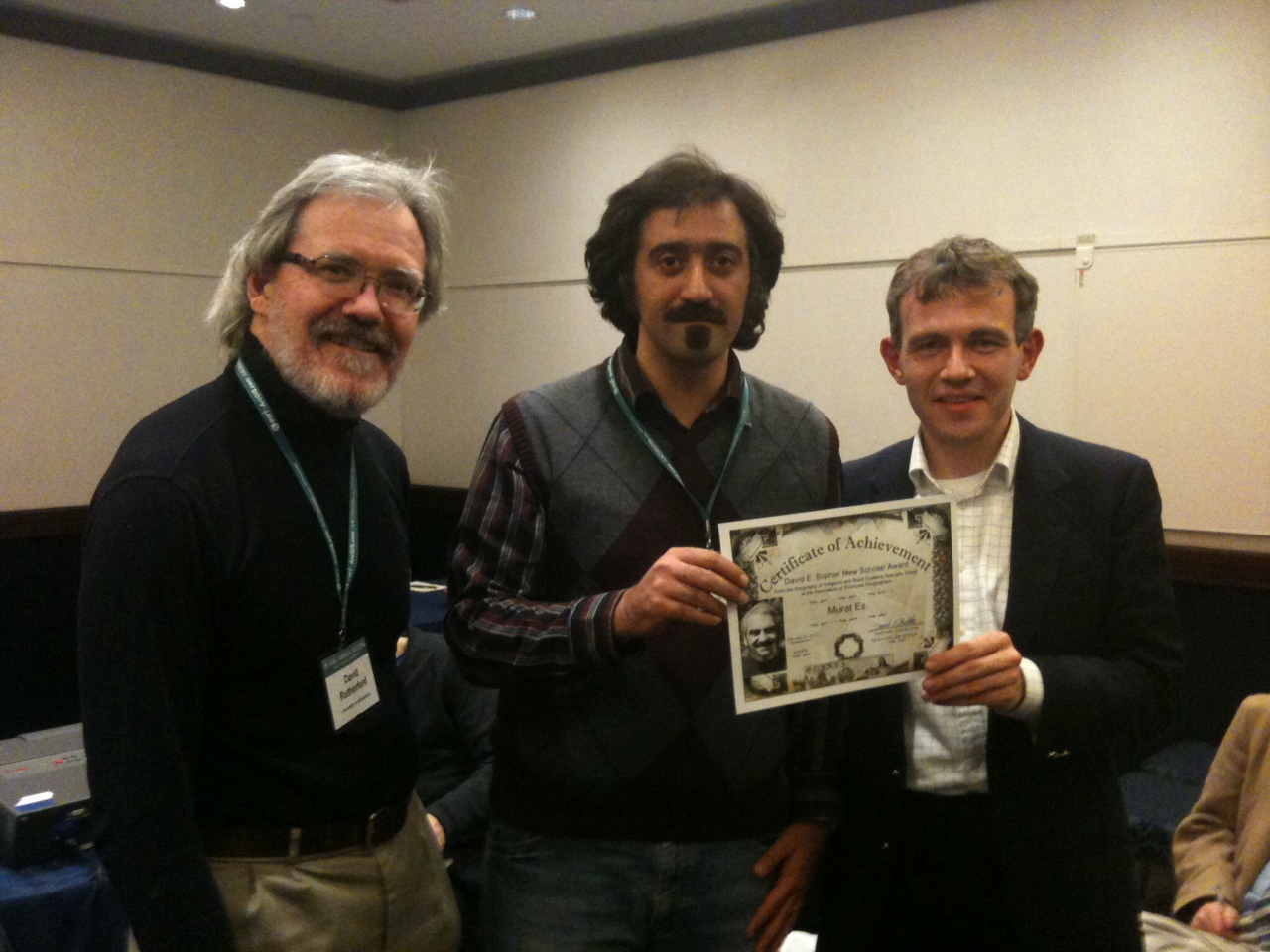
It’s our pleasure to circulate the first issue of the 2012/2013 newsletter for the AAG’s Geography of Religion and Belief Systems (GORABS) Specialty Group.  In this issue, you will find reports from both the AAG Annual Meeting, including notes from our annual lecturer Professor Ceri Peach, and the RGS-IBG Conference.  Minutes from both business meetings are also included.  We also congratulate Murat Es, PhD Candidate in Geography at the University of North Carolina at Chapel Hill, who was our Sopher Award winner for this year, and we encourage all interested applicants to submit papers for the 2013 Sopher Award.

Murat Es (centre), with David Rutherford (left), GORABS treasurer, and David Butler (right), GORABS chair, at the AAG Annual Meeting in New York

All these items, with details and member news, are included in this issue!

If there are any questions, comments, or omitted items that were previously submitted but not included, please do not hesitate to contact me. We have posted this newsletter on our online site, and if there are any corrections from members, we will certainly rectify those errors.

Book Review: Issei Buddhism in the Americas

Image

I recently had the privilege of reviewing Duncan Ryuken Williams and Tomoe Moriya’s edited volume, Issei Buddhism in the Americas (2010) for the Journal of Asian American Studies. It’s out in the most recent issue (15.2).

I liked the book quite a bit, and I think it shows in the review. I was really struck by how much of it was done in relation to Asian American Christianity and was very intrigued by its call to ramp up Buddhist studies for a more comprehensive contribution to religious studies, Asian American studies, and Asian studies. It features some very strong essays that serve as great introductions to various scholars in Asian American Buddhist studies and presents the key sources of historic first-generation Japanese American forms of Buddhist practice and teaching very well. I also appreciated them reaching out to Latin American and Canadian contexts as well in an attempt to paint a fuller picture of the Americas.

Thank you, JAAS, for inviting me to write this review. I want to thank Cindy Wu, the book reviews editor, for managing the review process so well. I also thank Rudy Busto (UC Santa Barbara) and Sharon Suh (Seattle University) for their very encouraging and constructive comments on earlier drafts of the piece and for being such inspiring mentors as the field of Asian North American religious studies continues to grow.

Converge Magazine, 7: Out of Order

Image

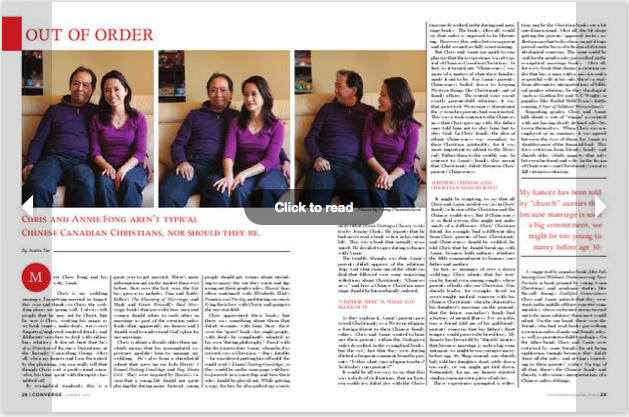
I recently wrote a piece on my wedding manager and his wife, Chris and Annie Fong, as a reflection on Chinese evangelicals and marriage. It is available in the current issue (#7) of Converge Magazine, a Canadian evangelical publication targeted to young people. This sort of popular article stands in the tradition of religion scholars such as Christian Smith, Tanya Luhrmann, and Russell Jeung writing in confessional magazines as a way of disseminating their academic research.

This article wrestles with the looseness of terms like ‘Chineseness,’ ‘evangelicalism,’ and ‘biblical gender roles’ and asks readers to consider narrative as a way of Christian spirituality that is more grounded than ideal typologies. Those who are more academically inclined will understand that I am drawing heavily on literature from critical Chinese diaspora studies, Asian American studies, and post-liberal theologies to make my point. Those who are attuned to issues within evangelicalism will recognize the gender debates around hierarchicalism, complementarianism, and egalitarianism as I review some of the existing popular evangelical literature on gender, sexuality, and marriage. It’s not written with a very academic tone; it’s meant for a wide, popular audience; and it’s absolutely meant to muddy the waters of simplistic, orientalist notions of East v. West for evangelical readers.

My hope is that this article is helpful to evangelical communities while serving as a source document for people interested in Asian North American religious studies. I want to thank Chris and Annie for letting me write about them, Shara Lee for being a fantastic editor, Casey Phaisalakani for taking great photos, and Carmen Bright for designing this so well.

Guest Lecture: Asia-Pacific Transnationalisms and Urban Geography

Tonight I am giving a guest lecture on Asia-Pacific transnational migrations and urban geography in a course on urban geography (Geography 350) at the University of British Columbia at Vancouver taught by my friend, Nicholas Lynch. I’ll be discussing transnational urbanisms, the feminization of migrant labour, Chinese transnationalisms and alternate Asian modernities, and the desire for global cities in the Asia-Pacific.  Of course, I have a plug on religion, migration, and the city toward the end as well.

I’m hoping to be able to do a few more guest lectures so as to have some talks prepared for when I get to teach a full-on course in topics such as urban geography, migration studies, and ethnic studies.

HKReporter: 天外有天 第19集 [The Sky Beyond the Sky, Ep. 19]- 快必、David、偉業、大曹 / 嘉賓: Justin [Fastbeat, David, Wai Yip, “Big Cho” / Guest: Justin]

I should have posted this earlier. On 5 April, at the tail end of my field work period in Hong Kong, I was interviewed by a bunch of people I had interviewed for my PhD project. They had all finished theological training at Chung Chi Divinity School (崇基學院神學院) in Sha Tin, Hong Kong and were mostly associated with a progressive church movement known as Narrow Road Church (路小教會). I made most of my interviewees, including the theologically and socially conservative ones, aware that I had this interview in my schedule, and most were fine with it, which speaks to a good level of civil discourse among Christians who might disagree otherwise on various issues.

I went to their studio at HK Reporter in Wan Chai, where they interviewed me for about an hour on my PhD work. We talked about practicing cultural geography, social conservatism among Chinese Christians, and the idea that Chinese Christian activism might take place along multiple subjectivities.

The interview is in Cantonese.  You can hear it here. (Note: there are two parts.)

The comments are fun to consider too. The most frequent comment was that my accent is Singaporean and that the hosts had mistaken me for a joksing (“flying bamboo”) North American Chinese. They need to read my post with Schema.

I am open to engaging people from a variety of perspectives about these interviews that I’ve done, and I am happy to be corrected or given alternative perspectives as I develop my thoughts and write them up.