Association of American Geographers, 9-13 April 2013: Los Angeles

I am right now at the Annual Meeting of the Association of American Geographers. I’m mainly attending religion panels and meeting with lots of geographers, putting what I do in conversation with everyone else. You can find the rundown of geography of religion events here in the AAG’s religion newsletter.

I am presenting as part of a panel on Post-secular Spaces: Explorations Beyond Secular Theory and Research. It’s organized by two geographers at the University of North Carolina – Chapel Hill, Banu Gökariksel and Betsy Olson. Here’s the session description:

The aim of this paper session is to explore the parameters of post-secular research and theory in Geography. From Habermas to Asad to Butler, post-secular theories and approaches unsettle previously taken-for-granted relationships between religion, the state, and society.  The challenge posed by post-secular theory is not to study religion more, or to study religion in isolation, but rather to re-view moments, meanings and events without the assumptions of secularization theory – that is, without assuming that religious practices, values and institutions have been historically or contemporarily irrelevant or marginalized in the functioning of ‘modern’ societies. As a critique of secularization theory, post-secular approaches encourage us to uncover and analyze the lingering and overt presence of religion in our social interactions, our economies, and in the everyday and exceptional practice of politics. Less clear in these broader debates (and, arguably, within geographical scholarship on the topic) is the relevance of space and spatial theory in either the theoretical development or empirical analysis of post-secular approaches. This paper session hopes to begin consolidating and synthesizing the spatial concerns of post-secular theory by exploring emerging empirical research on new (and old) interrelationships between religion, society, politics, and economy.

My paper is on Friday, 12 April 2013, at 1 PM at the Pacific Ballroom Salon 3 in the LA Hotel, 3rd floor. It’s titled Cantonese Protestant Activism and Secular Geographies: religion, ethnicity, and the secularization thesis. Here’s the abstract:

Geographers of religion have long assumed that the resurgence of religious practice in contemporary spaces are signs of the vitality of religion, demonstrating the falsity of the secularization thesis.  Fieldwork that I conducted in 2011 and 2012 with 140 Cantonese-speaking Protestant key informants and 115 Cantonese-speaking Protestant focus group participants in Vancouver, San Francisco, and Hong Kong would seem to indicate no different, for they have been active in advocating for traditional family values and offering social services to the poor through religious agencies.  While some might label these signs of post-secular geographies, I follow Wilford’s (2010) argument that geographies of religion need to be conceptualized in the context of secularization in the modern world.  I demonstrate that Cantonese Protestants active in the public sphere imagine their contributions as secular engagements, both espousing individualistic conceptions of the self and policing their activities as universally rational, not theological.  This paper advances the geography of religion by properly understanding such phenomena in the context of secular modernity while speaking to migration, ethnic, and political geographies by showing that new religious resurgences require modern contextual interpretations.

The reference to Justin Wilford in there is part of a broader discussion with his work that is most accessible in his book on Saddleback Church, Sacred Subdivisions: The Postsuburban Transformation of American Evangelicalism. Go read it, if you haven’t.

The Annual Lecturer for the Geography of Religion and Belief Systems (GORABS) Specialty Group this year is Professor Ann Taves (UC Santa Barbara, Religious Studies). It’s unfortunately at the same time as a panel for post-secular spaces organized by Gökariksel and Olson, but I will be at the Taves’s lecture and skip the panel. The lecture will be on Friday, 12 April 2013, from 4:40 – 6:20 PM at the Santa Barbara B, Westin, Lobby Level. It’s titled Mapping Significance: A Building Block Approach. Following the lecture, Adrian Ivakhiv (University of Vermont) will give a response via Skype. Ann Taves’s lecture abstract is here:

Ivakhiv (2006) has argued that religion and sacrality are unstable signifiers that should be studied as ways of distributing significance across geographic spaces and distinguishing between different kinds of significance.  To implement this agenda, we need to attend more carefully to the processes that work together to create a sense of significance.  A building block approach to significance would suggest the importance of at least three factors: setting apart, which marks things as non-ordinary; valuation, which ranks and orders them; and positioning, which situates them in relation to other things.  Examples will be used to illustrate the interplay of these factors, the contestations surrounding them, and thus the way that point of view constitutes such maps and makes them unstable.

Finally, everyone is welcome to the GORABS Business Meeting. This is from 7:30 – 8:30 PM in Santa Monica D at the Westin, Level 3. You can find an agenda on p. 46 in the GORABS newsletter.

BBC Heart and Soul: Chinese Christians in Vancouver

I am happy to announce the airing of a radio show episode in which I was honoured to participate. The show is the BBC’s Heart and Soul. The title of the episode is “Chinese Christians in Vancouver.

It is interesting that the episode is airing in the midst of Holy Week. The show host, Matt Wells, interviewed his participants over the Chinese New Year weekend in February. I am pleased to recognize friends, acquaintances, and even some research correspondents in the show, especially Stephen Cheung, the Rev. Simon Lee, Fr. Paul Chu, and Bill Chu.

The episode presents a fairly comprehensive view of Chinese Christianity in Vancouver. It tracks the growth of Chinese evangelicalism in Vancouver, drawing from early Chinese Canadian history to the growth of wealthier Hongkonger migrants to the current influx of people from the People’s Republic of China (PRC). It also compares Catholics and evangelicals, as well as generational and geopolitical divisions.

My contributions also ranged across these topics. The soundbite that Matt pulled from our fairly lengthy interview concentrated on the growth of second-generation English-speaking ministries within and without Chinese churches and their comparisons with the Southern Californian ‘silent exodus.’ I am happy to say that this serves as a preview into post-doctoral research I will be conducting next year.

It was also fascinating to see how Matt covered the other parts of my research through the other respondents’ voices. My master’s research into transnational Hongkonger evangelical churches was adequately covered by interviews with Cantonese communities and the comparisons between Protestant and Catholic voices. My PhD thesis on engagements with the public sphere, especially around sexuality issues and the provision of social services, was covered through interviews with Bill Chu, SUCCESS, and Vancouver Sun religion writer Douglas Todd. The work that I have been doing with Claire Dwyer and David Ley on the Highway to Heaven also made it into the program through the interview with Peace Evangelical Church.

As always, I need to provide a few caveats.

First, Matt always returns to China as the homeland for people in the Chinese diaspora. This needs to be more critically assessed. As Laurence Ma and Carolyn Cartier point out in their book The Chinese Diaspora, the issue of homeland is actually very complicated for people in the Chinese diaspora, as ideological claims that China is home don’t always match the material realities of multiple homelands.

Second, Matt seems to think that the church is the place where politics and social services emerge. I don’t blame him for assuming this, but the relationship between church and civil society for Chinese Christians in Vancouver is very complicated and needs to be more critically assessed. This is especially true for the sexuality issues, where it’s assumed that protests against sexual orientation discrimination bills, same-sex marriage, and anti-homophobic curricula emerge from congregations and are driven solely by a conservative theology. The reality is much more complicated, as religious values don’t always emanate from the church, but can be individually held and combined with secular factors.

Third, I worry about the near-portrayal of Chinese as homogeneously wealthy in Vancouver. While it is very true that wealthy Chinese migrants have transformed Vancouver’s urban landscape, the existence of organizations like SUCCESS that provide social services, employment help, and English-language and citizenship training indicates that there are economically disadvantaged Chinese people in Vancouver too. As a result, not all Chinese in Vancouver are of the same economic and political stripe, not even within church congregations.

However, overall, I am very pleased by the program.  I am especially happy to see that Matt has inferred with good insight the central issue here in Vancouver (though I am picky about the details): how does a multi-faceted Chinese evangelical population relate to Vancouver’s secular mainstream? To what extent is this about racialization vis-a-vis whiteness, and to what extent is it about religion? I am glad that Matt hasn’t provided definitive answers to these questions, but has framed them as starting points for further and deeper conversation and debate. In other words, Matt isn’t telling us what to think about Chinese Christians in Vancouver; he’s asking us to listen in and start a thoughtful conversation. Because of this, though I have caveats, I am happy to recommend this program as an introduction to the work that I have been doing in Vancouver. I would encourage listeners then to get in on the debate.

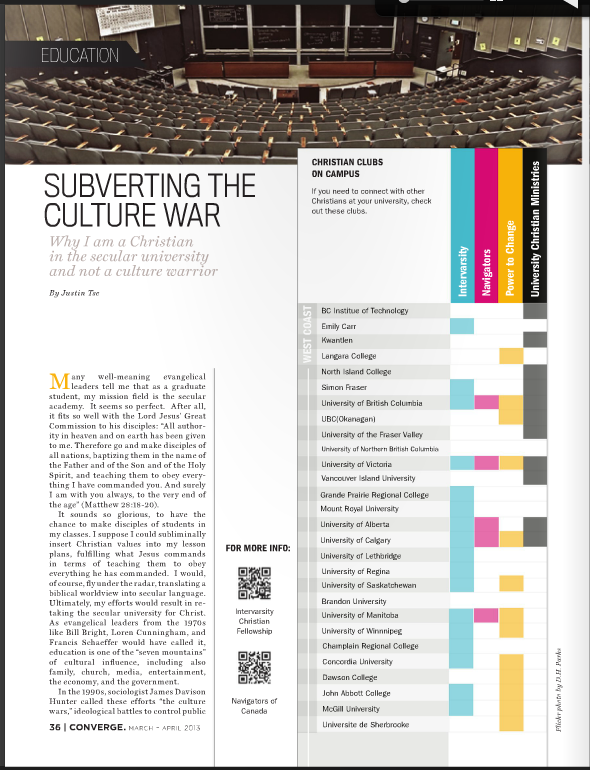
Converge Magazine: Subverting the Culture War: why I am a Christian in the secular university and not a culture warrior

I am pleased to announce the publication of a short piece in Converge Magazine, a periodical for young evangelicals based in Vancouver.

Image

The article is concerned with what sociologist James Davison Hunter has called ‘culture wars,’ especially the notion that evangelicals in secular universities have a responsibility to take back academic space for Christ in a battle for the mind. After reviewing some of the prevailing evangelical approaches since the 1970s, I explain that these practices are not only naïve about the place of young people in universities, but that they may be distortions of Christian theological praxis. I base this article on a re-reading of what evangelicals call ‘the Great Commission,’ a quotation from Jesus at the end of the Gospel according to St. Matthew (28.18-20) where he tells his followers to go make disciples of all nations, baptize them into Triune life, and teach them to obey everything he has commanded. I propose that readings of the Great Commission have become distorted because they fail to read it in the context of Jesus’ teachings in Matthew’s texts. In Matthew, Jesus’ call to repentance is to a kingdom founded on humility, charity, and forgiveness, with a mission that is based less on organized strategy as it is on living out this new mode of existence. Reflecting at the end on the notion of the ‘secular,’ I also make reference to the last chapter of Charles Taylor’s A Secular Age as an alternative way through which the Great Commission can be practiced in secular universities.

The argument, of course, is nothing completely original and is part of a much larger discussion both among evangelicals and about evangelicals. Younger evangelicals have reportedly become disenchanted with the notion of culture wars, and books and blogs such as Rachel Held Evans‘s Evolving in Monkey Town, Jonathan Merritt’s A Faith of Our Own, and Frank Schaeffer’s Crazy for God are all good examples. These cases have also been highlighted in the flagship evangelical publication Christianity Today as a sign of a generational shift. Moreover, academic studies such as Martha Pally’s The New Evangelicals (see The Immament Frame’s blog series), Omri Elisha’s Moral Ambition, and Christian Smith’s Christian America have observed these changes, and even William Connolly–a political scientist who has not been known to be sympathetic to evangelicals–gives a positive appraisal of these re-formulated paradgims in Capitalism and Christianity, American Style. As for how Christians should participate in secular universities, there has been an ongoing discussion among theologians and social scientists in books like John Milbank’s Theology and Social Theory, Charles Taylor’s A Secular Age, Talal Asad’s Formations of the Secular, Stanley Hauerwas’s State of the University, and Brad Gregory’s The Unintended Reformation. In other words, what I am saying here isn’t completely new, but it is my own reflective theological reading of Christian praxis and positionality in secular universities.

My purpose in writing this article is to clarify my own positionality in my academic work for a popular evangelical audience. I began this project of public dissemination in a post I wrote for Schema Magazine, in which I detailed why being a Chinese Christian myself should not paste over my own personal intersectional complexities and thus continues to allow for what geographer Paul Cloke calls a simultaneous ‘critical distance’ and ‘critical proximity’ in ethnographic work. That piece was directed to a popular secular audience as an exercise in public academia, explaining my own social location in relation to my academic project to people who don’t do academic work for their day job. In this post, I speak more directly to evangelicals who may assume that my project is to take back the secular university for Christ, clarifying my own theological praxis while calling my brothers and sisters to reflect deeper on Matthew’s Gospel account. To address this audience more directly, I chose to publish popularly in an evangelical magazine, but I will reflect on my positionality to academic readers in a scholarly journal in the future. There is, of course, a great deal of precedent for academics in religious studies studying evangelicals to publish in evangelical magazines, including reflective pieces and regardless of their own theological orientations, such as those written by Christian Smith, Tanya Luhrmann, and Russell Jeung. Indeed, these are publics that academics studying evangelicals must engage both as a way of giving back to communities we have researched and by way of meeting our duties to contribute to public discourse.

I am pleased overall by the editors’ discretion in preparing the piece for publication, especially by clarifying my meaning in several places where my language was more convoluted. One slight modification, however, that is a bit more significant is the final sentence in which it reads that we ‘show this world another way of thinking and being, one based around His ways, rather than our own.’ My original draft was a more direct quotation from St. John’s Gospel (17.22-23) where Jesus prays for Christian unity that the world may know that the Father has sent the Son. As it is printed, it sounds like I am calling for Christians to be examples to others through their character. Yet as I read Jesus’ prayer in John and Jesus’ teaching in Matthew, he doesn’t call Christians, including evangelicals, to lead from any moral high ground. Instead, the command is to simply be the church and live humbly in a sacramental ontology where justice is done precisely out of a humble spirituality and solidarity with the poor. This all said, though, the editorial choice is still sound if the reference to ‘His ways, not ours’ is taken from the words of the prophet Isaiah (55.8) where he discusses divine grace in calling out from exile a people that is marked by their new-found humility and charity. If that is so, the Isaianic passage’s meaning converges with both John’s and Matthew’s Gospel accounts about practicing a radically humble ontology, and the sentence is not only clarified, but enhanced.

I want to thank Converge Magazine for printing this piece and especially to Shara Lee for encouraging this publication. As I wrote in the byline, my friends Sam, Diana, Anna, Karl, and Aaron were valuable advisors who sharpened the piece significantly. I am thankful to be able to publish to an evangelical audience, and I hope that the piece will provoke thought and stimulate further discussion on Christian praxis.

Progress in Human Geography: Grounded Theologies: ‘religion’ and the ‘secular’ in human geography

As I noted in the previous post, I am excited to announce the publication of two articles today.  This post deals with the second one.

Progress in Human Geography, a widely-read journal where geographers publish reviews of current geographical research that point to new agendas for study, has published a piece that I contributed to them. It is available on OnlineFirst. It is titled ‘Grounded theologies: ‘religion’ and the ‘secular’ in human geography.‘ Again, I will post again when a print issue comes out.

This is a theoretical paper that deals with how ‘religion’ and ‘the secular’ should be studied in human geography.  I’ve had a long interest in examining these concepts more deeply, and I’m still interested in going deeper.  In 2007, when I began my master’s degree in geography at the University of British Columbia, I had to take an introductory course called Geography 520: Theory and Practice in Human Geography (here’s a sample syllabus, taken from 2011).  One of our assignments for that seminar was to write a short, 3,000 word essay modeled on Progress in Human Geography‘s review style. As I recall, we were told to review some 30 recent articles and books. I told our seminar instructors that I wanted to do a review essay on geographies of religion. They replied with something to the effect of: ‘Oh, let us know if you can find anything.’

In many ways, this is my way of saying: ‘I found something.’  I began developing these ideas more fully after that introductory course, which then culminated into my master’s thesis on Chinese churches in Vancouver. As I began my doctoral work, I began to toy with the idea of ‘grounded theologies’ in my directed studies courses, and I finally wrote about it in my comprehensive examinations on geographies of religion, secularism, and social theory.  That was when my supervisor, David Ley, encouraged me to develop this piece and put it into Progress in Human Geography, even as I was writing up my doctoral thesis proposal.

The reviews came back as I was conducting field work for my doctoral project. To my pleasant surprise, the editors and the reviewers were not only supportive, but extremely thorough, profound, and constructive, advising me on how to maximize my arguments for the best possible impact on the field. I then revised the paper, foregrounding the notion of ‘grounded theologies’ in human geography.

The paper is basically about how geographers should study ‘religion’ and the ‘secular.’ I began by engaging the work of Lily Kong, a cultural geographer and the Vice President at the National University of Singapore, who had suggested that geographers need to define what ‘religion’ is and is not.  I am an admirer of Lily’s work, as she has recently opened up many possibilities for us to study religion in geography. I was also struck by her corollary call to engage theology and religious studies more deeply. Engaging this literature, I found that ‘religion’ and the ‘secular’ are very contested terms and that to define what religion is and is not would reinforce the binary idea that some spaces are religious and others aren’t.

The alternative path proposed in the piece is that of grounded theologies, ‘performative practices of place-making informed by understandings of the transcendent’ (p. 2).  While there has been a growing literature in geography on the possibilities of ‘post-secularism’ (in fact, Paul Cloke and Justin Beaumont have a piece on this in the most recent print issue of Progress), there have also been some complaints that this literature doesn’t take seriously what secularization actually means (especially by Justin Wilford, also in Progress). I propose that the way forward is to see ‘the secular’ as much as a grounded theology as ‘religion.’  After reviewing the relevant literature on ‘religion’ and the ‘secular’ in theology and religious studies, I demonstrate how this concept has already been put into practice by social, cultural, and political geographers.

In doing so, I had to engage with what is known as the ‘canon’ in religious studies (e.g. the foundational work of social scientists like Emile Durkheim, Max Weber, William James, and Clifford Geertz), formative debates among religion scholars about what ‘religion’ is (e.g. a critical juxtaposition of the work of Mircea Eliade and Wilfred Cantwell Smith, as well as more recent work by Jonathan Z. Smith), and the recent critical conversation on secularization that blurs the lines between theology and religious studies (e.g. the work of John Milbank, William T. Cavanaugh, Talal Asad, Judith Butler, Saba Mahmood, Brad Gregory, and Charles Taylor). I then put this literature to work by looking at how geographers have already been engaging to some degree with grounded theologies as they undertook studies of how different religious subjects understood their identities by intersecting their social spaces. I also looked at recent discussions in critical geopolitics surrounding religion, especially as geographers have been interested in the eschatological dimensions of religious engagements with the public sphere.

My hope for this paper is that it will open avenues for geographers to research ‘religion’ and the ‘secular,’ as well as engage with scholars in theology and religious studies. Moreover, my aim has been to critique the notion that ‘religion’ and the ‘secular’ are mutually exclusive.  By doing this, we might be able to show ironically how people conventionally labeled ‘religious’ sometimes employ ‘secular’ ways of making place while people who call themselves ‘secular’ are guided by implicit theological narratives in their geographical practices.

I’d really like to thank David Ley for guiding me through this process, as well as the editors of Progress in Human Geography who oversaw this publication, Noel Castree and Anssi Paasi. The five anonymous reviewers who critically turned over every part of this piece have greatly strengthened this paper; I also feel extremely humbled that they have taken my work so seriously and have engaged it with such profound insights. Claire Dwyer, with whom I am working concretely on a project dealing with grounded theologies in Richmond, British Columbia’s ‘Highway to Heaven,’ has also been very encouraging. My friends, Robert Edwards and Carl Hildebrand, also read the piece and offered very constructive thoughts. I am very thankful that this piece is out, and I look forward to engaging fellow students of ‘religion’ and the ‘secular’ on how these concepts describe grounded theologies put to work in the making and contestation of real places in the world.

Global Networks: Transnational Youth Transitions: becoming adults between Vancouver and Hong Kong

I want to announce the publication of two papers today in two separate posts.  Let me take each in order.

The first is a collaborative paper that Dr. Johanna Waters (University of Birmingham, Geography) and I co-authored.  It is titled ‘Transnational youth transitions: becoming adults between Vancouver and Hong Kong,’ and is published in Global Networks: A Journal of Transnational Studies. It is currently available in Early View. I will post again when it comes into a print journal version.

The genesis of this paper is quite interesting. Jo Waters is a leading scholar in transnational geographies in the United Kingdom. Jo and I both received our graduate education in Geography at the University of British Columbia at Vancouver, and we shared a common supervisor, Professor David Ley. Jo wrote her master’s thesis on transnational Hong Kong family experiences in Vancouver (check out her pieces on astronaut women and transnational family settlement) and her doctoral thesis on how Hong Kong families strategized to send their children to Vancouver for education to gain cultural capital for future employment prospects in East Asia (it is now a book). Jo and I did not overlap in the department, but when I began to study Hongkonger migration as I wrote my master’s thesis on a transnational Hongkonger church, Jo’s work provided a very interesting launching point. I remember checking out both of her theses from the Geographic Information Centre in our department and reading them with rapid page-turning interest. At this point, I also contacted Jo, telling her how much I admired her work. She was very nice to me.

As I began my doctorate, Jo and I began talking about the common points between our data, especially as I had collected more recent data in Chinese churches in both Vancouver in 2008 and Hong Kong in 2010 that corroborated her earlier findings in 2002. Deciding to focus on what we found in common about young people’s experiences of transnational families between Hong Kong and Vancouver, we merged the data. We submitted the piece to Global Networks, from where we got very good feedback from the editors and the reviewers. Jo was then extremely generous in letting me take the lead on the revisions, as this gave me a chance to undergo some crucial professional development. We then revised the piece, and then sent it back to Global Networks with my name as the corresponding author.

The article sheds light on how young people become adults in families that straddle the distance between Hong Kong and Vancouver. It examines how these young people transition from youth to adulthood, combining the literature in social geography on youth and childhood (which is itself drawn from the new social studies of childhood) with the literature on transnational migration. We looked at how young people reacted to the ways that their parents and extended family attempted to supervise them and maintain contact with them at a distance, and we explored the young people’s own sense of place. One of our central contributions is that while many people predict that youth growing up in these families often return to Hong Kong for work, we have to be cautious about describing this as a norm, for young people were often critical of their own families’ transnational strategies.

We hope that this will be a helpful paper in transnational studies more broadly. We also hope that it will give back to the communities we have studied by accurately portraying them and by shaping conversations about them that are not overly determinative about their families’ patterns of migration. Moreover–and this is only implicit in the article–as I reflect on my own engagements with Asian American ethnic studies, my hope is that this paper will help empower Asian American and Asian Canadian families and young people by taking seriously their own sense of place instead of forcing them to constantly answer the question, ‘Where are you from?’ We thank Ali Rogers, the previous editor of Global Networks, as well as our three anonymous reviewers and the copy editors, for their very constructive feedback on our paper. For my part, the experience of working with Jo Waters has been phenomenal and a part of my graduate education and professional development that I will always consider valuable.

CFP: Consolation-scapes (Emotional Geographies, Groningen 1-3 July 2013)

I’ll likely be unable to make this conference, but I thought this was an excellent example of how geographies of religion are integral to current trends in social and cultural geography.  If you are interested, please apply following the instructions at the end of the call for papers.

Consolation-scapes: Analysing grief and consolation between space and culture
Emotional Geographies, Groningen 1-3 July 2013

Human beings are grieving animals and, moreover, animals that cannot let death have the last word. Anthropologist Douglas Davies (1997) famously suggested the simile of ‘words against death’ to address the manifold ways in which human beings respond to bereavement (words, music, rituals, architecture) and express their ‘trust in hope over fear’.

With the ‘spatial turn’ in the humanities and the social sciences at large, and the growing interest in human geography for the works of mourning, the phenomena of bereavement and memorialization have increasingly been analysed through a ‘spatial lens’ (see e.g. Maddrell & Sidaway 2010) and from the perspective of material culture (see e.g. Hockey et al. 2010).

The present session wants to carry the discussion further by focusing on consolation, a phenomenon which stayed on the background of earlier discussions. This altered focus is compounded in the session’s title. There have seen excellent analyses of ‘deathscapes’ (Hartig & Dunn 1998; Kong 1999; Maddrell & Sidaway 2010), what we want to achieve in this session is an analysis of ‘consolation-scapes’. How is space/place involved in consolation? How can material culture approaches inform analyses of consolation? Where do we stand today, consolation-wise, and how have we got here? How does our contemporary outlook differ from the outlook of times past, and how does all this relate to the spatial dimension of consolation?

The present session calls for contributions from a wide range of disciplines: geography, history, theology, philosophy, sociology, and anthropology.

Session convenors:
Christoph Jedan (c.jedan@rug.nl), Associate Professor of Ethics, Department Christianity, Philosophy and Culture, Faculty of Theology and Religious Studies, University of Groningen. Currently working on the history and continuing relevance of argumentative consolation across theology and philosophy. Together with Eric Venbrux (see below), he is founder of the thematic group Death and Consolation in the Netherlands School for Advanced Studies in Religion. Most recent monograph: Stoic virtues: Chrysippus and the religious character of Stoic ethics, London/New York 2009.

Eric Venbrux (e.venbrux@ftr.ru.nl), Professor of Anthropology of Religion, at Radboud University Nijmegen. He is director of its Centre for Thanatology. Eric Venbrux has researched widely on ritual change, in particular the transformation of rituals surrounding death in the Netherlands. Among his numerous publications is also the co-edited volume Rituele creativiteit: Actuele veranderingen in de uitvaart- en rouwcultuur in Nederland [Ritual creativity: Recent transformations in the burial and bereavement culture in the Netherlands], Zoetermeer 2008.

CFP: Asia-Pacific Worlds in Motion V: Migration Beyond Borders

Call for Papers (Deadline February 8, 2013)
Asia-Pacific Worlds in Motion V: Migration Beyond Borders
May 30 and 31, St. John’s College, University of British Columbia

We invite graduate students and early-career scholars to participate in a conversation about migration beyond borders. Recent scholarship in the interdisciplinary area of migration studies has begun to critically examine the significance of the border as a construct that separates territorial formations. The border is not just a line on a map; it is an ever-shifting political idea negotiated and practised in myriad ways. In this era of global mobility it is no longer geographically specifiable, but is implicated in a vast array of spaces and power relations in which citizens and bodies are controlled and made. In the Asia-Pacific, where some territorial divisions appear to stretch the breadth of the ocean and others are sensed but not demarcated, the border simultaneously has real, lived dimensions and is increasingly insignificant. But in an age of security discourses and supra-national political-economic partnerships, human experiences created by borders are as salient as ever.

For this conference, we solicit papers that consider migrant experiences and the migration phenomenon both in relation to borders and beyond them.  Our geographical focus is the greater Asia-Pacific, including intercontinental, transnational and regional dynamics, with an emphasis on relationships between Asia and the Americas. Themes include migration policy, human security, social justice, and the political dimensions of migration and migrant experiences.  We are also interested in papers that deal explicitly with methodology in migration research.

In the interest of a wide-reaching conversation, we welcome papers on the following related topics:
– Migration, borders and boundaries
– Geopolitics of migration
– Temporary migration
– Forced migration
– Diasporic communities
– Migration policy and politics
– Social justice and migration
– Asian migration and migrant experiences
– Second generation and later generation migrants
– Migration and religion
– Family, children and youth migration
– Migrants in the city
– Other topics related to migration beyond borders in the Asia-Pacific

Asia-Pacific Worlds in Motion is an international interdisciplinary conference. The 2013 meeting will be held in St. John’s College at the University of British Columbia (UBC) in Vancouver on May 30th and 31st, 2013. It will be the fifth in a series of meetings that are jointly organized by and alternately convened at UBC and the National University of Singapore (NUS). The conference website is under construction and can be found at http://kristofk.com/apwim.

Prospective participants are invited to submit an abstract of up to 300 words by February 8th, 2013 to Lachlan Barber and Kara Shin at apwim2013@gmail.com. Accommodation and meals for the duration of the conference will be provided for those travelling to Vancouver, but participants are responsible for covering all other travel costs.

For more information, please contact the conference organizers at apwim2013@gmail.com.

The conference is jointly presented by:
St John’s College, University of British Columbia
Metropolis B.C., University of British Columbia
Migration Cluster & Division of Research and Graduate Studies, Faculty of
Arts and Sciences, National University of Singapore

CFP: AAR 2013: ANARCS

Call for Papers | AAR 2013: Asian North American Religions, Cultures, and Society Group

The Group invites and welcomes individual papers, panel proposals, and nontraditional ways of sharing scholarly work that address:

  • Issues of empire, militarization, after-war trauma and memory;
  • Creative resistance practices;
  • Asian American Catholic life and Baltimore as the bastion of American Catholic life;
  • Asian American religious life in the greater Baltimore-DC metropolitan area;
  • Multiracial/Interracial bodies and theologies;
  • Exploring categories of “North” or “Asian” in Asian North American religion, culture, and society;
  • Intersections with Native American and indigenous critiques of settler colonialism; and
  • Any other critical aspect of Asian North American religion/s, culture, and society.

In addition to paper and panel submissions, we encourage the submission of nontraditional ways of sharing scholarly work and welcome a variety of formats to promote interactive sessions. Submissions are made directly to AAR.

Social Geographies of Religion: guest lectures

This week, I gave two lectures on the social geographies of religion for the University of British Columbia at Vancouver’s Geography 357.  The instructor is my friend, Elliot Siemiatycki, a labour geographer who has been doing a fantastic job teaching a course focused on what social geography is and what social geographers do social geography in the context of neoliberal urbanisms.  The course has covered theoretical themes (such as the move from positivism to the humanist/Marxist debates in social geography, feminist themes of embodiment and intersectionality, and the neoliberal restructuring of post-1980s cities) and empirical themes (such as segregation, homelessness, crime, architecture, work and leisure spaces, urban political ecology, and cyber-geographies).  He gave me an opportunity to deliver two lectures for the course on the social geographies of religion.

In these lectures, I simply reviewed the field, where we’ve been and where we’re going.  In the first lecture, I spoke on geographies of religion and intersectionality, how religious practitioners intersect their religious social spaces with other spaces like family, work, leisure, as well as spaces marked by gender and class.  In the second lecture, I introduced the current debate on post-secularization in social geographies and approached this through José Casanova’s (1994) work in Public Religions in the Modern World as he disaggregates the secularization thesis.  I am aware, of course, that discussions of secularization theory are wide-ranging, but to adequately cover the major theorists in theology and religious studies (e.g. Berger, Cox, Eliade, JZ Smith, WC Smith, Casanova, Asad, Taylor, Habermas, Milbank, Pickstock, Cavanaugh, Ward, Bruce, Davie, Lilla, Bellah, Butler, Brown, Mahmood, Hirschkind, Modood, Jakobsen, Connolly, Calhoun, Lilla, West, Herberg, Finke/Stark, R. Stephen Warner, Michael Warner, Fraser, etc.), I would need a whole course devoted to this (if not several), if not a graduate seminar (if not two).  I also presented some of my own original PhD research on Cantonese-speaking Protestants and the public sphere in the second class.

The material was very well-received by the instructor, the students, and my supervisor.  The sense that I got was that this material is very new and fresh to them, which speaks to the need for this material to actually be taught at the undergraduate level.  I was happy to hear that I was both clear and passionate–I would refrain from self-commenting on my own performance, but these seem to be the anecdotal consensus–and after delivering these lectures, I hope to be doing this long-term.  Indeed, my hope is one day to teach courses on geographies of religion and secularization where I can adequately cover the field in its emerging breadth, as well as to host graduate seminars where the material can be adequately debated by emerging scholars joining the effort.

ANARCS Steering Committee

Today I was invited to become–and accepted–membership on the Steering Committee of the Asian North American Religions, Culture, and Society (ANARCS) Group of the American Academy of Religion (AAR).  It is an honour and a pleasure to have been invited by such a great group of friends.  The duties of Steering Committee members is to design a call for papers for forthcoming AAR conferences, to vet abstracts and panel proposals, and to make sure that presenters actually write their papers and have a great time presenting them at panels and sessions that we sponsor.  Accordingly, we are influential in shaping what ANARCS will be doing and hope to have some influence on the development of the field of Asian North American religious studies as a whole.

I am very excited to be part of this.  During this year’s AAR, there were three ANARCS-sponsored sessions: 1) E Pluribus Pluribus: Transnational Hinduism in North America, 2) Asian North American “conservative” Christian communities, masculinities, and gender issues (in which I presented), and 3) Boundary Crossings: new directions in Asian American theologies (over which I presided–thanks, Sharon Suh, for the opportunity!).  The quality of the papers was very high, but what struck me even more was the abundance of younger, emerging scholars in the field who are pushing the boundaries of what should be studied as part of Asian American religious studies.  My sense from this year’s discussion was that there is a lot of emerging work on the intersection of Asian American religions and sexuality–an intersection that is similarly coming to fruition in geographies of religion, I might add!–and that there is much more attention being paid to critical theory among the younger scholars.  There was also a sense of these younger scholars being mentored by more senior faculty discussants on the panels who were very approachable for questions and constructive feedback after the sessions as well.

I am excited to be part of this burgeoning field that crosses American ethnic studies and religious studies.  Many thanks to ANARCS for the opportunity to serve in the Steering Committee, and I look forward to working with everyone.