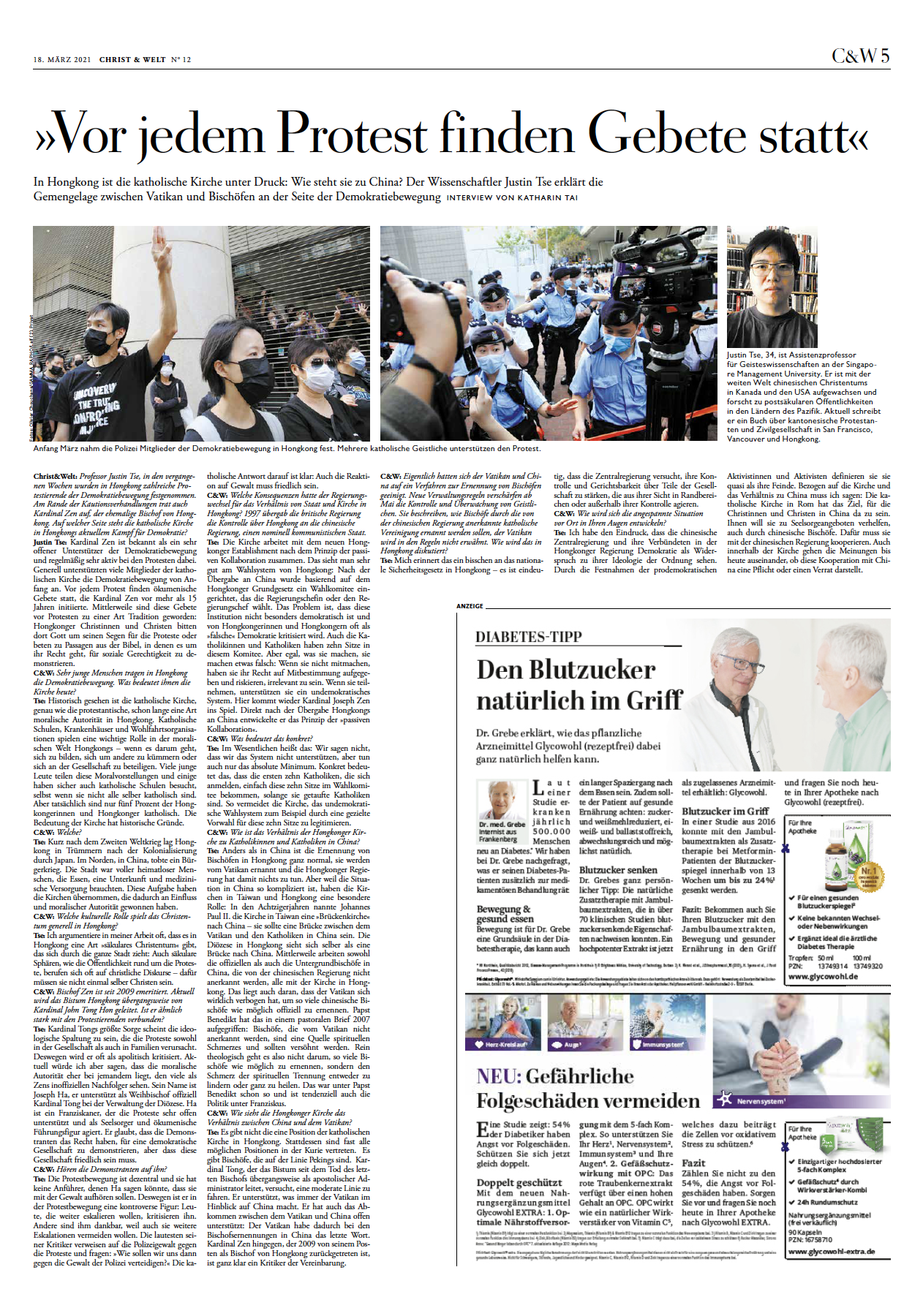
My interview with the journalist and scholar Katharin Tai is out in Christ & Welt. It’s on Hong Kong Catholicism, and it’s in German.
I remember the day this interview came about. A friend messaged me to see if I might be interested in being interviewed by a German newspaper about Hong Kong Catholicism. I thought about it for a bit. Was I a specialist in Hong Kong Catholicism? I mused as I am still hard at work on my book manuscript on Cantonese-speaking Protestants. Certainly there were ecumenical inflections.
For my interview with Christ & Welt, I continued with the line that the political scientist Beatrice Leung has set on Hong Kong as a ‘bridge church’ in her book Sino-Vatican Relations, and also offered a reading of John Baptist Cardinal Wu’s 1989 pastoral letter ‘March into the Bright Decade.’ I reflected as I worked through these complex politics of the Latin Church in Hong Kong with Tai that Hong Kong Catholicism is really where I cut my teeth on Catholic geopolitics. The experience felt like I was teaching an introduction to Hong Kong Catholicism, and I was both humbled and excited by it.
I am thankful to Katharin Tai and her editors at Christ & Welt for all their care in putting this interview together. I look forward to learning even more as Halyna Herasym and I move forward with our project.
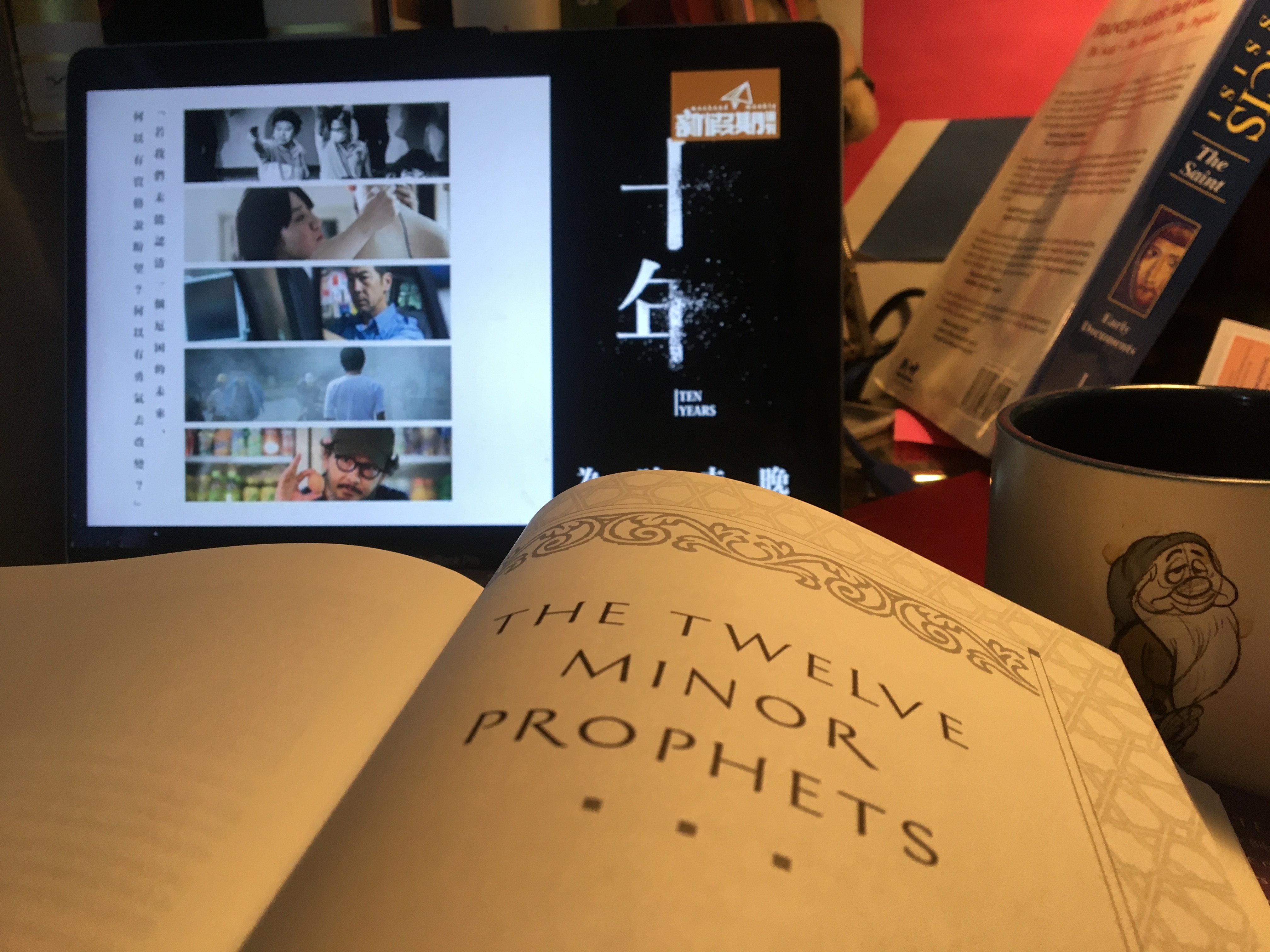
I am so thankful to my colleagues Devin Singh and Jeremy Sabella at Dartmouth College for inviting them to their course on Religion and Social Struggle to talk about Hong Kong. I was able to join into conversation with them some of my thoughts on the film Ten Years, which won many awards in Hong Kong when it came out in 2015.
Every time I teach the short films that make up this collection, my interpretation gets a little deeper. I think there are some who think that the dystopian nature of the film has very easy geopolitical explanations. But the meditation is much more ontological, and over the time of preparation, it sent me to Robert Alter’s translation of the Twelve Minor Prophets in his Hebrew Bible translation project. In this way, I recognize that this work of teaching is an act of what I have called ‘grounded theologies.’
I’m deeply thankful to Devin and Jeremy for the opportunity to guest lecture in their course, as well as the brilliant engagement of their students with these important events around the world. It helped me to deepen my thinking, and in this time when the value of the academy is being called into question, such conversations reveal that collegiality is not dead and that perhaps we are being invited to develop an intellectual commons with ecological significance.
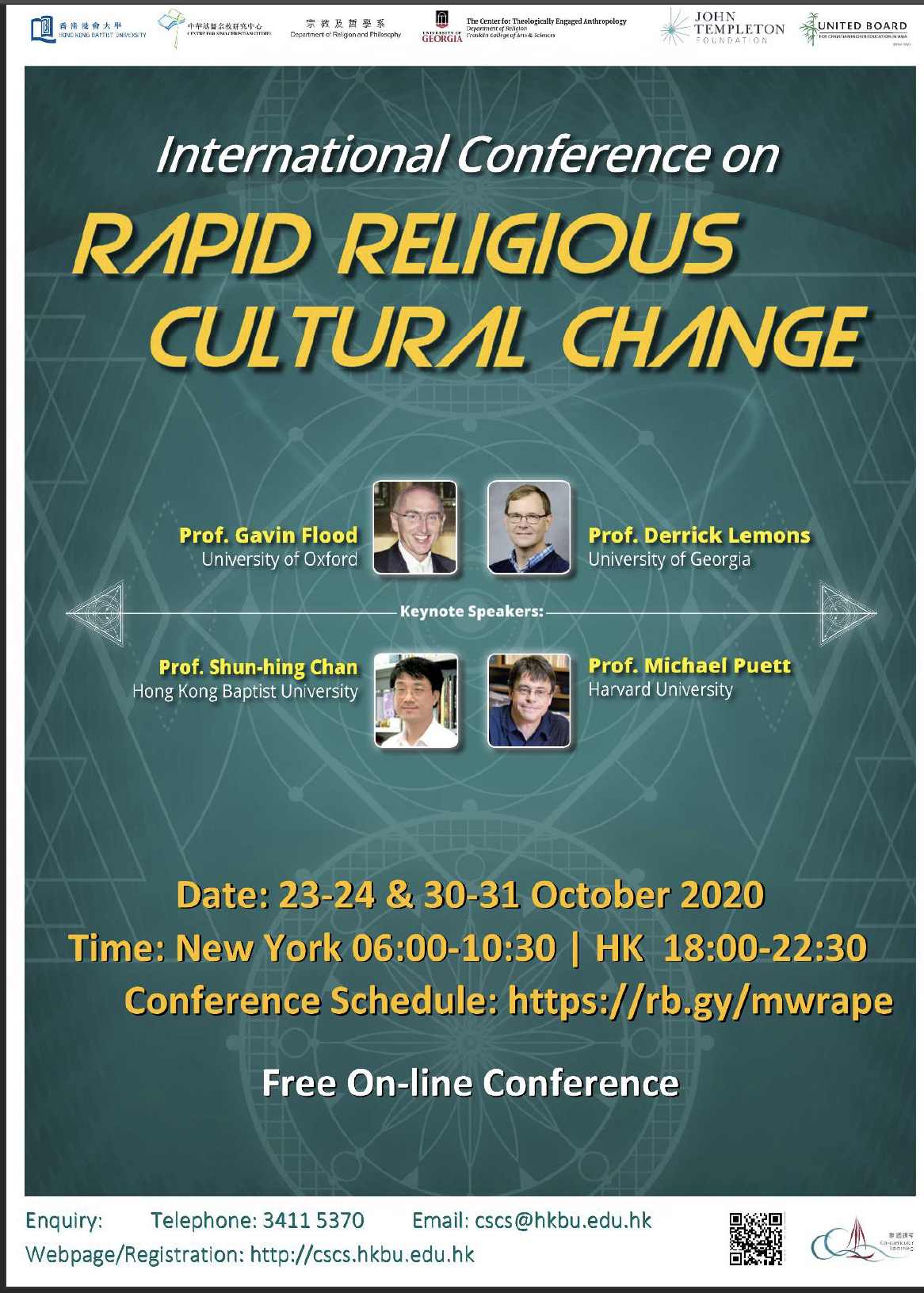
I’m so pleased. I just presented in the Rapid Religious Change Conference organized by Hong Kong Baptist University in a panel on Christianity in the Asian and African Conference, chaired by Mark Boone (Hong Kong Baptist University) with co-panelists Emilie Tran (Hong Kong Baptist University), Éric Sautedé (Educator, Editor, Columnist), and Arua Oko Omaka (Alex Ekwueme Federal University, Nigeria).
My paper was titled ‘Build an Ark: Media Evangelism’s Controversy as Theological Precursor to the Hong Kong Protests.’ Returning to the controversy around 2010 surrounding The Media Evangelism and Noah’s Ark Ministries International announcing that they were ‘99.9%’ sure that they had found Noah’s Ark on Mount Ararat, I argue that the battle lines that were said to have been formed within Hong Kong Christianity (actually, mostly Protestant evangelicals) around the post-2014 Hong Kong protests might actually have precedence here. It was a fun paper to give, and it certainly has me revisiting the moment in 2010 when I thought I might actually do my PhD on Noah’s Ark, until the ensuing controversy led some people to discourage me from working on it. Ecumenical engagements with democracy seemed more interesting anyway.
But here I return to it. I am especially thankful to Shun-hing Chan for doing such a great job helming the organization of this conference — and for a fantastic keynote that set the tone for provocations like mine — and to Mary Siu for keeping in such careful touch with all of us participants. I look forward to the forthcoming days when I can simply be a learner in the audience.
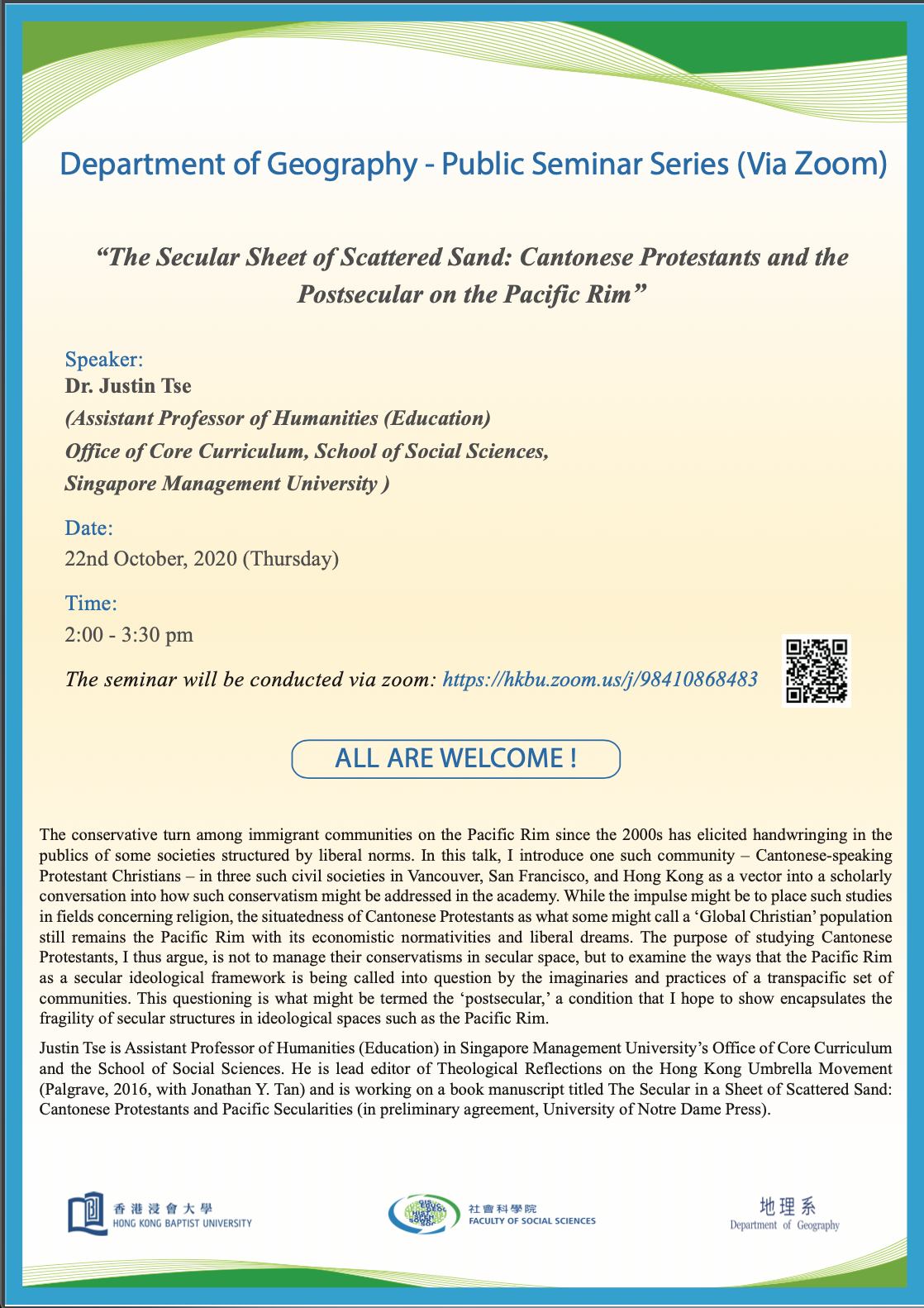
I just gave a Zoom seminar to Hong Kong Baptist University’s Department of Geography on my book. The talk was titled The Secular Sheet of Scattered Sand: Cantonese Protestants and the Postsecular on the Pacific Rim.
I really enjoyed the conversation that followed. There were so many good friends in the audience. One thing that stood out to me was how, even though the concerns of my book are capped at the year 2012, how much conversation we managed to have about the Hong Kong protests over the last five years, as well as the emergence of nationalisms that might fray the Pacific Rim in the 2010s. Somebody even asked me about the song ‘Sing Hallelujah to the Lord’ and inquired if that was perhaps a form of ‘secular Christianity.’ I said that I had written a piece on The Immanent Frame with exactly that framework. This was, among the many highlights of the conversation, a particularly joyful moment.
Indeed, I insist on this 2012 cap on in my first book project precisely because I am interested in this book on how Cantonese Protestants operated in the heyday of post-1980s Pacific Rim ideology. My next project will be much more about how some have said that it’s all falling apart, even though, as I once said in another version of this talk to my colleagues at my home institution, the Pacific Rim dream might be better described, in the words appropriated from The Princess Bride, as ‘mostly dead,’ as opposed to ‘all dead.’ There I really got my comeuppance. One of my deans noticed that I had attributed the quote to Mad Max. It was, of course, Miracle Max who said these words. The two Maxes are very different, and if one claims professional interest in post-1980s ideology, the eighties references really have to be right. I do, after all, also teach Blade Runner.
I am thankful to Claudio Delang and Lachlan Barber for inviting me. With so many friends across our departments, I deeply look forward to when our paths will cross again.
My contribution works through how ‘Sing Hallelujah to the Lord,’ an evangelical chorus from the Jesus Movement of the 1960s and 1970s, became for a while the informal theme song of the 2019 protests in Hong Kong. Bringing the fields of Global Christianities and secular studies into conversation, I attempt to make a methodological argument. Most journalists and scholars will be tempted, as I show, to try to figure out which Christians and Christian communities are behind the song. I propose another way forward, to look at what the song does in the secular publics of Hong Kong.
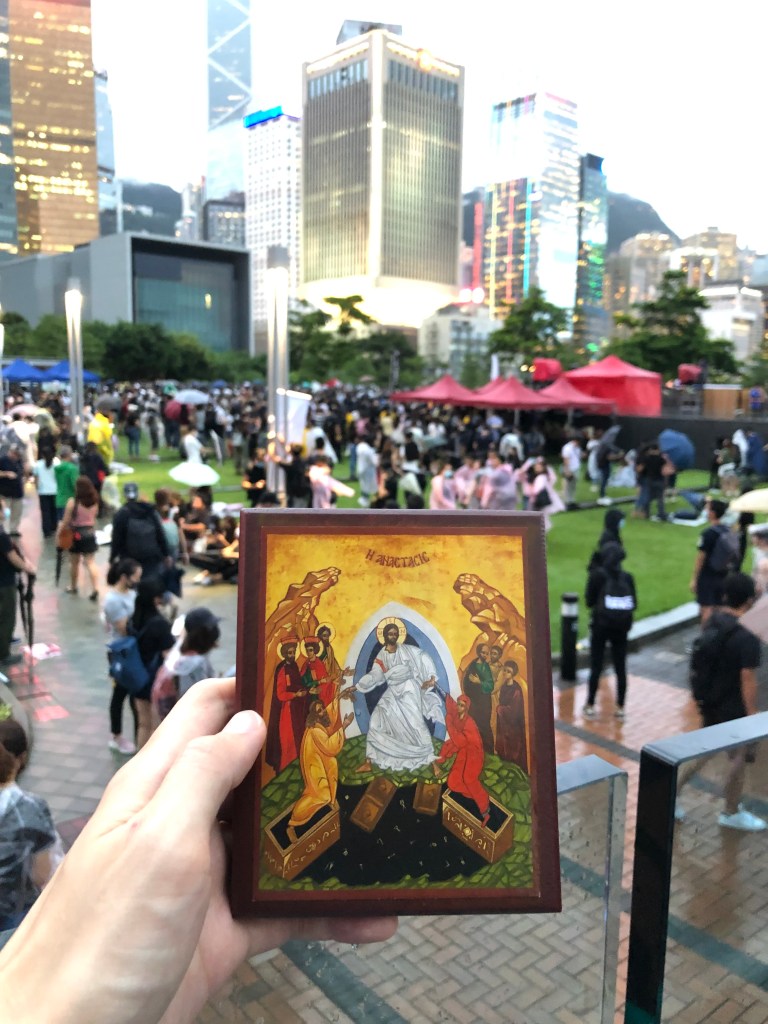
I am thankful to Mona Oraby, Olivia Whitener, and Nusrat Chowdhury for helping me sharpen this essay for this exciting forum, as well as to my colleagues who read it carefully and helped me navigate some of the thorny writing issues that befall every essay. I am also grateful to my friend Richard Wu for allowing me to publish his photo of an Eastern Orthodox icon of the Harrowing of Hades at the Hong Kong protests along with my piece. It’s not taken from the day I write about — June 12, 2019 — when ‘Sing Hallelujah to the Lord’ began to be sung, but it’s from the time afterward when, as I argue, the chorus took on a life of its own. I look forward to seeing what conversations I may find myself in as I continue the work that I have announced myself to be doing in this piece.
I was pleased with how this interview went, though the truth of the matter is that Mondays are my most serious workday, and my greatest hope when I arrived to speak with Jerome McDonnell was that I would at least be coherent. The questions were, as usual, very good, covering a range of topics from the appeals to the American government for support, Joshua Wong’s visit to Germany, the drama around the announcement about the bill’s imminent withdrawal in Legislative Council, and the possible futures of the protests. Jerome’s questions even got me to pull back deep into the heart of the research that consumed me from my undergraduate days and has percolated into the graduate work that fuels my career: the identity politics of the ‘Hong Kong person’ from the 1970s to the present. We also got to speak about protest music; my only regret is that I did not mention the new song being sung as an anthem titled ‘Glory to Hong Kong.’
I see these interviews as the community engagement portion of my scholarly work. As I told Jerome, the task of scholarship is to describe, not prescribe, so all that I am doing here is to see, to sort, and to say what I see and am sorting. It is an offering, then, for ongoing conversation on these momentous events in Hong Kong. I am thankful to Jerome and the team at Worldview, especially the producer Julian Hayda, for bringing me in yet again, and I hope that I was coherent enough in my description of the problems and prospects at hand to encourage further discussion among the publics who listened and will listen to this segment.
I’m very pleased to have been interviewed as part of the journalist Douglas Todd’s piece ‘Hong Kong protesters turn 1970s hymn into anthem.’ My main role in this article is to sketch how the protests in Hong Kong have been using the Jesus Movement chorus ‘Sing Hallelujah to the Lord,’ which I also did with my colleague Melissa Borja on her Anxious Bench group blog on Patheos, and how Christians may or may not be part of the protests in personal and institutional ways.
I like how Todd positions my comments as the lead-in to the story that he really wants to talk about, which is the hundred or so pro-China protesters who picketed the evangelical Tenth Church Vancouver during a Hong Kong prayer rally organized by an inter-denominational and ecumenical group of clergy. Interviewing one of the clergy leaders Samuel Chiu, Todd sketches a broader picture of Chinese Christians in North America — and indeed, Chinese communities in a more secular sense — that are internally divided in terms of transnational politics.
In addition to the Hong Kong interest, this is a developing and interesting story in Vancouver. I’ve written about the senior pastor Ken Shigematsu before as a ‘different kind of evangelical‘ who emphasizes an Asian Canadian sense of social justice and contemplative spirituality, and I’ve also put an article on Tenth into the Brazilian journal Relegens Thréskeia. On this particular issue, Shigematsu has commented on the church’s solidarity with ‘justice issues’ in a non-partisan way, and Fr Richard Soo SJ — the Eastern Catholic priest who brought me into the Greek-Catholic church that has formed so much of my recent musings on the postsecular even while I continue to write, research, and teach on publics on the Pacific Rim — has written an op-ed in the Vancouver Sun about how religious solidarity with Hong Kong is not the practice of partisan politics.
I am so pleased that my friends on the show Worldview on WBEZ 91.5 FM Chicago had me back on to discuss the Hong Kong protests and the recent mass arrests there. The host Jerome McDonnell wanted to discuss a number of issues with me, including the significance of the date August 31 to the 2014 Umbrella Movement, the (non)ideological stances of the protesters and the issues of (non)representation in a leaderless movement, the ramifications of ‘one country, two systems’ for the question of rule of law, and the future of the protests. My reflection on working through each of these themes is that it was not unlike giving an undergraduate lecture. There were quite a few technical terms that I found myself having to define as I was speaking, including ‘black hand’ and ‘white terror.’
As usual, my interpretations represent no one except for me, and in the context of a rapidly developing story, that ‘me’ is but a snapshot in time. The tentative arguments I make are, if you will, the work of a scholarly observer, and as I’ve clarified numerous times in the past, I have never claimed to be a ‘Hong Kong person.’ I also note that analytical commentary on protests is not the same as participating in them, and my comments are descriptive, not prescriptive. Just as I did as the lead editor of Theological Reflections on the Hong Kong Umbrella Movement(Palgrave, 2016), my aim is to offer analysis based on what we know to be facts, not invented opinions. Needless to say, scholars like me also have minds of our own, so as is always the case, our views do not represent anyone except for ourselves. This understanding is the basis for the academic freedom that enables the dialogue and conversation that helps us to understand the world, instead of imposing on it models, theories, and conjectures that lead more to confusion than clarity. It also means that all errors of judgment are strictly my own and that acknowledging them is how we come together to grow in knowledge.
The 2018-2019 school year has wrapped up, and summer is upon us. It’s been quite a year for me. I have a number of things coming through the pipeline, some articles, some book chapters, even a manuscript for a monograph that I’ve been crafting on Cantonese Protestants and postsecular civil societies on the Pacific Rim.
Some stuff has been happening already. A chapter of mine on cultural geography came out in the volume Theorizing ‘Religion’ in Antiquity, edited by Nickolas Roubekas, in which I continue my unlikely defence from my piece on ‘grounded theologies‘ of the legacy of Mircea Eliade as a historian of religion who is a central figure (at least as I argue) in geographies of religion. I gave a colloquium talk at Calvin College’s Department of Geology, Geography, and Environmental Studies on an article I’ve been crafting on Chinese American megachurches in the Silicon Valley. My critical reflective piece on the concepts ‘uniatism’ and the ‘model minority’ that the magazine Patriyarkhat invited me to write has come out, first in Ukrainian translation in the print version in December 2018, then online in English, and now also with footnotes and extended clarifications in Logos: A Journal of Eastern Christian Studies. I’ve attended four conferences — the American Academy of Religion in November 2018, a very interesting conference on Christian social activism and Chinese societies at Purdue’s Center for Religion and Chinese Society, the American Association of Geographers in April 2018 where I organized and presented an exegesis of Paulo Freire in a session on pedagogy and religion in geography, and the Association for Asian American Studies in that same month, during which I had the honour of organizing an all-star, standing-room-only panel on the historian Gary Okihiro’s provocation ‘Asians did not go to America; America went to Asia.’ We are going to continue the intervention with Okihiro’s work at the American Studies Association later this November in Honolulu, with another panel titled Third World Studies, Not Ethnic Studies, as a conversation around Okihiro’s longstanding argument that the internationalist sensibilities that gave rise to anti-colonial critiques of racial formations caved to liberal nationalist frameworks that led to the siloing of identity in the academy.
As I wrapped up my third and final year as Visiting Assistant Professor in the Asian American Studies Program at Northwestern University, I expanded the scope of my teaching. My course offerings this year ranged the full gamut of my repertoire in Asian American studies: Asian American history, Chinese American studies, Asian American religion, Asian American social movements, Global Chinatowns, and Asian American geographies. But this year especially, I have been drawn more directly into the formal individual supervision of students. In the past, I had taught some directed studies courses, as well as supervised research, on topics closer to my own research interests on Asian American Christianities and their relationship to Asian American studies. But this year, there has been a wide much range of independent studies topics, including Korean dance and ‘the invention of tradition,’ sonic orientalism in popular movie soundtracks, Global China and feminism, research methods in Chicago’s Chinese churches and trans-Pacific theologies, indigeneity and orientalism on the Pacific, the postsecular Pacific, and psychoanalysis and the Pacific. I also had the privilege of supervising my first thesis student Irina Huang, an undergraduate senior in American studies, who wrote a theoretically rigorous piece woven in with personal creative nonfiction essays on how obsessive-compulsive disorder functions in the normative public sphere as a ‘model minority’ of mental illness.
I continue to be active in my public engagements as well. The journalist Douglas Quan interviewed me for a very interesting piece last October on Richmond’s ‘cultural diversity policy.’ I have also been invited by Worldview on WBEZ 91.5 FM in Chicago four times over the last school year to offer scholarly analyses of Hong Kong, its tradition and practice of protests, and the recent blow-ups about the incarceration of some figures from the Occupy Central and Umbrella Movement occupations in 2014 as well as the controversial extradition law.
In terms of service, one role that I have taken on over the last year is to be program co-chair of the Society for the Scientific Study of Religion. Reading through the abstracts and thinking about organizing the program has given me new insight into what we do as social scientists of religion. I am glad to be working with our president Elaine Howard Ecklund and my co-chair Ryon Cobb as we expand the diversity of our organization, especially for the conference in St Louis this year in October.
Finally, my biggest and most exciting announcement is that I have just started work as Assistant Professor in Humanities (Education) at Singapore Management University. In addition to teaching courses in the School of Social Sciences, my major role there is to offer the Core Curriculum, a program that seeks to engage students across the school with the big concepts that are fused throughout our contemporary world. This year, the theme will be Happiness and Suffering, which I will teach, along with my colleagues, as a philosophical, psychoanalytical, and postsecular exploration of these affects, emotions, and orientations to the world. As an academic, my work is to write and to probe the complex phenomena common to our shared inhabitation of the earth, so it obviously goes without saying that my published views anywhere are in no way to be associated with my employers, as if academics could fully agree on anything anyway. Indeed, my convictions about all academic work — whether under the pillar of research, teaching, service, or community engagement — is that it should all be a springboard into a larger discussion in which all participants are strengthened through engagement, never the final word on any topic. I am thrilled to ‘let my work grow up,’ as I heard one senior academic once describe to a junior colleague, in this intellectual community, and I look forward to spirited engagements and enthusiastic conversation here.
I am honoured to have been given an opportunity to comment at a recent community screening of the award-winning film 十年 Ten Years (dir. Andrew Choi) at Tenth Church Vancouver on October 21, 2016. Because I was unable to physically make it to the screening, the organizers asked me to make a video with my comments. This video subsequently turned into my first foray into the world of YouTube, which I plan to explore further in the future.
Ten Years is a set of dystopian film shorts about a possible future in Hong Kong without democracy and autonomy from the People’s Republic of China (PRC). This community screening was an attempt to help people in Vancouver, especially (but not limited to practicing Christians), become conscious that such conditions are ripe material for doing theology. Because I was the lead editor of a book that was recently published (Theological Reflections on the Hong Kong Umbrella Movement[Palgrave, 2016]), the organizers asked me to help with the task of theological reflection. In the video, I introduce viewers to the basic methods of theologies of liberation in the see-judge-act method, which we use in the book as well. The organizers attached this video to the beginning of the film and played it before showing the movie.
The ease of being able to make this video on my phone has given me the idea of possibly making more videos explaining basic concepts that I use in my work on YouTube. I suppose this is a way for me as an academic to conduct some public engagement. It was fun and productive, and I look forward to seeing where this may head.
I want to thank the team that organized this screening of Ten Years for bringing me along for the ride and for helping me to see that my work has public importance. I’m excited to see where the conversation in Vancouver is going, and I hope that I’ll be able to use the medium of YouTube videos for more public engagement going forward as well.
 Justin K.H. Tse